
Eni SpA history can be categorized into four key evolutionary phases:
- Foundation and State Ownership(1953–1991): Founded by Enrico Mattei as Ente Nazionale Idrocarburi, Eni was created to secure energy independence for post-war Italy. Mattei pioneered the “Mattei Formula,” offering host countries up to 75% of oil production profits, which challenged the hegemony of the major Anglo-American oil companies(“Seven Sisters”).
- Privatization and International Expansion(1992–2013): Converted into a joint-stock company in 1992, Eni underwent sequential privatization waves between 1995 and 1998, though the Italian government retained a controlling minority stake. During this era, Eni expanded heavily into North Africa, West Africa, and Kazakhstan.
- Exploration Successes and Fast-Track Strategy(2014–2019): Under CEO Claudio Descalzi, Eni shifted toward a high-equity exploration model. This led to massive natural gas discoveries, including the giant Zohr field off the coast of Egypt in 2015, which was brought online in a record 28 months.
- Satellite Strategy and Decarbonization(2020–Present): Facing the global energy transition, Eni introduced its “Satellite Model,” carving out specialized units(such as Plenitude and Enilive) to attract third-party private equity and public market capital to fund green initiatives while preserving parent company cash flows.
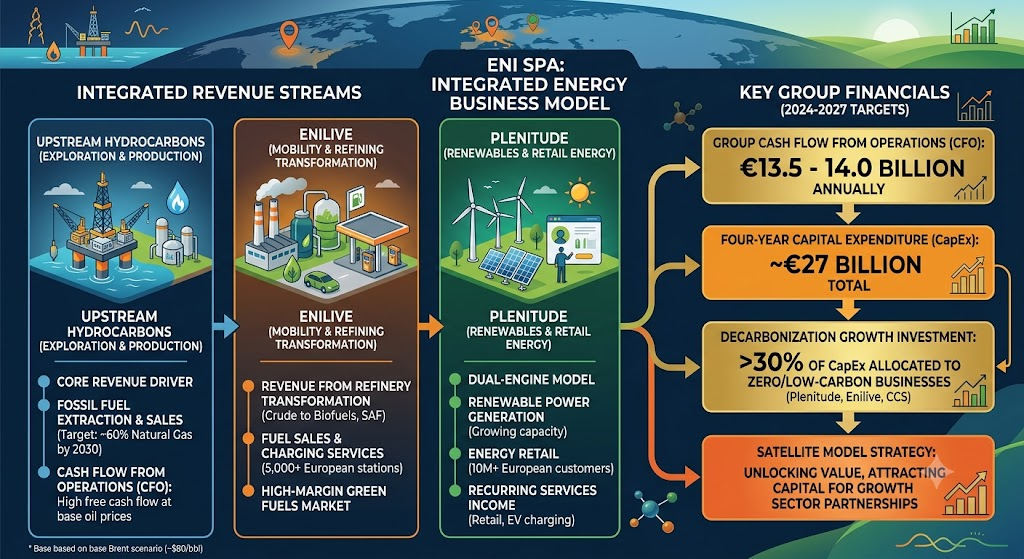
Eni operates an integrated energy business model designed to generate revenue across the entire energy value chain, from raw resource extraction to end-user retail distribution.
- Upstream Hydrocarbons(Exploration & Production): The core revenue generator, focusing on low-cost natural gas and crude oil extraction. Eni monetizes reserves through direct crude and gas sales, prioritizing natural gas(targeted to reach 60% of hydrocarbon production by 2030) due to higher long-term demand security.
- Enilive(Mobility & Refining Transformation): Eni generates high-margin revenue by converting legacy crude refineries into biorefineries. Enilive sells HVO(Hydrotreated Vegetable Oil) biofuels, Sustainable Aviation Fuel(SAF), and provides charging/fueling services across its network of over 5,000 service stations in Europe.
- Plenitude(Renewables & Retail Energy): This division operates a dual-engine financial model combining renewable power generation with energy retail to over 10 million European customers. It earns recurring income by selling green electricity, natural gas, and EV charging infrastructure directly to consumers and businesses.
- Financial Performance and Targets: Eni targets a 2024–2027 Group Cash Flow From Operations(CFO) before working capital of €13.5 billion to €14 billion annually at base Brent oil prices ($80/bbl). Capital expenditure(CapEx) is projected at approximately €27 billion over the four-year plan, with over 30% allocated to zero-carbon and low-carbon growth businesses(Plenitude, Enilive, CCS).
Source:
- https://www.eni.com/en-IT/investors.html
- https://www.eni.com/en-IT/about-us/strategy-and-business-model.html
- https://www.eni.com/assets/documents/investor/2024/en/Strategy-2024-2027-Presentation.pdf
Eni’s artificial intelligence and high-performance computing(HPC) strategy is a key operational differentiator, designed to accelerate exploration accuracy, optimize industrial processing, and lower carbon intensity.
- High-Performance Computing Infrastructure: Eni operates one of the world’s most powerful private supercomputers in the industrial sector, located at the Ferrera Erbognone Green Data Center. The HPC5 system, combined with previous iterations, delivers a peak computational capacity exceeding 70 Petaflops(70 quadrillion mathematical operations per second).
- Budget and Tech Deployment: Eni invests tens of millions of euros annually into digital transformation and computing infrastructure, integrating AI across upstream reservoir modeling, predictive maintenance, and real-time processing plant optimization.
- Subsurface AI Integration: By pairing AI algorithms with HPC processing power, Eni processes complex 3D seismic imaging algorithms in weeks rather than months. This directly led to major discoveries like the Zohr gas field and lower dry-hole exploration costs.
- Strategic Partnerships:
- Microsoft: Strategic collaboration focused on cloud transformation, integrating Azure AI services to optimize upstream operations and enhance workplace digital tools.
- Commonwealth Fusion Systems(CFS): A spin-out from MIT where Eni is a major strategic investor. Eni leverages its advanced computational modeling capabilities and engineering expertise alongside CFS to simulate plasma physics and accelerate the commercialization of magnetic confinement fusion energy.
Back to Eni