
Company History
Phase 1: State Monopolization and Infrastructure Establishment (1962–1998)
Enel (Ente nazionale per l’energia elettrica) was founded as a public body by the Italian government in 1962 to unify the national power system and complete the electrification of Italy. During this era, Enel acquired hundreds of regional power entities, expanding national grid infrastructure, thermal plants, and hydroelectric facilities under a strict state monopoly.
Phase 2: Privatization, Market Liberalization, and Internationalization (1999–2013)
Following EU directives on electricity market liberalization, Enel was transformed into a joint-stock company (SpA) in 1999, releasing a 31.7% stake in an initial public offering. To comply with market concentration caps, Enel unbundled its generation, transmission, and distribution arms. During the mid-2000s, Enel launched an aggressive cross-border M&A push, notably acquiring Spain’s Endesa in 2007, which turned Enel into a multinational power giant across Southern Europe and Latin America.
Phase 3: The Green Transition and Digital Grid Expansion (2014–2022)
Under a renewed strategic focus, Enel pivoted heavily toward decarbonization, creating Enel Green Power and committing to phase out coal generation. It became a global leader in renewable capacity additions (wind, solar, geothermal) and pioneered large-scale smart meter deployment across Europe and Latin America. However, rapid capital spending during this period pushed debt to elevated levels, requiring management to streamline operations.
Phase 4: Asset Rationalization, Debt Reduction, and Core Refocus (2023–Present)
Facing higher interest rates and volatile energy commodity prices, Enel executed a strategic pivot away from non-core geographic markets (such as exits or asset sales in Argentina, Peru, and Romania). The current corporate era focuses on capital discipline, balance sheet deleveraging, and heavy capital allocation toward regulated grid operations in core countries (Italy, Spain, Brazil, Chile, and Colombia).
Business Model & Growth Strategy
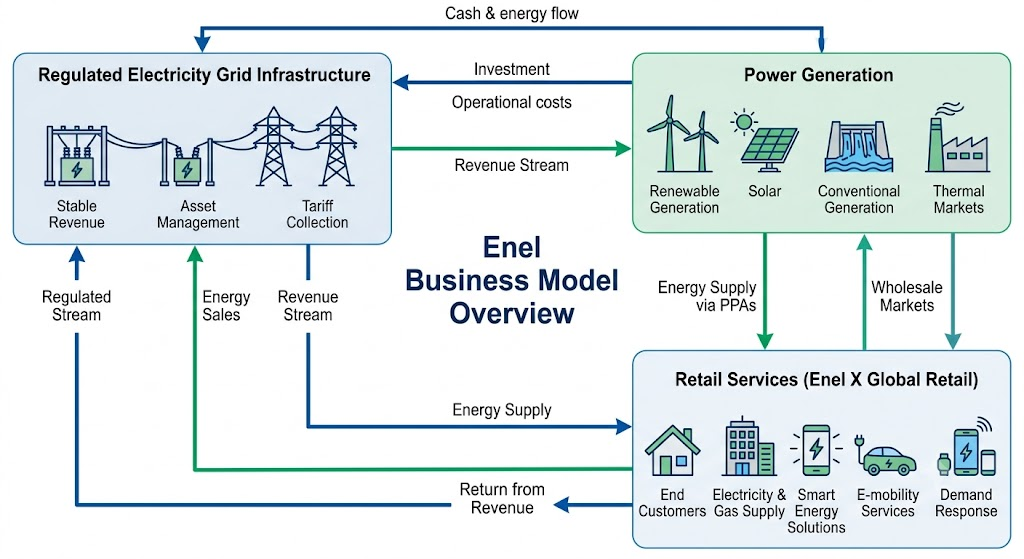
Enel’s financial model operates as an integrated utility engine designed to capture value across the entire power value chain while stabilizing returns via regulated assets.
Primary Revenue Streams
- Regulated Infrastructure & Networks (Grids): Generates predictable, low-risk revenue based on regulated asset bases (RAB) and tariffs set by national authorities. Enel manages over 1.9 million kilometers of power lines worldwide.
- Renewable & Conventional Generation: Earnings derived from power purchase agreements (PPAs), merchant power sales, and capacity market auctions across hydroelectric, solar, wind, and thermal assets.
- Retail Energy & Advanced Services (Enel X): Sales of electricity and gas to over 60 million residential and commercial customers in liberalized markets, alongside energy efficiency solutions, EV charging networks, and demand response services.
Financial Performance & Capital Strategy
- Preliminary 2025 Financials: Reported revenues of approximately €80.4 billion with an Ordinary EBITDA reaching €22.9 billion, supported by international business activities and stable regulated utility returns.
- Capital Allocation Plan: Over the multi-year strategic cycle, Enel allocated approximately €38 billion in gross investments, prioritizing regulated grids (€26 billion) over merchant risk exposure, while aiming to keep Net Debt to EBITDA constrained near ~3.3x.
- Growth Strategy: The company’s strategic pivot focuses on “capital efficiency” over market-share accumulation. Enel recycles capital by divesting non-strategic international units to fund high-return network modernizations in core regions.
- https://www.enel.com/media/explore/search-press-releases/press/2026/02/enel-preliminary-results-2025-ordinary-ebitda-at-229-billion-euros-increasing-thanks-to-international-activities
- https://umbrex.com/resources/company-profiles/enel/
- https://finbox.com/WBAG:ENEL/explorer/total_debt_to_ebitda/
AI Strategy, Budget, and Key Partnerships
Enel leverages artificial intelligence and edge computing to turn its physical power grid into an automated, data-driven platform, optimizing asset performance and managing volatile renewable inputs.
AI Deployment Strategy
Enel focuses its enterprise AI initiatives around three operational domains:
- Grid Digital Twins: Enel deployed a widespread “Digital Twin” network across nine country grids. The system uses predictive machine learning to simulate physical grid conditions, automating approximately 80% of customer connection quotes and continuously running predictive maintenance models on secondary substations.
- Smart Meter Data Analytics: Processing data from over 45 million deployed smart meters, AI algorithms handle real-time load forecasting, peak demand balancing, and automated energy fraud/theft detection.
- Trading & Asset Optimization: Machine learning models optimize daily algorithmic bidding for battery energy storage systems (BESS) and renewable power plants in wholesale spot markets.
Budget & Capital Allocation
- Digitalization Capital Expenditure: A significant portion of Enel’s €26 billion grid investment strategy is explicitly allocated toward smart grid infrastructure, IoT sensor installation, edge computing nodes, and enterprise AI capabilities.
- Innovation Pipeline: Enel operates dedicated technology innovation hubs, such as its AI & Robotics Lab in Tel Aviv, funding startups and pilots focused on automated infrastructure inspection (drones/computer vision) and cyber-threat defense.
Strategic Technology Partners
- Grid Transformation: Collaborates with industrial partners such as Hitachi Energy to implement smart transformers integrated with digital sensors and localized intelligence.
- Specialized Software & Security: Partners with specialized AI firms including Leap and Axyon AI for algorithmic energy market modeling, alongside Nozomi Networks for AI-backed industrial cybersecurity across power plants and distribution hubs.
Back to Enel