
Company History
Foundation and Belgian Grid Unbundling(1999–2002)
Elia was established in 2001 following the European Union directives that mandated the unbundling of electricity generation and transmission to create competitive energy markets. It merged the transmission activities previously held by Electrabel and SPE, creating the single high-voltage transmission system operator for Belgium. In 2005, the company went public on Euronext Brussels.
German Expansion and International Scale(2010–2018)
In 2010, Elia executed a transformational cross-border acquisition by purchasing 50Hertz Transmission(one of Germany’s four TSOs) from Vattenfall in partnership with Industry Funds Management(IFM). In 2018, Elia exercised its pre-emptive rights to raise its ownership in Eurogrid International(the holding company of 50Hertz) to 80%, while Germany’s state-owned development bank KfW acquired the remaining 20%, cementing a strategic intergovernmental partnership.
Corporate Restructuring and Offshore Transition(2019–Present)
In 2019, the group restructured into a holding entity, Elia Group SA/NV, segregating regulated domestic activities from non-regulated ventures. It subsequently established WindGrid to pursue offshore wind transmission opportunities in non-regulated international markets. The group also pioneered hybrid offshore interconnectors and artificial energy islands, such as the Princess Elisabeth Island in Belgium.
Business Model and Strategy
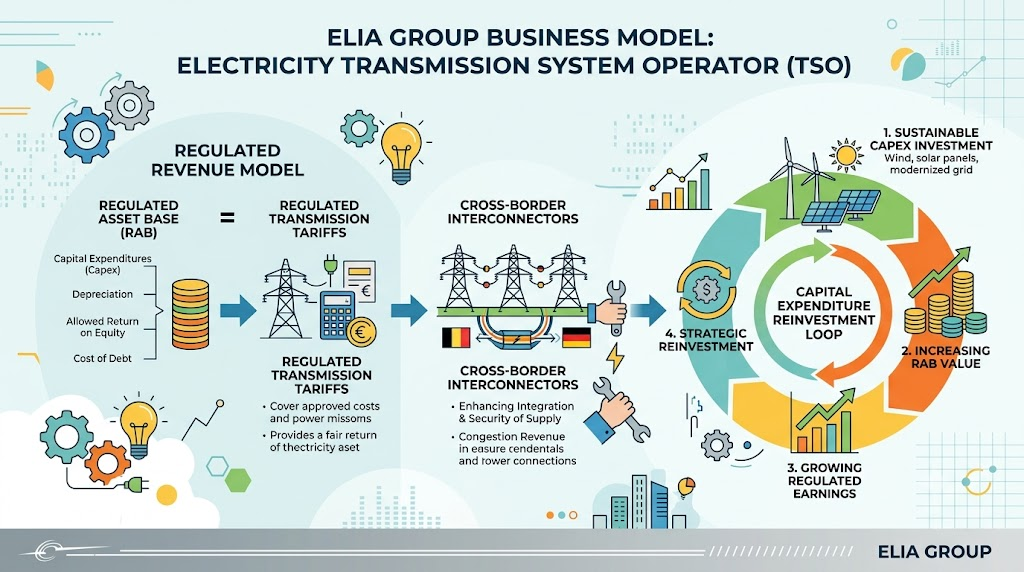
Elia Group generates revenue through regulated transmission tariffs and capital remuneration frameworks rather than power generation or retail supply.
Regulated Asset Base(RAB) Remuneration
The core profit engine is the regulatory framework established by independent regulators: CREG in Belgium and the Bundesnetzagentur(BNetzA) in Germany. Revenue is determined using a cost-plus and incentive-based formula:
$$\text{Allowed Revenue} = \text{Regulated Operating Expenses} + \text{Depreciation} + (\text{Regulatory Asset Base} \times \text{Allowed Return})$$
- Asset Growth as Profit Growth: Because earnings are calculated as a percentage return on invested equity within the Regulatory Asset Base, profit growth is directly tied to capital expenditures. Elia Group deployed a multi-year capex plan exceeding €30 billion between 2024 and 2028(including more than €22 billion allocated to Germany), driving the group’s RAB from €22.6 billion toward sustained double-digit annual expansions.
- Allowed Return on Equity: In Belgium, CREG sets the allowed Return on Equity(RoE) around 5.7% to 6.9% depending on asset vintage and operational incentives. In Germany, BNetzA fixes the equity return for network operators, which is indexed against reference financial market rates.
Non-Regulated and Interconnector Operations
Complementing domestic monopolies, Elia Group co-owns and operates merchant and regulated interconnectors such as Nemo Link(a 1 GW high-voltage direct-current subsea link between the UK and Belgium). Nemo Link operates under a cap-and-floor regime set by regulators, earning arbitrage revenue on power price spreads between the British and continental European markets. Through WindGrid, the group targets equity returns in offshore grid connections abroad.
Capital Allocation and Growth Strategy
The group’s operational strategy centers on the North Sea and Baltic offshore wind corridors. To fund this unprecedented infrastructure buildout without deteriorating credit profiles, Elia employs a structured capital strategy: issuing long-term green bonds and raising equity(such as its €2.2 billion rights issue) to balance leverage against its expanding asset base.
Sources for Business Model Information
- https://www.eliagroup.eu/en/investor-relations
- https://www.bundesnetzagentur.de
- https://www.creg.be
- https://www.spglobal.com/ratings/en/regulatory/article/-/view/sourceId/12600713
AI Strategy, Budget, and Partnerships
Elia Group views artificial intelligence as an operational necessity to manage a power system shifting from centralized fossil baseload to weather-dependent, decentralized renewable energy.
Operational Focus and Use Cases
Rather than building standalone speculative foundational models, Elia Group operates a dedicated, use-case-driven AI engineering program integrated across both Elia Transmission Belgium and 50Hertz:
- Dynamic Grid Forecasting and Imbalance Control: Machine learning algorithms ingest real-time meteorological sensor feeds, satellite imagery, and historical demand patterns to forecast renewable in-feed and predict regional grid imbalance minutes and hours in advance.
- Computer Vision and Predictive Maintenance: Elia utilizes drone-mounted cameras and computer vision models to automate high-voltage transmission tower and line inspections, detecting structural anomalies, micro-cracks, and vegetation encroachment without physical climbing. Similar predictive models monitor sulfur hexafluoride(SF6) gas containment in gas-insulated substations.
- Control Room Decision-Support Systems: The group is deploying algorithmic decision-support engines to assist human grid dispatchers during emergency congestion and re-dispatch scenarios, running automated contingency analyses to maintain network stability.
Budget and Digital Investment Allocation
While Elia does not break out AI expenditures as a standalone accounting line item, the company’s IT and digitalization initiatives form a core subset of its operational and capital expenditure envelopes, historically consuming hundreds of millions of euros across digital transformation, smart substations, and automation. Digital programs are systematically embedded inside the group’s allowed operational expenditures(OPEX) accepted by regulators.
Technology Partnerships and Ecosystem
Elia Group relies on ecosystem collaborations with technology providers, universities, and consortia:
- Hyperscalers and Cloud Platforms: Integration of enterprise cloud environments(such as Microsoft Azure and AWS) for data lakehouse architectures and model training pipelines.
- Energy Transition Consortia: Partnerships through the European Network of Transmission System Operators for Electricity(ENTSO-E) and initiatives with academic institutions like KU Leuven and TU Berlin to develop open-source power-flow optimization algorithms.
- Industrial and Sensor Partners: Joint development with electrical equipment vendors(such as Siemens Energy and Hitachi Energy) to embed edge-AI diagnostics directly into digital substations and offshore converter platforms.
Back to Elia