
Company History
Origins and Consolidation(1844-1992) Eiffage’s industrial roots trace back to 19th-century French contracting, notably Fougerolle(founded in 1844) and Quillery(founded in 1863). Over more than a century, these independent engineering firms developed major transport infrastructure across Western Europe and French overseas territories. In 1992, Fougerolle acquired the SAE group(Société Auxiliaire d’Entreprises) to establish Eiffage, consolidating regional earthworks, civil engineering, and structural fabrication entities into a single French contracting powerhouse.
Expansion and the Concessions Bet(1993-2005) Following the merger, Eiffage pioneered high-profile infrastructure delivery, completing iconic projects such as the Millau Viaduct under concession agreements. Recognizing the volatility of pure contracting, management prioritized long-term public concessions. When the French state privatized its motorway concessions in 2005-2006, Eiffage formed the Financière Eiffarie consortium with Macquarie to acquire APRR(Autoroutes Paris-Rhin-Rhône), shifting the company’s financial profile from cyclical contracting toward high-margin, predictable cash flow generation.
Corporate Defense and Modern Scaling(2006-Present) In 2006-2008, Spanish builder Sacyr Vallehermoso launched a hostile takeover attempt. Eiffage’s employee shareholders, backed by French institutions and legal victories, repelled the raid, preserving its decentralized operational structure and employee-shareholder foundation. In subsequent years, Eiffage diversified internationally into energy systems(Eiffage Énergie Systèmes), secured major civil contracts across Europe(HS2 railway in Britain, Grand Paris Express rail lines), and expanded into renewable energy infrastructure, green mobility installations, and concessions asset extensions.
Business Model and Strategic Trajectory
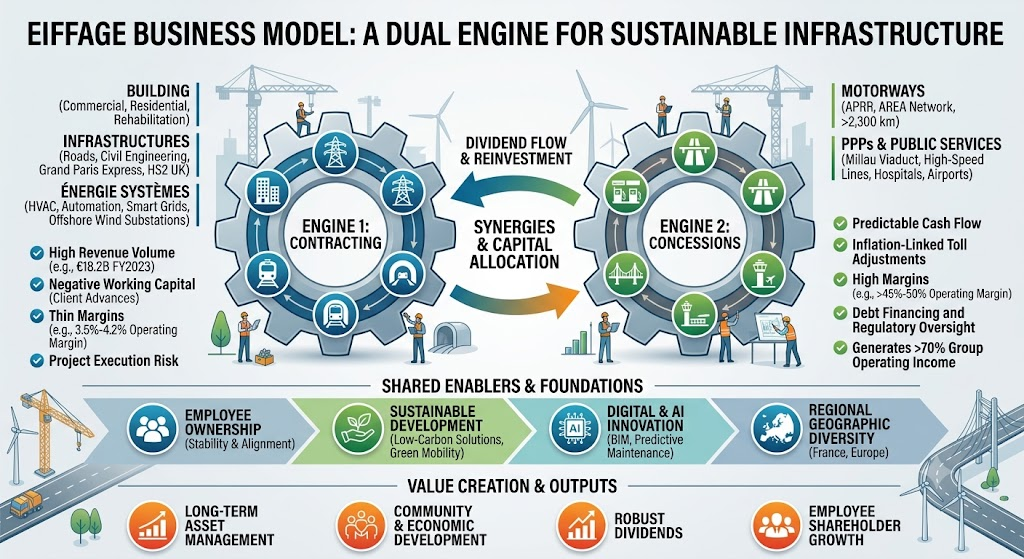
Eiffage monetizes its operations through a synergistic dual-engine framework: a high-volume, low-margin Contracting Division and a capital-intensive, high-margin Concessions Division.
Revenue and Profit Dynamics In FY2023, Eiffage generated approximately €21.8billion in consolidated revenue, representing an 8.5% year-over-year increase, with an operating profit on ordinary activities(EBIT) reaching roughly €2.4billion. The structural split demonstrates how the company generates economic profit:
- Contracting Engine(Construction, Infrastructures, Énergie Systèmes): Generates approximately 83-85% of consolidated group revenue(around €18.2billion), but operates with thin margins. Contracting operating margins historically fluctuate between 3.5% and 4.2%. Contracting functions as the execution and cash-generating base, securing advance customer payments, generating negative working capital requirements, and feeding projects into regional hubs.
- Concessions Engine(Motorways and PPPs): Generates only 15-17% of total revenue(approximately €3.6billion, anchored by APRR’s toll network of over 2,300kilometers), yet generates over 70% of the entire group’s operating income(EBIT margins on concessions regularly surpass 45-50%).
Strategic Mechanics of Capital Allocation The business model relies on concession cash flows to absorb cyclic downturns in residential and commercial building construction. The toll roads feature contractual inflation-linked toll adjustments that protect operating margins against raw material price shocks(bitumen, cement, steel). Surplus concession dividends are subsequently reinvested into high-growth energy transition niches—such as high-voltage offshore wind substations, nuclear plant maintenance, EV charging hubs, and industrial automation via Eiffage Énergie Systèmes. This counter-cyclical redeployment creates a self-funding infrastructure cycle without diluting the defensive employee-owned balance sheet.
Sources
- https://www.eiffage.com/en/finance/financial-results
- https://www.eiffage.com/en/group/our-business-model
- https://aprr.com/en/group/financial-information
- https://www.euronext.com/en/products/equities/FR0000130452-XPAR
AI Strategy, Budget, and Partnerships
Eiffage pursues a pragmatic, application-driven artificial intelligence roadmap centered on project risk modeling, predictive maintenance, automated site safety, and energy efficiency optimization. Rather than building foundational large language models internally, the company embeds operational AI into its engineering workflows through targeted joint ventures and enterprise software platforms.
Strategic Focus Areas and Use Cases
- Generative Design and Building Information Modeling(BIM): Eiffage embeds computer vision and predictive scheduling into digital twin platforms for major ventures like the Grand Paris Express. Computer vision models assess daily site camera feeds and drone surveys against 4D BIM plans to detect engineering deviations, worker perimeter violations, and structural discrepancies in real time.
- Predictive Infrastructure Asset Management: Across the APRR motorway network, Eiffage deploys smart pavement-monitoring sensors combined with machine learning algorithms. The system processes pavement degradation telemetry, traffic density metrics, and weather patterns to anticipate asphalt crack formation, shifting motorway resurfacing from calendar-based maintenance to dynamic condition-based intervention.
- Energy Management Systems(EMS): Through Eiffage Énergie Systèmes, AI-driven automation algorithms control HVAC and power distribution for enterprise real estate and smart factories, cutting facility energy overhead by an estimated 15% to 25%.
Budget Allocation and Resource Deployment Eiffage embeds its artificial intelligence spending within broader digital transformation and R&D capital expenditure envelopes. The group allocates an estimated €40million to €60million annually toward enterprise digitalization, applied R&D, and construction-tech modernization, with approximately 20-30% of this spend funneling into industrial AI, machine vision implementations, and automated analytics.
Partnerships and Technology Alliances
- Big Tech and Cloud Infrastructure: Eiffage maintains deep enterprise deployments with Microsoft(Azure AI and cloud data architecture) to centralize telemetry across thousands of decentralized work sites into secure corporate data lakes.
- Academic and Research Partnerships: Collaborates with academic institutions such as École des Ponts ParisTech and the French national research institute Gustave Eiffel on structural modeling, automated materials durability analytics, and low-carbon concrete lifecycle forecasting.
- Contech and Startups: Eiffage actively sources specialized computer vision, robotic layout marking, and predictive site safety algorithms through incubators like Impulse Partners, directly piloting emerging construction tech across European roadworks and tunneling shafts.
Back to Eiffage