
Market Position and Market Share
EDP Renováveis (EDPR) is the renewable energy arm of Portuguese utility EDP Group and ranks as the 4th largest onshore wind energy producer in the world by installed capacity, trailing only Iberdrola, NextEra Energy Resources, and China Energy Investment Corporation (CEIC).
- Installed Capacity: EDPR manages approximately 16.6 GW to 17.5 GW of operational wind and solar capacity across Europe, North America, South America, and the Asia-Pacific region. When integrated under EDP Group’s total portfolio, global clean energy capacity exceeds 22 GW.
- Market Share: In the global onshore wind segment (excluding domestic China), EDPR commands an estimated 4% to 5% market share of installed capacity. Regionally, it holds top-tier positions:
- Europe: EDPR is among the top 3 operators in the Iberian Peninsula (Spain and Portugal), holding over 10% of operational wind capacity in Portugal and approximately 7% in Spain. It maintains established footholds in Poland, Italy, France, and Greece.
- North America: EDPR North America is a top-5 operator in utility-scale onshore wind and solar assets, controlling an operational footprint exceeding 7 GW across the United States and Canada.
- Offshore Wind:Through Ocean Winds, its 50/50 joint venture with ENGIE, EDPR manages an offshore pipeline surpassing 16 GW across fixed-bottom and pioneer floating offshore installations (such as WindFloat Atlantic).
Supply Chain Analysis and Key Suppliers
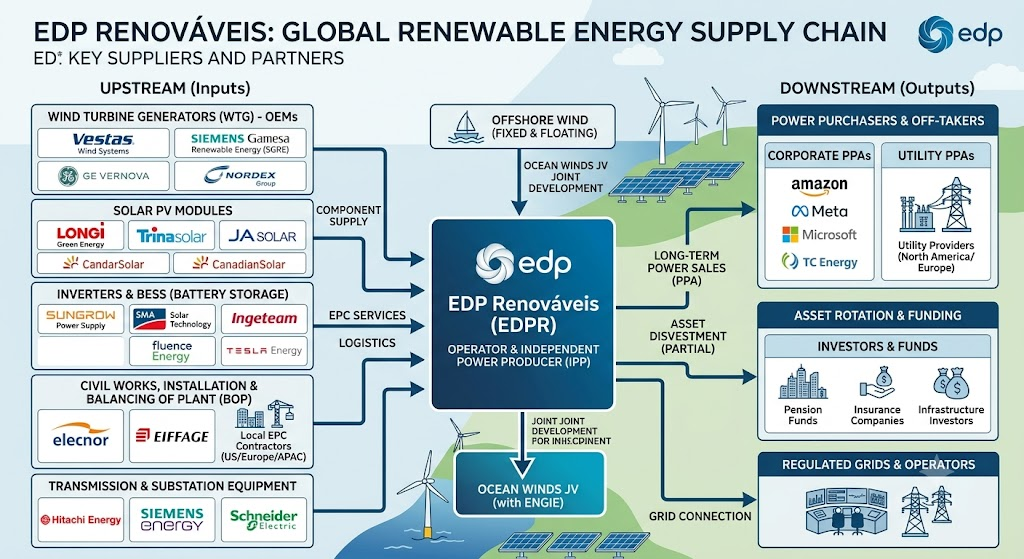
EDPR operates primarily as a project developer, asset owner, and Independent Power Producer (IPP). Its supply chain structure spans upstream component fabrication, midstream Engineering, Procurement, and Construction (EPC) management, and downstream power off-take.
- Upstream (Turbines, Modules, and Inverters):
- Wind Turbines (WTG): EDPR relies on long-term master supply agreements to secure turbine components and long-tail operations/maintenance (O&M) service packages. Critical original equipment manufacturers (OEMs) include Vestas Wind Systems, Siemens Gamesa Renewable Energy (SGRE), GE Vernova, and Nordex Group.
- Solar PV Modules & Inverters: Upstream wafer and cell procurement is exposed to APAC manufacturing centers. Tier-1 module suppliers include LONGi Green Energy, Trina Solar, JA Solar, and Canadian Solar. For central and string inverters, EDPR procures from Sungrow Power Supply, SMA Solar Technology, and Ingeteam.
- BESS (Battery Energy Storage Systems): As hybrid solar-plus-storage and standalone storage scale, EDPR contracts cell/system integrators such as Fluence Energy, Tesla Energy, and Sungrow.
- Midstream (EPC and Civil Infrastructure):
- EDPR manages high-level system engineering and grid-interconnection permitting internally while subcontracting balance-of-plant (BOP) civil works, turbine installation, and high-voltage substation builds to regional EPC contractors (such as Elecnor, Eiffage, and local US electrical contractors).
- High-voltage transmission lines, transformers, and switchgear represent primary logistical bottlenecks with extended procurement lead times, sourced from Hitachi Energy, Siemens Energy, and Schneider Electric.
- Downstream (Power Off-take & Monetization):
- Corporate & Utility PPAs: The majority of EDPR’s electricity generation is hedged via 10-to-20-year Power Purchase Agreements (PPAs) with utility providers and enterprise corporate buyers (e.g., Meta, Amazon, Microsoft, and TC Energy).
- Asset Rotation Strategy: A defining operational model for EDPR is its capital recycling program (“Asset Rotation”), wherein the company sells 50% to 100% equity stakes in mature, de-risked operational assets to infrastructure funds and institutional investors, reinvesting the proceeds into high-yield pipeline developments.
Competitor Analysis: Technical and Financial Comparison
EDPR competes primarily with multinational utility developers and pure-play clean energy players, including Iberdrola (via Avangrid in the US and ScottishPower in the UK), NextEra Energy Resources (NEER), Enel Green Power, and Orsted.
| Metric / Dimension | EDP Renováveis (EDPR) | Iberdrola Renovables | NextEra Energy Resources (NEER) | Orsted |
| Installed Capacity | ~17 GW | ~44+ GW | ~34+ GW | ~16 GW (Offshore focus) |
| Core Technology Focus | Onshore Wind (~65%), Solar (~25%), Offshore via JV (~10%) | Balanced Onshore Wind, Solar, Hydro, and Offshore Wind | Onshore Wind, Solar PV, and Grid-scale BESS | Offshore Wind (~70%+), Onshore Wind & Solar |
| Capex & Funding Model | Aggressive asset rotation (capital recycling); moderate leverage | Integrated utility balance sheet; low cost of capital | Strong cash flow from FPL regulated utility; Tax Equity financing | Corporate green bonds, farm-downs, asset divestments |
| Offshore Wind Footprint | Shared risk via Ocean Winds JV (pioneer in floating wind) | Global direct development (East Anglia, Vineyard Wind) | Minimal offshore exposure | Global pure-play market leader in fixed-bottom offshore wind |
- Technical Comparison:
- Asset Integration & Digitalization: EDPR operates centralized remote dispatch centers (dispatching global wind/solar sites via unified SCADA and predictive maintenance algorithms). Compared to NextEra’s machine-learning-driven fleet optimization, EDPR is agile in multi-regional dispatching across disparate European and American transmission grids.
- Offshore & Deepwater Capabilities: While Orsted leads in massive scale and shallow-water fixed installations, EDPR took an early technological lead in deepwater floating wind foundations through its WindFloat technology deployments via Ocean Winds. However, fixed-bottom offshore projects carry lower Levelized Cost of Energy (LCOE) than EDPR’s floating pilot projects.
- Financial Comparison:
- Capital Efficiency vs. Balance Sheet Strength: NextEra and Iberdrola benefit from parent utility models with substantial regulated cash flows, granting them lower borrowing spreads. In contrast, EDPR utilizes its Asset Rotation strategy to crystalize development gains early, maintaining a self-funding growth trajectory without overleveraging parent EDP S.A.
- Margin & LCOE Exposure: Due to inflation and supply chain shocks in turbine procurement, developers across the board faced margin compression. EDPR’s disciplined use of long-term indexed PPAs protects its operational margins against wholesale power price volatility better than unhedged merchant producers, though it sacrifices peak spot-market upside.
Sources
- https://edp.com/en/media/edp-stories/new-business-plan-12-questions
- https://www.edpr-investors.com/en/media/news/edpr-year-end-166-gw-installed-renewable-capacity-increase-12-compared-year-end-2022
- https://www.offshore-mag.com/renewable-energy/news/55290791/ocean-winds-ocean-winds-marks-five-years-of-service-at-windfloat-atlantic
- https://stockanalysis.com/quote/eli/EDPR/market-cap/
- https://companiesmarketcap.com/edp-renovaveis/marketcap/
- https://www.globaldata.com/company-profile/edp-renovaveis-sa/competitors/
- https://www.engie-na.com/oceanwinds/
Back to EDPR