
Corporate History
- 1902–1989: Coal Mining to Petrochemicals (DSM Era) Founded as De Nederlandse Staatsmijnen(Dutch State Mines)to extract coal, the company shifted into bulk chemicals and petrochemicals after coal mines were closed in the mid-20th century.
- 1990–2022: Shift to Life Sciences and Nutrition DSM systematically exited petrochemicals and commodity plastics to focus on health, nutrition, and materials, acquiring Roche’s vitamins division in 2003 to become a major functional ingredient provider.
- 1895–2022: Fragrance and Flavor Leadership (Firmenich Era) Firmenich was established in Geneva as a family-owned fragrance creator, growing into the world’s largest private perfume and taste enterprise, known for pioneering synthetic aromatic molecules.
- 2023–Present: The Merger and Portfolio Streamlining Royal DSM and Firmenich completed their equal-value merger in May 2023. In 2024, the group announced plans to carve out its volatile Animal Nutrition & Health division to focus on higher-margin human nutrition, personal care, and perfumery.
Business Model and Growth Strategy
The company generates revenue by developing, manufacturing, and supplying specialized ingredients, formulations, and aromatic compounds to global enterprise clients across B2B channels.
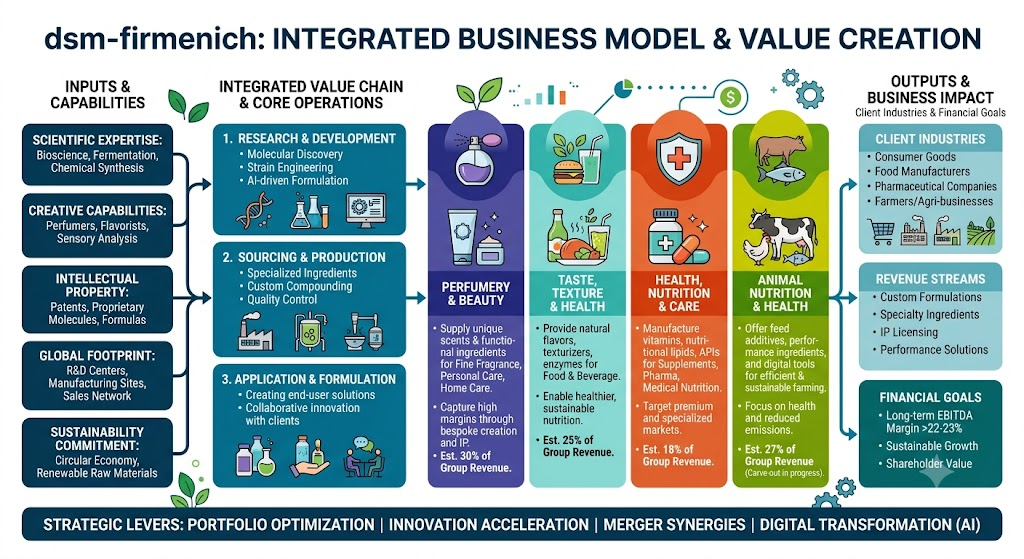
- Revenue Drivers and Segment Performance In FY2023, the combined entity delivered net sales of €12,310 million and an Adjusted EBITDA of €1,775 million(a 14.4% margin). Sales are split across four principal core business units:
- Perfumery & Beauty: Contributes approximately 30% of total revenue, supplying fine fragrances, consumer care scents, and UV filters.
- Taste, Texture & Health: Represents around 25% of sales, serving food and beverage makers with natural flavors, enzymes, and cultures.
- Health, Nutrition & Care: Accounts for roughly 18% of revenue, producing dietary supplements, medical nutrition, and pharmaceutical APIs.
- Animal Nutrition & Health: Generates about 27% of group sales, producing feed additives and vitamins, though subject to heavy earnings cyclicality.
- Monetization Mechanics and Margin Capture The company captures value by integrating proprietary biotechnology and sensory IP directly into customer formulations. Instead of selling standard bulk commodities, it locks in higher margins through custom compounding and long-term supply agreements. Strategic focus centers on portfolio optimization—specifically divesting lower-margin animal vitamin operations—to reach a target long-term Adjusted EBITDA margin above 22-23%.
- (https://www.dsm-firmenich.com/corporate/investors/results-center.html)
- (https://www.dsm-firmenich.com/corporate/investors/results-center/annual-reports.html)
AI Strategy, Investment, and Strategic Partnerships
- Generative AI and Scent Creation The company leverages proprietary AI platforms, such as Firmenich’s legacy “Scentmate” tool, to assist perfumers in formulating fragrances. AI algorithms analyze historical sensory data, market trends, and safety regulations to auto-generate thousands of viable formula variations in seconds, reducing product development cycles by over 30%.
- Biotech and Precision Fermentation R&D R&D execution relies heavily on machine learning models to accelerate strain engineering and computational biology. By predicting how micro-organisms synthesize complex proteins and lipids, AI platforms narrow down target molecules for scale-up, lowering lab trial overheads and time-to-market for novel health ingredients.
- Enterprise Partnerships and Ecosystem
- Microsoft: Deployment of Azure AI infrastructure and enterprise cloud solutions to handle large-scale molecular modeling and digital workplace automation.
- Academic & Tech Collaborations: Active partnerships with specialized computational biology startups and European research institutes to integrate predictive AI into supply chain forecasting and precision nutrition development.
Back to DSM