
Market Position and Market Share Analysis
1. Global Luxury Market Position
- Top-Tier Global Luxury House: Christian Dior belongs to the elite tier of global luxury brands alongside Louis Vuitton, Chanel, and Hermès.
- World’s Strongest Luxury Brand: According to Brand Finance’s recent rankings, Dior achieved a Brand Strength Index (BSI) score of 93.5 out of 100, ranking as the world’s strongest luxury brand.
- Top 6 by Global Revenue: With an estimated annual revenue of approximately $9.5 billion, Dior ranks 6th among global luxury fashion brands, behind Louis Vuitton (~$22.8 billion), Chanel (~$19.7 billion), Hermès (~$14.2 billion), Gucci, and Rolex.
2. Strategic Position Within LVMH Group
- Second Largest Growth Engine: Among LVMH’s 75+ Maisons, Dior and Louis Vuitton serve as the two primary powerhouses driving group profitability and stock valuation.
- Key Revenue Contributor: Dior accounts for roughly 15% of total LVMH Group revenue, functioning as a key driver across both Fashion & Leather Goods and Perfumes & Cosmetics divisions.
3. Market Share Across Key Categories
- Leather Goods & Ready-to-Wear: Iconic lines such as Lady Dior, Book Tote, and Saddle bags maintain dominant market share and strong brand equity in the premium handbag market.
- Beauty & Fragrances (Parfums Christian Dior): Dior Sauvage stands among the world’s top-selling men’s fragrances globally, while Miss Dior and Rouge Dior hold leading market positions in high-end women’s fragrances and cosmetics.
Source Links
- https://k.sina.com.cn/article_7879995982_1d5af324e06801gmui.html
- https://cj.sina.cn/articles/view/7879777217/1d5abdbc1068028j0g
- https://www.lvmh.com/en/investors/key-figures
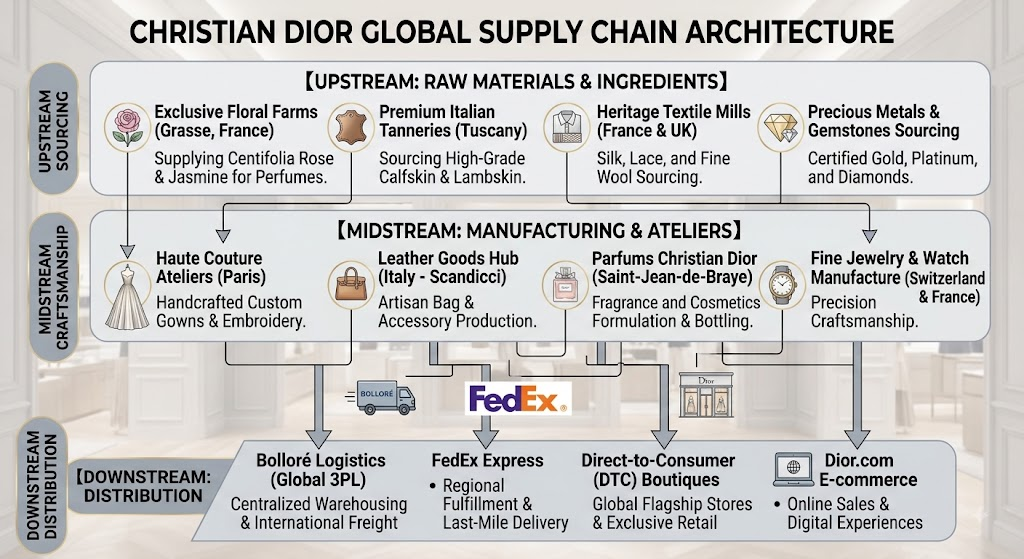
Christian Dior’s (LVMH Group) supply chain ecosystem centers on uncompromising quality control, nearshore European craftsmanship, and integrated global distribution.
1. Supply Chain Architecture & Operational Stages
1. Raw Material Sourcing
- Leather & Hardware: Leather represents a primary profit driver. Dior sources hides almost exclusively from high-end tanneries in Europe, particularly in Italy and France.
- Textiles & Haute Couture Fabrics: Silks, laces, wools, and intricate embroideries are sourced from heritage textile hubs across France, Italy, and the UK.
- Fragrance Ingredients: Parfums Christian Dior relies heavily on exclusive flower farms in Grasse, France—the world’s perfume capital—for harvests of May rose and Jasmine.
2. Manufacturing & Craftsmanship
Dior emphasizes “Made in Europe” heritage, focusing its production footprint in France and Italy:
- 30 Avenue Montaigne Ateliers (Paris): The creative heart of the brand, producing handcrafted Haute Couture collections.
- Italian Leather Goods & Footwear Hubs: Key facilities include specialized artisan sites in Scandicci for leather goods and Fossò for high-end footwear.
- Saint-Jean-de-Braye Industrial Complex (France): The production engine for Parfums Christian Dior, overseeing the formulation, aging, and bottling of iconic fragrances like Miss Dior and Sauvage.
3. Logistics & Retail Integration
- Finished products route through centralized European warehouses before distribution across global Direct-to-Consumer (DTC) networks, including Directly Operated Stores (DOS) and official e-commerce platforms.
2. Key Partners & Supplier Segments
While specific contract manufacturers remain under strict non-disclosure agreements, Dior relies on essential key partners across packaging, logistics, and raw materials:
| Supply Chain Segment | Key Partner / Category | Role & Scope of Partnership |
| International Logistics (3PL) | Global Freight Logistics Partners | Oversee bulk cross-border freight transportation from European manufacturing facilities to central and regional fulfillment hubs. |
| Express & Last-Mile Delivery | FedEx | Manages regional fulfillment, store replenishment, and last-mile e-commerce delivery directly to consumers. |
| Fragrance Floral Ingredients | Domaine de Manon / Clos de Callian | Exclusive flower farm partnerships in Grasse, France, supplying May Rose and Jasmine harvests for Dior fragrances. |
| Flacon & Packaging Glass | Pochet du Courval / Verescence | Premier French glass manufacturers crafting bottles for Dior’s fragrance lines. |
| Leather & Tanning | European Luxury Tanneries | Provide high-grade calfskin, lambskin, and exotic leathers for classic lines like the Lady Dior, Saddle, and Book Tote. |
3. Supply Chain Governance & Sustainability
- LVMH LIFE 360 Framework: Dior operates under LVMH’s “LIFE 360 Business Partners” initiative, requiring all suppliers to comply with strict carbon reduction, labor rights, and social responsibility standards.
- Traceability & Vertical Integration: To mitigate risks and secure supply integrity, Dior actively increases direct auditing and oversight over upstream tanneries and artisan workshops.
Competitive Analysis: Christian Dior (Financials & Technical Dimensions)
In the global luxury landscape, Christian Dior (under the LVMH umbrella) competes directly with a select group of mega-brands in the top tier: Hermès, Chanel, and its sister brand Louis Vuitton.
1. Financial Comparison
| Financial & Operating Metrics | Christian Dior (LVMH) | Hermès | Chanel | Kering Group (Gucci Focus) |
| Annual Brand Revenue | ~€9.5B–€10.0B | ~€16.0B | ~$19.3B (€17.8B) | ~€17.0B (Gucci ~€9.0B) |
| Operating Profit Margin | ~22.0%–22.5% | ~41.0% | ~24.3%–28.0% | ~20.0%–22.0% |
| Brand Value | ~$17.3B | ~$19.9B | ~$37.9B | ~$11.4B (Gucci) |
| Brand Strength Index (BSI) | 93.5 / 100 (World #1 Luxury) | 91.0 / 100 | 90.5 / 100 | 82.0 / 100 |
| CapEx-to-Sales Ratio | ~5%–6% (DTC Flagships & VIC Salons) | ~4%–5% (Workshop Expansion) | ~5% | ~6% |
Financial Diagnosis
- Profitability & Pricing Power: Hermès achieves an industry-leading 41% operating margin due to absolute scarcity control, minimal markdown activity, and ultra-high gross margins on leather goods. While Dior operates at a lower margin (~22.5%), its Return on Assets (ROA) and cash flow stability are exceptionally strong, buoyed by the high-volume, recurring cash flows of Parfums Christian Dior.
- Conglomerate Leverage: Backed by LVMH, Dior enjoys massive economies of scale in media buying, prime real estate acquisitions (e.g., global flagship locations), and supply chain negotiation that independent brands cannot match.
2. Technical & Operational Competencies
In luxury, “technical competence” encompasses craftsmanship heritage, R&D & formula technology, and digital supply chain infrastructure.
1. Haute Couture Craftsmanship & Formula R&D
- Atelier Expertise: Dior retains one of the very few functioning Ateliers de Haute Couture in Paris, representing a massive technical barrier in pattern-making, hand embroidery, and structural tailoring.
- Beauty & Fragrance Innovation: Unlike fashion-only peers, Dior operates a major dedicated beauty R&D complex in Saint-Jean-de-Braye, France. It holds numerous patents in micro-encapsulation, long-wear lipstick formulation, and sustainable floral extraction, outpacing competitors like Chanel and Hermès in beauty tech scale.
2. Archival Digitization & Design AI
- 3D Heritage Archive: Dior has digitized nearly 80 years of design sketches, pattern books, and historic gowns into a 3D digital vault. Creative directors utilize AI search tools to pull archival motifs (e.g., Cannage quilting, Oblique canvas) and rapidly re-engineer them into contemporary bestsellers.
3. Supply Chain Traceability & Anti-Counterfeiting
- AURA Blockchain: Dior integrates LVMH’s proprietary AURA Blockchain Consortium technology. Each flagship item (such as the Lady Dior) receives an encrypted digital twin certificate, allowing clients to verify authenticity, leather sourcing (tanneries), and artisan origin, which protects resale value and combat counterfeiting.
3. Strategic Positioning Summary
- Dior vs. Hermès: Hermès relies on absolute supply constraint and artisanal scarcity; Dior executes a dual strategy of using Haute Couture to build unmatched prestige while leveraging leather bestsellers and beauty to drive global market share.
- Dior vs. Chanel: Chanel maintains independence and high single-brand pricing; Dior leverages LVMH’s cross-category scale (beauty, jewelry, fashion), earning a 93.5 Brand Strength Index (BSI) score as the world’s strongest luxury brand.
Back to Dior