
Historical Evolution
Denso’s growth trajectory spans several distinct developmental eras:
- Foundation and Post-War Independence(1949–1960s): Separated from Toyota Motor Co., Ltd. in 1949 as Nippondenso Co., Ltd., the company established technical cooperation with Germany’s Robert Bosch in 1953 to acquire advanced electrical component technologies. This laid the foundation for quality-driven mass manufacturing outside Toyota’s direct umbrella.
- Global Expansion and System Integration(1970s–1990s): The firm expanded overseas manufacturing facilities across North America, Europe, and Southeast Asia. Denso broadened its portfolio from basic electrical parts into integrated air conditioning systems, electronic fuel injection, and engine management controllers, renaming itself Denso Corporation in 1996.
- Consolidation and Advanced Electronics(2000s–2010s): Denso prioritized hybrid electric vehicle(HEV)components, millimeter-wave radar, and advanced driver assistance systems(ADAS). It formed dedicated cross-OEM consortiums and strengthened internal silicon wafer fabrication capabilities to support high-reliability automotive microcontrollers.
- The CASE and Electrification Transition(2020s–Present): Facing the CASE(Connected, Autonomous, Shared, Electric)shift, Denso divested non-core ICE product lines(such as spark plugs and fuel injection systems to Niterra/others)to concentrate capital into silicon carbide(SiC)inverters, centralized electronic control units(ECUs), software architecture, and cross-shareholding unwinding.
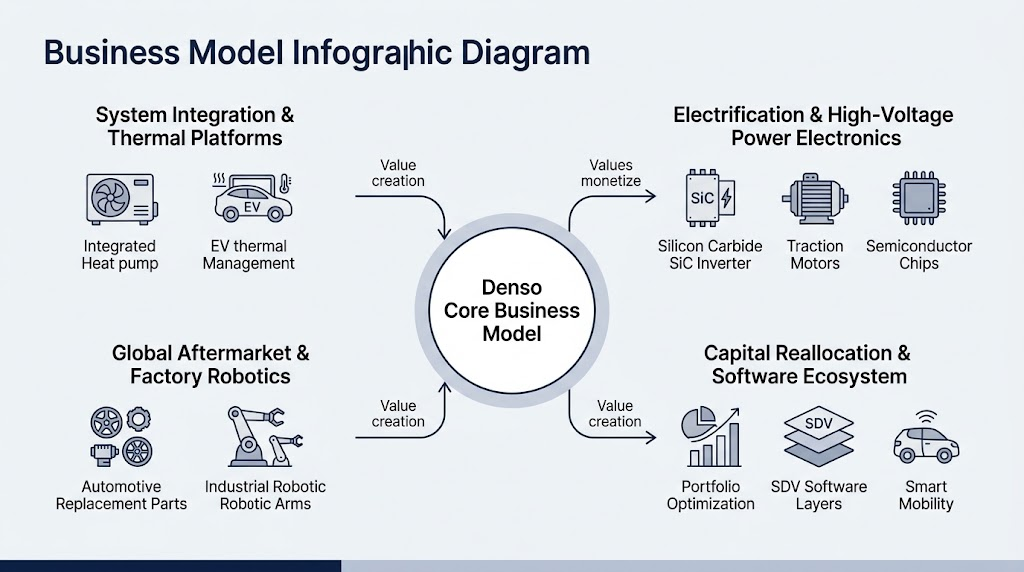
Business Model and Strategic Monetization
Denso generates revenue through the development, manufacturing, and supply of integrated automotive systems and high-margin replacement components. Its top line reached approximately ¥7.14 trillion in fiscal year 2024, operating with an operating margin target expanding toward 10% under its Mid-Term Policy.
- System Bundling over Commoditized Parts: Rather than selling isolated sensors or actuators, Denso captures high dollar-content per vehicle by delivering integrated systems. For example, its Thermal Systems segment bundles heat pump systems, cabin climate modules, and battery cooling circuits into unified energy-management platforms. In electric vehicles, integrated thermal units enhance driving range in cold weather by up to 20%, commanding higher average selling prices(ASPs)than discrete parts.
- Electrification and High-Voltage Power Electronics: Denso monetizes EV powertrains through traction inverters, motor generators, and DC-DC converters. Revenue from electrification systems exceeds ¥1.2 trillion annually, supported by vertical integration in silicon carbide(SiC)power semiconductors produced at its Hirose and Kota plants, reducing electrical power losses while generating proprietary IP licensing and tier-one supply agreements.
- Aftermarket and Industrial Monetization: The company sustains recurring cash flows through its global non-OEM aftermarket distribution, providing replacement alternators, starters, filters, and diagnostic tools to independent repair networks. Additionally, Denso leverages factory automation expertise to commercialize compact industrial robotics and QR/RFID inventory systems for manufacturing logistics.
- Capital Allocation and Portfolio Pruning: Denso’s financial strategy focuses on divesting mature, commoditizing ICE businesses and systematically unwinding legacy cross-shareholdings with Toyota Group affiliates. The resulting capital is channeled into high-ROE segments: specialized automotive semiconductors, system-on-chip(SoC)integration, and subscription/license-capable vehicle software layers.
Sources
- https://www.denso.com/global/en/about-us/investors/annual-report/
- https://www.denso.com/global/en/about-us/investors/financial-results/
- https://www.denso.com/global/en/news/newsroom/
Artificial Intelligence and Advanced Computing Strategy
Denso treats artificial intelligence as a core operational and architectural pillar across automated driving, manufacturing automation, and embedded vehicle intelligence.
- R&D Budget and Software Allocation: Denso allocates approximately ¥500 billion to ¥550 billion annually toward research and development(representing roughly 7% to 8% of consolidated revenue). Over 40% of its current R&D expenditure is targeted at software, computing platforms, ADAS algorithms, and AI integration. The company has structured its global engineering organization to scale software talent beyond 12,000 engineers.
- Autonomous Driving and Computer Vision: Denso’s AI development centers on multimodal perception, edge-AI image recognition, and predictive path planning. Its systems combine high-resolution imaging radar and stereo vision cameras with onboard deep learning neural networks to identify pedestrians, edge-case road obstacles, and occluded environments under adverse lighting conditions.
- Strategic Joint Ventures and Compute Partnerships:
- J-QuAD DYNAMICS: A specialized joint venture formed with Aisin, Advics, and JTEKT dedicated to developing integrated control software and AI-driven autonomous vehicle motion logic.
- Semiconductor Alliances(TSMC/JASM and Rapidus): To ensure deterministic AI compute hardware, Denso invested in TSMC’s Japan Advanced Semiconductor Manufacturing(JASM)subsidiary in Kumamoto to secure advanced FinFET node capacity for image signal processors and automotive MCUs. Denso also participates in the Japanese advanced semiconductor venture Rapidus to access next-generation sub-2nm silicon suitable for high-throughput edge AI inference.
- Quadric and AI Startups: Denso has invested directly into edge-AI processor architectures such as Quadric, integrating high-efficiency neural processing units(NPUs)into sensor-fusion domain controllers to enable low-latency real-time inference within strict automotive thermal budgets.
- Generative AI and Smart Factory Integration: Across its global plants, Denso deploys industrial computer vision AI for automated wafer defect inspection and acoustic anomaly detection in motor assembly. Internally, the organization utilizes secure generative AI environments to accelerate C++ and AUTOSAR embedded code generation, documentation verification, and simulation scenario testing for functional safety compliance(ISO 26262).
back to Denso