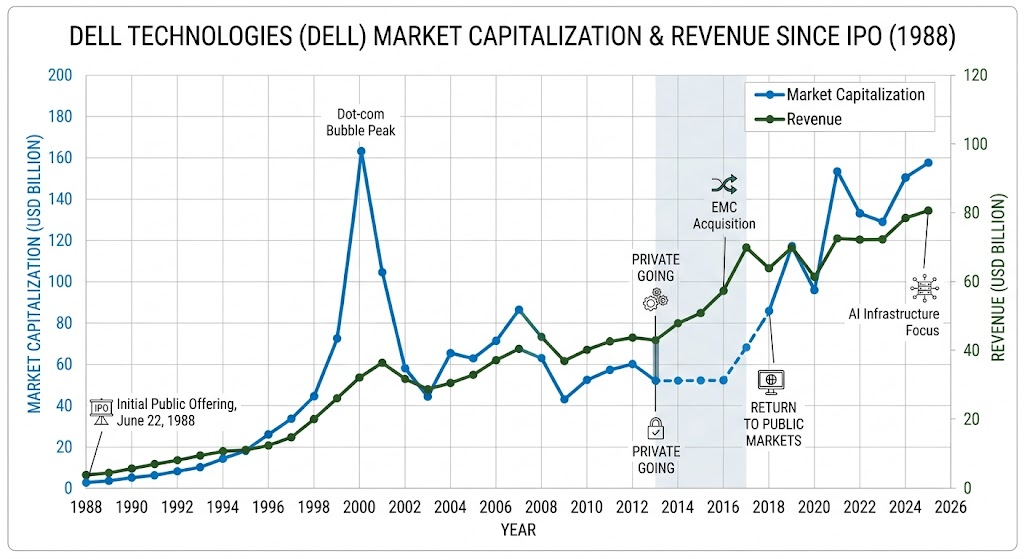
The history of Dell can be categorized into the following four key stages:
1. Founding and Direct-Sales Innovation (1984–1990s)
Michael Dell founded the company (initially named PC’s Limited) in his University of Texas dorm room in 1984. He pioneered the direct-to-consumer business model, bypassing retailers to sell custom-configured PCs directly to customers. This strategy drastically reduced inventory costs and enhanced price competitiveness, allowing the company to rise rapidly in the PC market.
2. Market Dominance and Global Expansion (2000–2010)
During this period, Dell became the global leader in the PC market, with its supply chain management efficiency reaching its peak. The company actively pursued vertical integration and market expansion, transitioning from a pure-play PC manufacturer into the enterprise server and storage sectors, cementing its status as a cornerstone of corporate IT infrastructure.
3. Privatization and Strategic M&A (2013–2018)
Facing the rise of mobile computing and cloud services, Michael Dell took the company private in 2013. In 2016, Dell completed the acquisition of EMC for 67B, one of the largest technology mergers in history. This successfully expanded the company’s scope into data storage, virtualization, and cloud computing, leading to the formation of Dell Technologies.
4. Cloud, Edge, and AI Infrastructure (2019–Present)
After returning to the public markets, Dell streamlined its structure by spinning off assets like VMware. The company is currently focused on hybrid cloud architectures, edge computing, and AI infrastructure. Dell is positioning itself as a key partner for enterprise AI deployment, providing dedicated AI servers and storage solutions to drive digital transformation.
Dell Technologies’ competitive landscape in 2026 centers on its strategic deployment of AI infrastructure, enterprise server refresh cycles, and supply chain mastery. Below is a comprehensive analysis:
Core Competitive Advantages
- Enterprise Customer Stickiness: Dell possesses a deep-rooted foothold in the large enterprise market. These clients prioritize stability, reliability, and service guarantees when building multi-year infrastructure, favoring Dell’s mature service ecosystem.
- Supply Chain Excellence: Dell maintains exceptional scale and bargaining power in component procurement. In an era where critical components like NVIDIA GPUs and high-end memory are in high demand, Dell’s ability to secure and integrate supply is a significant differentiator.
- End-to-End Solutions: By offering a highly integrated portfolio—spanning endpoint PCs, enterprise servers, storage, and networking—Dell facilitates localized, on-premises AI deployments, catering to organizations that prioritize data security and sovereignty over pure public cloud models.
Key Competitors
- Super Micro Computer (SMCI): Previously known for superior innovation speed and design flexibility in AI servers. However, recent regulatory scrutiny and market pressures have prompted some enterprise customers to shift orders toward Dell, seeking greater supply chain reliability and compliance.
- Hewlett Packard Enterprise (HPE): Competes through its strengthened networking portfolio (post-Juniper acquisition) and the GreenLake hybrid cloud platform, focusing on delivering a cloud-like consumption experience for on-premises infrastructure.
- Hyperscalers (AWS, Google, Meta): These tech giants are aggressively investing in custom silicon (TPUs, MTIA, Trainium). Their vertical integration poses a long-term structural threat to Dell’s enterprise infrastructure dominance as they increasingly handle their own hardware needs.
Market Opportunities and Risks
- Opportunities:
- AI Server Expansion: AI server revenue is projected to reach 50B by FY2027. Beyond GPU-accelerated servers, demand for traditional CPU servers is rising as enterprises upgrade their workflows to integrate AI capabilities.
- Localized AI Demand: Dell’s internal data suggests approximately 85% of enterprises plan to deploy AI locally within the next two years, increasingly opting for “single-vendor” integrated solutions, which plays directly into Dell’s core strength.
- Risks:
- Margin Compression: Because GPUs represent a massive share of the bill of materials (BOM) in AI servers, the margin profile of AI business is inherently lower than that of traditional Infrastructure Solutions Group (ISG) business, requiring a focus on service attach rates to compensate.
- Component Volatility: Fluctuations in memory prices and long lead times for GPUs create a lag between market share gains and realized revenue, with significant scaling expected to materialize fully by 2027.
- PC Cyclicality: The PC segment still accounts for roughly 40% of Dell’s total revenue. If elevated memory costs force enterprises to delay device refresh cycles, short-term demand pressure is likely.
Summary
Dell is currently in a pivotal transition from a traditional hardware vendor to an “AI Infrastructure Factory.” Its competitive edge lies in leveraging entrenched enterprise relationships and superior supply chain execution to capture the demand for stable, reliable AI deployments. The primary focus for the near-to-mid term is maintaining ISG margins while mitigating the dilutive effects of rapid AI server adoption.
Source:
Back to Dell page