
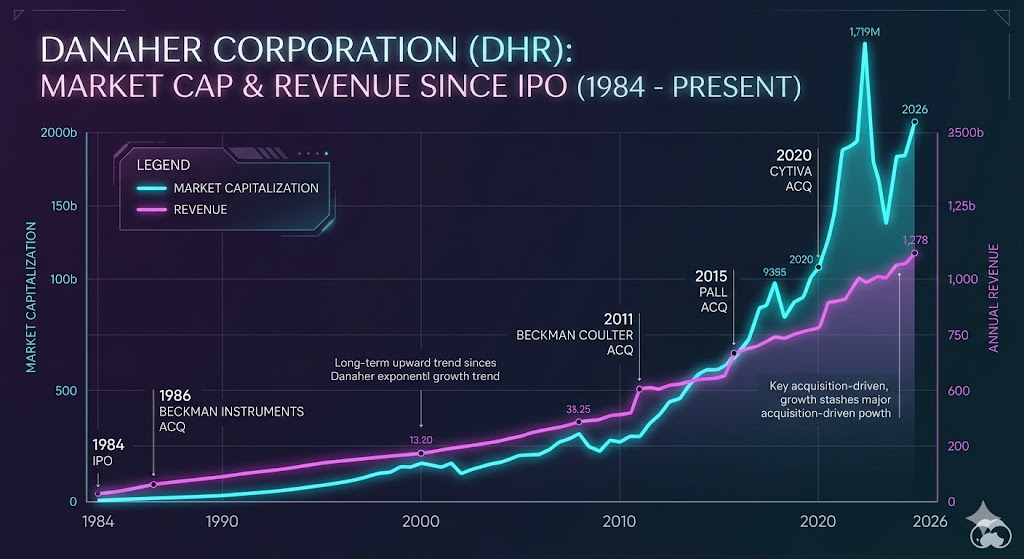
The history of Danaher can be categorized into four distinct phases, illustrating its evolution from an industrial conglomerate to a pure-play life sciences and diagnostics powerhouse:
1. Origins and Expansion (1969-1984)
The roots of Danaher trace back to 1969 with the formation of a real estate investment trust called DMG. In 1984, brothers Steven and Mitchell Rales acquired the company and rebranded it as Danaher. During this era, it functioned primarily as an industrial holding company, focusing on automotive parts, tools, and various industrial components through a series of aggressive acquisitions.
2. Establishing the Operating System (1985-2000)
This period marked the birth of the company’s most vital asset: the Danaher Business System (DBS). Derived from the Toyota Production System, DBS became the core framework for driving operational efficiency and integrating acquired companies. During this time, the company began shifting its portfolio away from low-margin industrial products toward higher-technology sectors, such as electronic testing and environmental water quality solutions.
3. Technical Specialization and Healthcare Pivot (2001-2019)
At the turn of the century, Danaher systematically divested its industrial businesses to focus on life sciences, diagnostics, and dental technologies. By acquiring industry leaders like Beckman Coulter, Radiometer, and Leica Microsystems, the company solidified its market-leading position in medical diagnostics and laboratory instrumentation.
4. Pure-Play Life Sciences and Precision Medicine (2020-Present)
Danaher completed its transformation by spinning off its dental segment (Envista) and executing high-profile acquisitions such as GE’s biopharma business (Cytiva), Aldevron, and Abcam. Today, Danaher operates as a pure-play medical technology company, dedicated entirely to supporting biopharmaceutical development, gene therapy, and clinical diagnostics.
Danaher (DHR) operates in a highly competitive landscape within the life sciences and diagnostics sectors. Its competitive positioning is defined by a unique operational philosophy and a disciplined capital allocation strategy.
1. Key Competitors
Danaher’s diverse business units face competition from industry giants and specialized players across several segments:
- Thermo Fisher Scientific (TMO): The primary direct competitor. TMO is larger and maintains a massive “one-stop-shop” ecosystem, covering analytical instruments, life science tools, and clinical services, providing significant market leverage.
- Specialized Competitors:
- Bioprocessing: Sartorius and Merck KGaA (MilliporeSigma) are the main rivals in single-use technologies and purification consumables.
- Diagnostics: Roche and BD (Becton, Dickinson) compete directly in clinical laboratory workflows and molecular diagnostics.
- Analytical Instrumentation: Agilent Technologies and Waters Corporation are key rivals in liquid chromatography and mass spectrometry.
2. Core Competitive Advantages
Danaher consistently maintains superior profitability compared to many peers due to three main pillars:
- Danaher Business System (DBS): This is the company’s central “moat.” DBS is a proprietary system based on lean management principles. It drives continuous improvement, standardized workflows, and data-driven decision-making, allowing Danaher to significantly boost the margins and efficiency of acquired businesses.
- High Recurring Revenue: Over 80% of total revenue is derived from consumables, services, and maintenance. This creates high visibility, stability, and strong cash flow generation, which funds further growth and acquisitions.
- Disciplined M&A Strategy: Danaher is highly skilled at acquiring high-quality market leaders (e.g., Cytiva, Cepheid, Abcam). By applying the DBS framework post-acquisition, they effectively capture synergies and scale operations rapidly.
3. SWOT Summary
- Strengths: Superior operational efficiency driven by DBS, robust cash flow generation, and a high percentage of recurring revenue.
- Weaknesses: Smaller absolute R&D expenditure compared to massive peers like Thermo Fisher; inherent integration risks associated with a serial acquisition model.
- Opportunities: Integrating AI into diagnostic workflows and expanding deeper into gene therapy and precision medicine.
- Threats: Margin pressure from competitors with significant scale; regulatory uncertainties in key markets like China; and cyclicality in biopharmaceutical R&D spending.
Source:
- https://www.danaher.com/about-danaher
- https://en.wikipedia.org/wiki/Danaher_Corporation
- https://investors.danaher.com/
- https://www.danaher.com/about-danaher/history
- https://www.forbes.com/companies/danaher/
- https://investors.danaher.com/2026-04-21-Danaher-Reports-First-Quarter-2026-Results
- https://www.hudson-labs.com/research/danaher-competitors-dhr-top-peers-2026
- https://koalagains.com/stocks/NYSE/DHR/competition
- https://portersfiveforce.com/blogs/competitors/danaher
Back to Danaher page