
Market Position and Market Share
Daikin Industries, Ltd. is the world’s largest manufacturer of heating, ventilation, and air conditioning(HVAC)equipment by revenue. In the fiscal year ended March 31, 2025(FY2024), Daikin generated consolidated net sales of ¥4,752.3 billion(approximately $31-33 billion depending on currency conversion), with over 84% of revenue derived outside Japan.
- Global Market Ranking and Share:Daikin ranks No. 1 globally in dedicated HVAC equipment sales.In the overall global HVAC market(estimated between $240 billion and $275 billion), Daikin commands a leading market share of roughly 12% to 15%.
- Regional Positions:
- Japan: Ranks No. 1, commanding over 35% of the commercial air conditioning market and roughly 20-25% of the residential segment.
- Europe: Consistently ranks No. 1 in split systems and Variable Refrigerant Flow(VRF)units, holding leading share in hydronic heat pumps despite cyclical European subsidy headwinds. Daikin Europe contributed over €5.0 billion in revenue.
- North America: Ranks No. 2 overall behind Trane Technologies, holding approximately 19.4% market share(driven by Goodman Global for unitary ducted systems and Daikin-branded VRF/applied systems).
- Asia-Pacific, India, and China: Holds the No. 1 foreign-brand position in China for high-end residential multi-split systems, while holding the No. 1 market position in India, Southeast Asia, and Oceania.
Upstream and Downstream Supply Chain Analysis and Key Suppliers
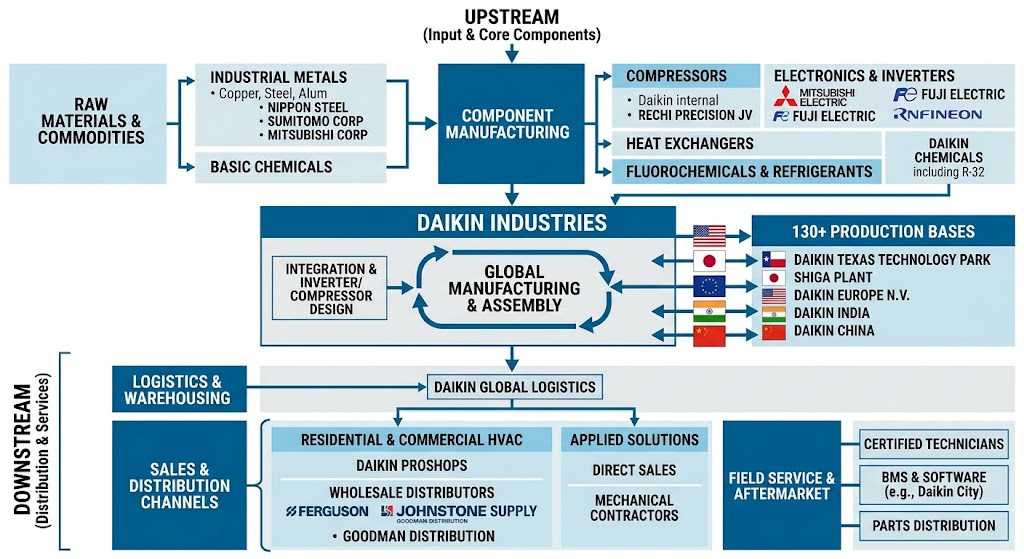
Daikin operates a distinct supply chain model built on heavy vertical integration across core electromechanical components and chemical refrigerants, complemented by regional assembly centers.
- Upstream(Raw Materials and Core Components):
- Fluorochemicals and Refrigerants: Unlike traditional HVAC assemblers, Daikin develops and synthesizes its own fluorochemicals and refrigerants(Chemicals Division), notably pioneering lower-GWP alternatives such as R-32.
- Compressors: Daikin designs and manufactures its proprietary swing, scroll, and screw compressors internally across plants in Japan, China, the Czech Republic, and the US. It also partners via joint ventures(such as with Rechi Precision for specific compressor lines)to balance volume requirements.
- Inverters and Microelectronics: Daikin designs dedicated motor-drive inverters and printed circuit boards(PCBs)in-house. Key silicon and power semiconductor suppliers include Mitsubishi Electric, Fuji Electric, Renesas Electronics, and Infineon Technologies for insulated gate bipolar transistors(IGBTs)and microcontrollers.
- Raw Metals: Heavy procurement exposure to raw copper(tubing and heat exchanger coils), electrical steel(motor stators/rotors), and sheet aluminum/steel. Key industrial metal providers include Japanese trading houses(such as Sumitomo Corporation and Mitsubishi Corporation)sourcing from steelmakers like Nippon Steel.
- Manufacturing and Assembly Infrastructure:
- Daikin operates under a “Local Production for Local Consumption” doctrine across 130+ production bases globally. Major production nodes include the Daikin Texas Technology Park(DTTP, North America), Sakai and Shiga plants(Japan), Daikin Europe N.V.(Oostende, Belgium; Brno/Plzen, Czech Republic), and dedicated facilities across Neemrana/Sri City(India)and Huizhou/Shanghai(China).
- Downstream(Distribution, Channels, and Field Service):
- North America: Goodman distribution network utilizes both company-owned distribution centers and independent wholesale distributors(e.g., Ferguson, Johnstone Supply, ABCO)selling to residential HVAC mechanical contractors. Applied commercial chillers sell direct-to-engineer and via mechanical contractors.
- Europe and Asia: Relies on direct-to-installer sales networks and specialized “Proshop” franchised retail networks in China, Japan, and Southeast Asia, bypassing general multi-brand wholesalers to retain pricing power and service quality.
- Aftermarket Solutions: Building management system(BMS)connectivity, maintenance contracts, energy management analytics, and replacement parts delivered through proprietary engineering teams and certified technicians.
Competitor Analysis: Technical and Financial Comparison
Daikin competes with distinct tiers of global peers: US pure-play applied/commercial giants(Trane Technologies, Carrier Global, Johnson Controls)and Chinese scale manufacturers(Gree Electric, Midea Group).
- Technical Comparison:
- Daikin vs. US Peers(Trane, Carrier, Johnson Controls):
- Inverter and Heat Pump Architecture: Daikin pioneered VRF(Variable Refrigerant Volume)technology and compact DC inverter systems, outperforming traditional US single-stage or two-stage ducted systems in energy efficiency and part-load modulation. US peers historically excelled in large-tonnage applied equipment(centrifugal chillers, data center cooling, building automation controls). Daikin closed this gap via acquisitions(McQuay/OYL, Alliance Air Products, and modular data center cooling solutions).
- Vertical Integration: Daikin manufactures both refrigerants and compressors in-house. In contrast, US peers often outsource standard compressors(e.g., from Copeland or Danfoss)and source refrigerants entirely from external chemical manufacturers(such as Chemours or Honeywell).
- Daikin vs. Chinese Peers(Midea, Gree):
- Product Segmentation: Gree and Midea possess enormous manufacturing capacity and cost advantages in mass-market mini-splits and entry-level unitary air conditioners. Daikin differentiates through durability, lower acoustic decibel levels, high-end multi-split algorithms, and proprietary oil-free magnetic bearing chillers for commercial installations.
- Daikin vs. US Peers(Trane, Carrier, Johnson Controls):
- Financial and Valuation Comparison:
- Revenue Scale:Daikin leads in total HVAC equipment turnover(over ¥4.7 trillion / ~$32 billion), outpacing Carrier Global(~$22 billion)and Trane Technologies(~$18-20 billion), while Midea Group’s total revenue is larger overall but heavily diluted by non-HVAC major consumer appliances.
- Operating Margin(OPM): Daikin typically generates consolidated operating margins in the 8.5% to 9.2% range. By comparison, US peers Trane Technologies and Carrier generate higher operating margins(14% to 17%), driven by high-margin commercial service contracts, recurring software revenues, and lower exposure to cyclical Asian residential markets.
- Return on Capital and Shareholder Returns: Trane Technologies leads the peer group in Return on Equity(ROE > 30%), buoyed by aggressive share buyback programs and asset-light services. Daikin maintains a conservative, net-cash-leaning balance sheet(equity ratio above 54-55%)with an ROE of 9% to 11%, leading to activist involvement(such as Elliott Investment Management)pushing to narrow its valuation multiple discount against US peers.
Sources
- https://www.daikin.com/-/media/Project/Daikin/daikin_com/investor/library/annual/2025/2025_E-pdf.pdf
- https://www.daikin.com/-/media/DB861448CF134980AE6819F941132C7D.ashx
- https://www.daikin.com/-/media/4AA39D61E8B546E38454A7C62FEC7152.ashx
- https://en.deallab.info/hvac/
- https://en.deallab.info/hvac-us/
- https://en.wikipedia.org/wiki/Daikin
- https://thechillbrothers.com/leading-hvac-brands-performance-and-market-share-analysis/
- https://www.pzena.com/americas/institutional-investors/insights/highlighted-holding-daikin-industries-4q-2025/
back to Daikin