
Corporate History
Founding and Domestic Foundation(1924–1960s)
Founded in Osaka in 1924 by Akira Yamada as Osaka Kinzoku Kogyosho LP, the enterprise initially focused on specialized radiator tubes for aircraft. In the 1930s, the company diversified into fluorocarbon refrigerants, establishing a foundation as both a mechanical engineering and chemical manufacturer. In 1951, Daikin launched Japan’s first commercial package air conditioner, followed by rotary compressors and heat pump systems that supported Japan’s postwar urban construction boom.
Technological Commercialization and Early Overseas Expansion(1970s–1993)
Renamed Daikin Industries, Ltd. in 1982, the company pioneered the multi-split commercial air conditioning system known as Variable Refrigerant Volume(VRV), allowing individual room temperature control from a single outdoor condenser unit. During this period, Daikin established production and sales outposts across Europe and Southeast Asia, creating dedicated direct-sales channels rather than relying entirely on third-party trading intermediaries.
Aggressive Global M&A and Market Dominance(1994–2019)
Under the leadership of Noriyuki Inoue, Daikin executed large-scale cross-border acquisitions to secure distribution networks and manufacturing footprints. Critical takeovers included OYL Industries of Malaysia in 2006(absorbing McQuay International and American Air Filter) and Goodman Global in 2012 for approximately $3.7 billion, which gave Daikin immediate scale in the residential ducted HVAC market across North America. In 2016, Daikin consolidated its European presence with the acquisition of commercial refrigeration specialist Zanotti, followed by Austrian refrigeration firm AHT Cooling Systems in 2019.
Energy Transition, Digital Transformation, and Portfolio Realignment(2020–Present)
Navigating recent supply chain volatility and evolving environmental mandates, Daikin accelerated heat pump adoption across Europe and expanded manufacturing footprints in North America and India under its “FUSION 25” and “FUSION 30” management plans. Recent initiatives focus on decarbonized refrigerants(such as R-32), inverter conversions in emerging markets, and software-driven energy optimization solutions for commercial buildings.
Business Model and Growth Strategy
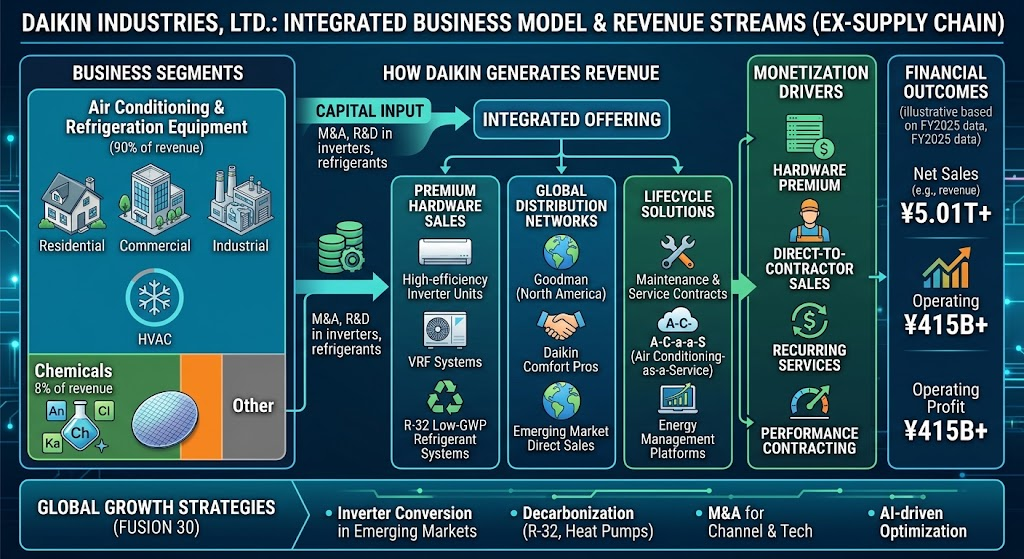
Daikin generates revenue through an integrated equipment and materials framework across two core operating pillars: Air Conditioning & Refrigeration Equipment(which accounts for roughly 90% of consolidated net sales) and Chemicals(representing approximately 7% to 8% of sales, with the remainder in oil hydraulics and defense systems). In fiscal year 2025(ended March 31, 2025), Daikin exceeded ¥5.01 trillion in net sales, generating operating profit of ¥415.0 billion.
The business model monetizes along several distinct vectors:
- Hardware Premium and Inverter Technology: Daikin commands pricing power by packaging energy-efficient variable-speed inverter compressors, patented heat exchangers, and proprietary refrigerants into unified systems. In emerging markets like India and Southeast Asia, it drives top-line expansion by converting unpenetrated markets from fixed-speed units to high-efficiency split units.
- Direct-to-Contractor and Dealer Distribution: Unlike competitors that rely on third-party distributor layers, Daikin acquired and developed proprietary wholesale distribution networks(notably through Goodman and Daikin Comfort Pros in North America). This reduces channel margin erosion and provides direct market feedback on warranty rates and replacement cycles.
- Solutions and Recurring Service Monetization: Equipment sales serve as an entry point for high-margin recurring revenues. Through air-conditioning-as-a-service(ACaaS), remote monitoring platforms(Airnet), predictive maintenance, and filter replacements, Daikin captures ongoing lifecycle cash flows, aiming to expand service revenue to insulate corporate earnings from volatile construction and installation cycles.
- Chemical Integration: Daikin’s chemical segment synthesizes fluorochemical materials, producing fluoropolymer resins(such as PTFE), fluoroelastomers, and fluorocoatings used in semiconductor wafer manufacturing, lithium-ion battery coatings, and automotive fuel lines. This specialty niche generates higher operating margins than mass-market residential hardware during economic upswings.
Sources
- https://www.daikin.com/-/media/Project/Daikin/daikin_com/investor/library/annual/2025/2025_E-pdf.pdf
- https://www.daikin.com/-/media/Project/Daikin/daikin_com/investor/data/kessan/2026/4Q_financial_results2_en-pdf.pdf
- https://www.daikin.com/-/media/Project/Daikin/daikin_com/investor/data/fusion/FUSION30/FUSION30_presentation3-pdf.pdf
- https://www.daikin.com/-/media/Project/Daikin/daikin_com/investor/financial/Financial-Data/Financial-Data-2025-pdf.pdf
AI Development Strategy, Budget, and Partnerships
Daikin treats artificial intelligence not merely as an IT function, but as an operational layer integrated into edge hardware, factory automation, and human capital transformation.
- Capital Allocation and Investment Budget: Under the “FUSION 25” framework, Daikin committed ¥180 billion(approximately $1.2 billion) specifically to digital transformation(DX) and information technology investments. In addition, Daikin maintains an active corporate venture capital(CVC) allocation of over ¥11 billion for minority equity stakes in emerging AI and IoT startups globally. Across its broader “FUSION 30” plan, total global research and development expenditure is targeted at ¥550 billion over the first three-year phase.
- Internal Talent Development(Daikin Information, AI and Data Science Center): Facing domestic engineering shortages, Daikin established the “Daikin Information and Communications Technology College” in partnership with Osaka University. Rather than relying solely on external hiring, Daikin sends roughly 100 new graduate engineers annually through an intensive two-year AI and data science curriculum, developing in-house technical personnel capable of training machine learning models for fluid dynamics and compressor diagnostics.
- Strategic Partnerships and Practical Implementations:
- NEC Corporation Collaboration: Daikin and NEC co-developed workplace AI systems designed to regulate thermal environments dynamically. Using camera vision and biometric AI algorithms that monitor employee drowsiness and eyelid movement patterns, the system automatically alters ambient room airflow and temperature between 27°C and 24°C to stimulate cognitive alertness and reduce commercial building energy consumption.
- Fairy Devices and University of Tokyo Startups: Daikin partnered with Fairy Devices(a deep-tech venture spun out of the University of Tokyo) to roll out “THINKLET” smart neck-worn wearable edge devices. The system uses field-level computer vision and natural language processing to assist remote maintenance technicians, automatically recording service procedures, conducting voice-activated diagnostic checks, and converting unstructured field technician actions into automated institutional training data.
- Edge AI in Building Energy Optimization: Daikin embeds localized machine learning algorithms within central building management systems(such as the SVV and Intelligent Touch Manager platforms). These models forecast heat-load curves by synthesizing weather forecasts, tenant occupancy rates, and real-time electricity tariff swings, autonomously adjusting refrigerant evaporation temperatures to lower operational power use by up to 20% to 30%.
back to Daikin