
Market Position and Market Share
Dai-ichi Life Holdings, Inc.(TSE: 8750) ranks as the 2nd largest private life insurance group in Japan by premium income and total consolidated assets, and the 3rd largest overall in the Japanese life insurance sector behind state-linked Japan Post Insurance(Kampo Seimei) and mutual giant Nippon Life(Nissay).
- Market Share: Dai-ichi Life commands approximately 12% to 14% of the total Japanese life insurance market by annualized net premium(ANP) in force. Within the private(non-postal) commercial life insurance segment, Nippon Life and Dai-ichi Life form an effective duopoly, with Dai-ichi Life maintaining a steady 18% to 20% private market share.
- Asset Scale: Consolidated total assets exceed ¥65 trillion(consolidated Group level), with the domestic flagship subsidiary, The Dai-ichi Life Insurance Company, Limited, holding over ¥33.7 trillion in general account assets.
- Global Footprint: Unlike domestic mutual peers, Dai-ichi Life transformed into a joint-stock holding company in 2010 and operates a diversified multi-regional platform, generating over 30% of group adjusted profits internationally across the United States(Protective Life), Australia(TAL), Southeast Asia(Dai-ichi Life Vietnam, Panin Dai-ichi Life), and Europe.
Supply Chain Analysis and Key Suppliers
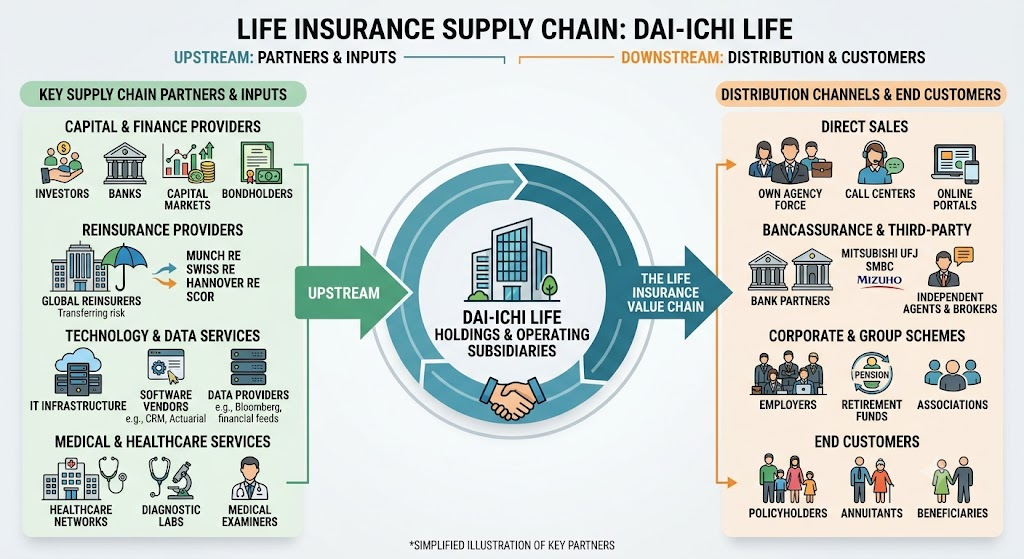
In the life insurance and asset management industry, the value chain does not mirror traditional physical manufacturing. Instead, it functions as an integrated financial manufacturing and distribution architecture spanning upstream capital and reinsurance, internal underwriting and asset-liability management(ALM), and downstream multi-channel distribution.
- Upstream Capital, Reinsurance, and Investment Infrastructure:
- Global Reinsurers(Risk Capacity): To manage peak longevity risk, catastrophic mortality, and product-level capital volatility, Dai-ichi Life relies on global tier-1 reinsurers. Key counterparties include Munich Re, Swiss Re, Hannover Re, and SCOR. Reinsurance treaties allow Dai-ichi Life to optimize economic capital under the Economic Solvency Ratio(ESR) framework and transfer tail-risk.
- Custody, Clearing, and Market Liquidity: Given an investment portfolio heavily weighted toward Japanese Government Bonds(JGBs), domestic equities, foreign sovereign/corporate credit, and alternative private assets, prime custodians include The Master Trust Bank of Japan, Trust & Custody Services Bank, State Street, and BNY Mellon.
- Financial Market Data and Core Enterprise Systems: Actuarial valuation, portfolio risk systems, and market execution depend heavily on Bloomberg LP, FactSet, MSCI(Barra ALM models), alongside enterprise core software provided by SAP and Salesforce for unified policyholder records.
- Midstream Value Creation: Underwriting and Product Manufacturing:
- Policy structuring combines medical risk actuarial engines, algorithmic underwriting, and biometric health tracking(e.g., Dai-ichi’s “Just” customizable policy suite and wellness-linked incentives).
- Asset-Liability Management(ALM): Hedging duration mismatches between ultra-long-term life liabilities and fixed-income assets, actively rebalancing domestic yen bond portfolios amidst Bank of Japan monetary policy shifts.
- Downstream Distribution Channels:
- Proprietary Agency Force: Over 40,000 Total Life Plan Designers in Japan provide high-touch consultative advisory for traditional mortality, whole life, and nursing care policies.
- Bancassurance and Independent Financial Advisors(IFAs): Through Dai-ichi Frontier Life, the group distributes savings-oriented, foreign-currency, and fixed/variable annuity products via mega-banks(MUFG, SMBC, Mizuho) and regional bank networks.
- Digital and Direct Platforms: Neo First Life targets younger demographics via digital-native, unbundled medical and cancer riders sold online or through independent broker agencies(e.g., Hoken-No-Madoguchi).
Competitor Analysis: Technical and Financial Comparison
Dai-ichi Life’s primary domestic competitors comprise Nippon Life Insurance Company, Japan Post Insurance(Kampo), Meiji Yasuda Life, and Sumitomo Life, alongside listed international peers such as T&D Holdings.
- Technical and Structural Comparison:
- Corporate Architecture: Dai-ichi Life is a publicly traded joint-stock corporation listed on the Tokyo Stock Exchange(TSE Prime: 8750). In contrast, Nippon Life, Meiji Yasuda, and Sumitomo Life remain mutual companies(相互会社) owned by policyholders. This structure gives Dai-ichi Life direct access to public equity markets for capital raises and shares-for-assets M&A, whereas mutual companies rely strictly on retained earnings and subordinated debt.
- M&A and Digital Integration: Dai-ichi Life has been more aggressive than mutual peers in overseas balance sheet acquisitions(Protective Life in the US, TAL in Australia) and asset management expansion(Capula Investment Management, Canyon Partners partnerships). From an underwriting tech perspective, its proprietary dynamic pricing engines and cloud-based medical screening platforms outpace the legacy mainframe architectures often maintained by older mutual insurers.
- Asset-Liability Management(ALM) and Economic Solvency Ratio(ESR): With Japan transitioning toward the new Economic Value-Based Solvency Framework, Dai-ichi Life maintains an ESR above 200%. Its ALM duration-matching capability has allowed it to actively capture yield widening by rebalancing more than ¥1.3 trillion annually into higher-yielding super-long JGBs and alternative private debt while trimming domestic equity cross-holdings.
- Financial Comparison:
- Scale and Premium Revenue: Nippon Life leads the domestic market with over ¥85 trillion in assets and superior overall premium income. However, Dai-ichi Life Holdings generates roughly ¥10 trillion to ¥11 trillion in consolidated revenue, outperforming Sumitomo Life(
¥40 trillion in assets) and Meiji Yasuda(¥45 trillion in assets) in geographical revenue diversification. - Return on Equity(ROE) and Profit Margins: As a public company, Dai-ichi Life operates with explicit ROE accountability. Its group adjusted ROE runs at 10% to 12.7%, significantly higher than the implied capital returns generated by mutual companies which prioritize policyholder surplus over shareholder capital efficiency.
- Valuation Multiples: Dai-ichi Life trades at a Price-to-Earnings(P/E) multiple of approximately 11.5x to 12.5x and a Price-to-Book(P/B) ratio around 1.4x to 1.5x, reflecting strong institutional investor demand driven by dividend increases, share buybacks, and upside sensitivity to rising Japanese domestic interest rates.
- Scale and Premium Revenue: Nippon Life leads the domestic market with over ¥85 trillion in assets and superior overall premium income. However, Dai-ichi Life Holdings generates roughly ¥10 trillion to ¥11 trillion in consolidated revenue, outperforming Sumitomo Life(
Information Sources
- https://www.dai-ichi-life-hd.com/en/
- https://www.dai-ichi-life.co.jp/english/
- https://www.investing.com/equities/the-dai-ichi-life-insurance-co.
- https://www.tradingview.com/symbols/TSE-8750/
- https://zh.wikipedia.org/zh-tw/%E7%AC%AC%E4%B8%80%E7%94%9F%E5%91%BD%E4%BF%9D%E9%9A%AA
back to Dai-ichi Life