
Early Development & Agricultural Foundation (1894–1919)
- 1894: French legislation allowed the creation of local agricultural credit funds to provide micro-loans to farmers, marking the group’s inception.
- 1899: Regional funds were established, forming the foundational two-tier cooperative architecture of local and regional banks.
Structural Refinement & Retail Expansion (1920–1987)
- 1920: The National Office of Crédit Agricole was established to serve as the central administrative body.
- 1966: The institution gained financial autonomy, severing direct reliance on state budgets to operate independently.
- 1970s: Expanded beyond specialized agricultural lending into general public retail banking, including residential mortgages.
Mutualization & Internationalization (1988–2000)
- 1988: The French government privatized the central body by transferring ownership entirely to the regional mutual funds.
- 1990s: Diversified into insurance (establishing Pacifica and Predica) and expanded asset management through key acquisitions.
- 1996: Acquired Banque Indosuez, significantly scaling its global corporate and investment banking operations.
Public Listing & Modern Structure (2001–Present)
- 2001: Listed its central entity, Crédit Agricole S.A., on the Euronext Paris exchange, locking in its hybrid “cooperative + public listed company” model.
- 2010: Consolidated its asset management operations to launch Amundi, building one of Europe’s largest asset managers.
- Recent Focus: Transitioned toward ESG and green finance initiatives, serving retail and corporate clients across more than 50 countries.
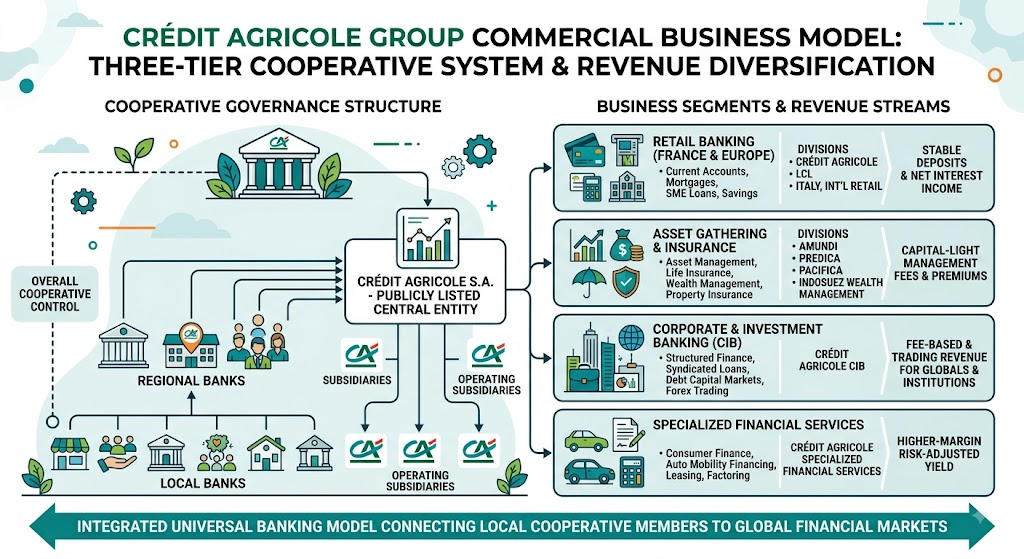
Business Model: Three-Tier Cooperative Structure & Revenue Diversification
The group’s organizational model consists of local banks, regional banks, and the publicly listed central entity, Crédit Agricole S.A. (CASA). The regional banks collectively own a majority stake in CASA, while CASA acts as the central body and oversees specialized operating subsidiaries.
- Retail Banking: Serves core European markets—primarily France (via Crédit Agricole and LCL) and Italy—generating net interest income and fee income through dense branch networks and digital channels.
- Asset Gathering & Insurance: Leverages Europe’s largest asset manager, Amundi, alongside insurance subsidiaries (Predica, Pacifica) and wealth management units to generate stable, capital-light management fees and insurance premiums.
- Corporate & Investment Banking (CIB): Operates globally under Crédit Agricole CIB, driving fee and trading revenue through structured finance, syndicated loans, debt capital markets, and foreign exchange.
- Specialized Financial Services: Encompasses consumer finance, auto mobility financing, leasing, and factoring, capturing higher-margin yield through risk-adjusted lending.
Development Strategy: Sustainability, European Scale, and Tech Efficiency
- ESG & Climate Leadership: Integrates sustainable finance into core operations, prioritizing green bond underwriting, renewable energy project financing, and energy transition advisory while winding down fossil fuel exposures.
- Consolidation of European Footprint: Treats France and Italy as dual domestic markets, expanding scale across Europe through targeted acquisitions (e.g., Amundi’s strategic roll-ups) and cross-border bank distribution partnerships.
- Universal Customer-Focused Model: Combines local branch relationships with digital-first servicing, investing in automation, AI, and cloud infrastructure to lower the overall cost-to-income ratio.
Crédit Agricole has significantly accelerated its artificial intelligence deployment, positioning AI as a core driver for operational efficiency and business transformation.
Investment Budget
- Dedicated Strategic Budget: Under its “ACT 2028” strategic plan, the group allocated a dedicated budget of approximately €500 million (~$550 million) spanning 2026 through 2028 to deepen its AI capabilities.
- Establishment of a Dedicated AI Subsidiary: As part of this budget, €150 million in capital was used to launch an independent group-wide entity (“AI Company”) tasked with operating unified AI infrastructure, operational platforms, and cross-departmental AI agents.
Core Strategy & Deployment Focus
- Group-Wide Adoption (“AI For All”): Scaling internal AI solutions, including daily office assistants, automated email response systems (e.g., Mailbot), and wealth advisor support tools (e.g., ASCO).
- European Sovereignty & Tech Autonomy: Prioritizing European technology solutions and local AI ecosystems to reduce over-reliance on non-European tech giants.
- Domain-Specific Applications:
- Sustainable Finance (ESG): Launched SPASE, an AI-driven trade finance platform that automatically analyzes ESG data within supply chains.
- Capital Markets & Research: Utilizes AI to aggregate hundreds of external data sources (e.g., central banks, institutions) for personalized research reports and real-time price anomaly detection.
- Advanced Tech Frontiers: Exploring quantum-AI algorithms for portfolio optimization and risk modeling.
Partnerships & Ecosystem
- Digital Transformation Partners: Collaborated with European tech consultancy Onepoint to build a generative AI portal hosted on AWS for its consumer finance subsidiary, Sofinco.
- European AI Ecosystem: Partnered with French AI training platform Mendo to accelerate employee upskilling across Microsoft 365 Copilot, ChatGPT, and Mistral AI.
- Quantum Computing Partners: Maintained a long-term collaboration with French quantum startup Pasqal to combine quantum processing with AI for capital markets algorithms.
Source:
- https://www.credit-agricole.com/en/group/business-lines
- https://www.credit-agricole.com/en/group/group-presentation/group-structure
- https://www.credit-agricole.com/en/finance/finance/financial-publications
- https://www.amundi.com/institutional/about-amundi
- https://www.ca-cib.com/our-solutions
Back to Credit Agricole