
China Railway Engineering Group (CREC) holds a pivotal and leading position in both the domestic and global infrastructure construction markets:
I. Global and Domestic Rankings
- Top Global Contractor: According to Engineering News-Record (ENR), CREC consistently ranks among the top global contractors, holding the No. 2 spot on the “Top 250 International Contractors” list.
- Domestic Duopoly: In the Chinese domestic and global railway and tunnel engineering sectors, CREC forms a highly stable duopoly with China Railway Construction Corporation (CRCC), with the two jointly capturing over half of the market share.
II. Absolute Advantages in Niche Sectors
- High-Speed Rail and Transit: As China developed the world’s most extensive high-speed railway network, CREC constructed the vast majority of these high-speed rail and urban transit projects, making it the practical global leader in this domain.
- Tunneling and Underground Equipment (Shield Machines): The production and sales volume of large-scale tunnel boring machines (shield machines) independently researched and manufactured by CREC have ranked first globally for many years, with products exported to over 30 countries and regions, giving the company decisive market influence in high-end underground engineering equipment.
III. International Strategic Status
- Core Builder of the “Belt and Road” Initiative: As one of the earliest Chinese infrastructure enterprises to “go global,” CREC’s business footprint extends across more than 100 countries and regions. It has undertaken numerous landmark cross-border railways, highways, and major infrastructure projects, serving as a primary force for national industrial capacity cooperation and international connectivity.
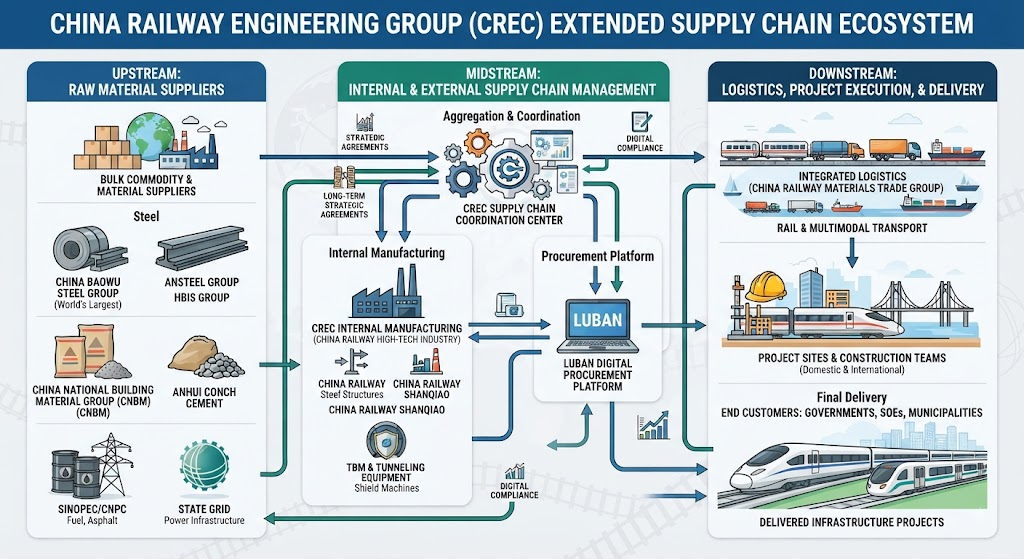
To provide a comprehensive overview of China Railway Engineering Group’s (CREC) supply chain , here is the detailed breakdown of its external supplier ecosystem:
I. Core Raw Material and Bulk Commodity Suppliers
Given the massive scale of infrastructure projects, CREC relies heavily on long-term strategic agreements with major state-owned enterprises to lock in prices and ensure stable supplies of steel, cement, and asphalt.
- Steel Suppliers:
- China Baowu Steel Group: The world’s largest steelmaker, serving as a primary supplier of structural steel and high-speed rail track materials for CREC projects.
- Ansteel Group: Provides specialized structural steel and high-alloy steel.
- HBIS Group: Supplies large-scale construction steel for major regional engineering projects.
- Cement and Building Materials Suppliers:
- China National Building Material Group (CNBM): A global leader in cement and building materials, acting as a major supplier across CREC’s nationwide and international sites.
- Anhui Conch Cement: Supplies high-strength, bulk cement and ready-mix concrete.
II. Core Machinery Equipment and Technology Partners
While CREC possesses internal manufacturing capabilities (such as China Railway High-tech Industry), it relies on external technology and industrial leaders for key components and specialized digital systems.
- Power Systems and Heavy Components:
- Caterpillar and Komatsu: Frequently utilized or procured for high-performance excavators and heavy machinery on overseas projects to supplement internal fleets.
- SKF and Schaeffler: Provide high-precision critical bearings required for tunnel boring machines (TBMs) and railway bogies.
- Digital and Automation Systems:
- Huawei: Supplies smart construction site solutions, 5G communications infrastructure, and project management data center systems for digital infrastructure projects.
- Siemens and Schneider Electric: Provide substation systems, control architectures, and electrical automation components for railway electrification.
III. Energy and Fuel Suppliers
- State Grid Corporation of China: Manages large-scale power grid access and electricity supplies for construction sites and transit facilities.
- CNPC and Sinopec: Supply fuel oils for heavy machinery fleets as well as petroleum-derived construction materials such as asphalt.
IV. CREC Supply Chain Coordination Framework
To manage this vast external and internal ecosystem, CREC operates a centralized platform structure:
- Group-Level Centralized Procurement: Handled by China Railway Materials Trade Group (CREC Trading), which aggregates national project demand to negotiate annual framework purchasing agreements with upstream giants like Baowu and CNBM.
- Upstream Resource Safeguards: Executed through CREC Resources, which engages in global mining and extraction (such as copper and cobalt ventures) to secure raw metal resources and hedge against price volatility.
- Digital Management Layer: Utilizes the proprietary “Luban Platform” to track logistics, manage settlements with external suppliers, and ensure compliance and punctuality across massive infrastructure projects.
As a global infrastructure giant, China Railway Group Limited (CREC)’s competitive landscape and advantages are analyzed as follows:
I. Market Competitive Landscape
The Chinese infrastructure construction market is highly oligopolistic. In the railway engineering sector specifically, a duopoly exists between CREC and China Railway Construction Corporation (CRCC), with the two companies collectively holding over 50% of the market share.
- Key Competitors:
- China Railway Construction Corporation (CRCC): The most direct competitor with significant business overlap, possessing equivalent capabilities in surveying, design, and construction for railways, tunnels, bridges, and urban transit systems. The two often compete for large-scale national projects and overseas contracts.
- China Communications Construction Company (CCCC): A formidable force in ports, waterways, bridges, and high-end highway construction; it competes with CREC on large-scale, integrated transportation infrastructure projects.
- Other State-Owned Enterprises (SOEs): Companies like China State Construction Engineering Corporation (CSCEC) and China Energy Engineering Corporation possess specialized strengths in niche sectors (such as building construction or energy infrastructure), though their competition with CREC in the core railway construction segment is relatively lower.
II. Competitive Advantages
- Integrated Industrial Chain: CREC possesses a full-service chain spanning survey, design, construction, and equipment manufacturing (notably in shield tunneling/TBM technology). This allows the company to provide “one-stop” solutions, offering a significant edge in international bidding.
- Economies of Scale and Cost Efficiency: As a massive state-owned enterprise, CREC leverages superior project execution and financing support. This enables the firm to undertake ultra-large-scale infrastructure projects while maintaining relatively stable operational costs through economies of scale.
- Technological Moats: The company holds a world-leading position in complex tunnel excavation and high-speed railway construction technology, making it indispensable for high-barrier-to-entry projects.
- Strategic National Positioning: Capitalizing on the “Belt and Road” Initiative, CREC has successfully established a presence in emerging markets across Asia, Africa, and beyond, securing a steady pipeline of government-to-government cooperation projects.
III. Challenges and Pressures
- Financial Pressure and Debt Management: Due to the massive capital requirements and long payback periods of infrastructure projects, high debt-to-equity ratios and cash flow management remain critical challenges for all large-scale construction firms.
- Global Macro Risks: Overseas projects are susceptible to geopolitical shifts, currency volatility, and changes in local regulations and policies.
- Industrial Transformation Needs: As global infrastructure growth shifts from “new construction” to “maintenance and upgrades,” and with increasing requirements for green and low-carbon infrastructure, the firm must accelerate its digital and green technology deployment to meet new market standards.
IV. Competitive Strategy Trends
- Deepening “Investment-Construction-Operation” Integration: By adopting this model, the company aims to enhance project profitability beyond mere construction margins.
- Digital and Green Transformation: Increasing R&D investment in digital tunnel construction and carbon-neutral building techniques to meet new bidding requirements under global ESG trends.
- Market Diversification: Beyond traditional railways, the company is actively expanding into smart urban transportation and logistics infrastructure to mitigate operational risks.
Source:
- https://www.crecg.com/web/gywm46/gsjs/gsjj35/index.html
- https://zh.wikipedia.org/zh-tw/%E4%B8%AD%E5%9B%BD%E9%93%81%E8%B7%AF%E5%B7%A5%E7%A8%8B%E9%9B%86%E5%9B%A2
Back to CREC