
The development history of China Railway Engineering Group (CREC) can be categorized into four major stages:
I. Inception and Foundation (1950 – 1980s)
- Origin: In 1950, the Ministry of Railways of the People’s Republic of China established the General Bureau of Engineering and the General Bureau of Design to oversee national railway construction planning.
- Construction Surge: During this period, the group led the initial development of the national railway network. The establishment of the Wuhan Bridge Engineering Bureau in 1953 marked the professionalization and formalization of large-scale bridge construction in China.
- Reorganization: In 1958, the two bureaus were integrated, establishing the management framework that would support subsequent large-scale infrastructure construction.
II. Institutional Transformation and Corporatization (1989 – 2000)
- Establishment of the General Corporation: In July 1989, the State Council approved the dissolution of the General Bureau of Capital Construction and the formation of the “China Railway Engineering Corporation” (CREGC), marking the shift toward corporate management.
- Separation of Government and Enterprise: In 2000, CREGC completed its separation from the Ministry of Railways and was transferred to the management of the Central Enterprise Work Commission, signifying the transition into an independent market entity.
III. Shareholding Reform and IPO (2001 – 2007)
- Asset Restructuring: To prepare for entry into capital markets, the company underwent significant shareholding reforms, transforming subsidiaries into limited liability companies and resolving historical issues regarding employee shareholding associations.
- Public Listing: In 2007, CREGC restructured its core construction business to establish “China Railway Group Limited” (CREC), achieving simultaneous “A+H” listings in Shanghai and Hong Kong, completing the transition from a state-owned enterprise to a modern, publicly traded conglomerate.
IV. Global Expansion and Diversification (2008 – Present)
- Global Footprint: The company has continued to expand its international presence, with projects spanning over 100 countries across Asia, Africa, Europe, and the Americas.
- Diversification: The scope of business has evolved from traditional railway construction to include urban transit, highways, tunneling, TBM (Tunnel Boring Machine) research and development, and international logistics. CREC is now established as a global infrastructure giant with a complete industrial chain covering survey, design, construction, and operation.
Reference:
China Railway Engineering Group – Wikipedia
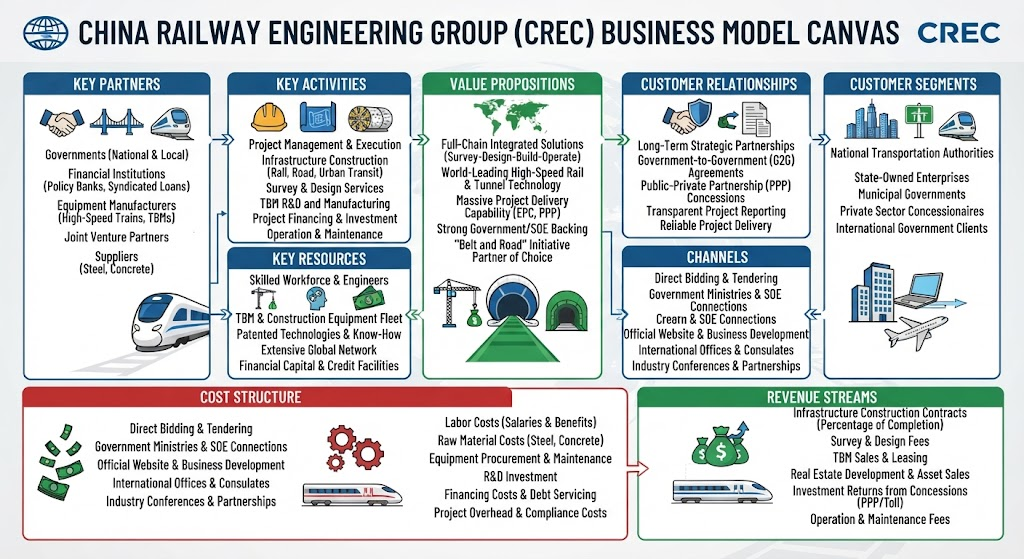
China Railway Engineering Group (CREC) adopts a typical “vertical integration” and “investment-construction-operation” business model for large-scale comprehensive infrastructure development, capturing diversified revenue and profits through advantages that span the entire industrial chain.
I. Core Businesses and Revenue Sources
The company’s primary business segments and profit drivers include:
- Infrastructure Construction (Core Pillar): Accounts for the vast majority of revenue (over 80%). CREC generates construction revenue and profits by undertaking contracting projects for domestic and international railways, highways, municipal engineering, urban rail transit, and water conservancy.
- Survey, Design, and Consulting Services: Leveraging front-end technical strengths to provide early-stage feasibility studies, surveying, design, planning, and engineering supervision services for various infrastructure projects, earning professional fees while frequently utilizing design advantages to secure Engineering, Procurement, and Construction (EPC) contracts.
- Engineering Equipment and Component Manufacturing: Independently researching and manufacturing specialized large-scale construction machinery (such as tunnel boring machines/shield machines), bridge steel structures, and railway switches, which are used internally for major projects as well as sold and leased externally.
- Real Estate Development and Asset Operations: Combining urban development and railway hub construction for comprehensive land development and real estate projects, while participating in long-term infrastructure asset operations through PPP (Public-Private Partnership) and concession models to secure steady cash flow.
II. Customer and Partner Structure
- Primary Customers: Consist mainly of government agencies, national transportation authorities, large state-owned enterprises, and investment development entities affiliated with local governments, characterized by massive project scales and state-backed credit.
- Key Partners: Collaborates closely with policy banks and state-owned commercial banks (securing large-scale project funding through policy-based financing and syndicated loans), and coordinates with high-end equipment manufacturers and technical solution providers to advance large-scale cross-border or cross-regional projects via comprehensive models like EPC+F or PPP.
III. Competitive Advantages and Profit Drivers
- Full-Chain Vertical Integration: Providing “one-stop” solutions from front-end planning and design, mid-end equipment manufacturing and construction, to back-end operations and maintenance, effectively minimizing internal friction and controlling costs.
- Economies of Scale and Technological Barriers: Establishing a strong technological moat through a world-leading position in high-speed railway and complex geological tunnel construction (especially shield machine technology), enabling the company to undertake mega-projects beyond the reach of ordinary firms.
Back to CREC