
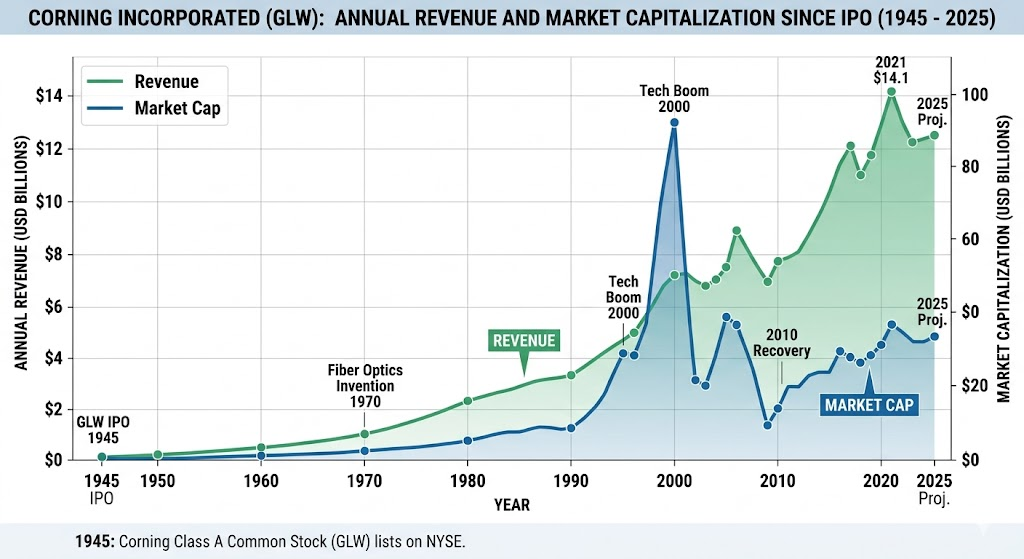
The history of Corning can be summarized in the following four key stages:
Early Accumulation and Glass Innovation (1851 to early 1900s): Founded in New York State, the company initially focused on industrial and household glass products. It later ventured into scientific glass, establishing the first industrial research laboratory in the United States in 1908, which marked the beginning of a development model centered on technological innovation.
Breakthroughs in Fundamental Materials Science (1910s to 1960s): During this period, Corning invented Pyrex heat-resistant glass, which was widely used in kitchenware and laboratory equipment, and developed glass for television picture tubes. These foundational achievements established the company’s global leadership in specialty glass and materials science.
Transition to Optical Communications and Display Technology (1970s to early 2000s): Corning developed the world’s first low-loss optical fiber, officially entering the era of optical communications and becoming a key supplier for modern internet infrastructure. Subsequently, the company seized opportunities in the booming global consumer electronics market through technological breakthroughs in liquid crystal display (LCD) glass substrates.
Diverse High-Tech Materials Platform (2010s to Present): Corning has committed to integrating materials science into the mobile device, automotive, and life sciences sectors. With the monopoly of Gorilla Glass in the smartphone market, combined with its strategic layout in advanced optics, environmental technology, and precision pharmaceutical packaging, the company has transformed into a critical materials platform supporting the digital economy and green industries.
Corning holds a dominant position in materials science, characterized by an oligopolistic market structure. The company’s deep technical moat is built on extensive patent portfolios and its proprietary “Fusion Draw” manufacturing process, which creates high barriers to entry.
Here is the competitive analysis by its primary business segments:
1. Optical Communications
This segment is a key growth engine, driven by the global expansion of AI data centers and cloud infrastructure.
- Major Competitors: Prysmian Group, CommScope, Sumitomo Electric, Furukawa Electric, and Fujikura.
- Competitive Landscape: Corning maintains pricing power in the high-end data center interconnect and low-loss fiber optic market due to its technical specifications. However, in the general telecom infrastructure space, Chinese manufacturers like Yangtze Optical Fibre and Cable (YOFC) exert downward price pressure on the mid-market segment.
2. Display Technologies and Specialty Materials
This segment includes LCD glass substrates and Gorilla Glass.
- Major Competitors: AGC Inc., Nippon Electric Glass (NEG), and SCHOTT AG.
- Competitive Landscape: The glass substrate market is a long-standing oligopoly where Corning leverages deep OEM partnerships—such as long-term joint development agreements with Apple—to solidify its position. While Gorilla Glass remains the industry standard for flagship smartphones, Corning faces intense competition from SCHOTT in the Ultra-Thin Glass (UTG) market for foldable devices.
3. Environmental Technologies and Automotive
- Major Competitors: NGK Insulators and Ibiden.
- Competitive Landscape: In the market for ceramic substrates used for automotive emission control, Corning and NGK are the primary rivals. As the industry transitions toward electric vehicles, the competition has shifted focus toward thermal management materials and optical components for automotive sensors.
4. Life Sciences
- Major Competitors: Thermo Fisher Scientific, Danaher (Cytiva), and Eppendorf.
- Competitive Landscape: This sector, encompassing laboratory consumables and pharmaceutical containers, is more fragmented. Corning differentiates itself through precision glass container technology, though it faces scale-based challenges from large, diversified medical device conglomerates.
Summary
Corning’s competitive advantage lies in its significant R&D investment—typically 8-10% of annual revenue—and deep supply chain integration. The company’s recent strategic pivot emphasizes AI infrastructure, notably its partnership with NVIDIA to expand optical connectivity manufacturing capacity, aiming to capitalize on the industry’s shift away from copper-based transmission bottlenecks.
Source:
- https://www.morningstar.com/news/business-wire/20260427020032/corning-announces-strong-first-quarter-2026-financial-results-1
- https://simplywall.st/stocks/us/tech/nyse-glw/corning/news/assessing-corning-glw-valuation-after-nvidia-ai-partnership-1
- https://businessmodelcanvastemplate.com/blogs/competitors/corning-competitive-landscape
Back to Corning page