
The history of CME Group can be defined by its evolution from a regional agricultural exchange into a global financial derivatives powerhouse. This journey can be categorized into four key stages:
Stage 1: Origins and Agricultural Trading (1848–1970)
This era established the foundation for modern futures markets. In 1848, the Chicago Board of Trade (CBOT) was founded to provide price stability and hedging for Midwest farmers. Subsequently, the Chicago Butter and Egg Board was established in 1898 (later renamed the Chicago Mercantile Exchange, or CME, in 1919), focusing on standardized contracts for perishable agricultural goods.
Stage 2: Innovation in Financial Derivatives (1972–1990)
This was a transformative period. In 1972, the CME launched the world’s first financial futures (currency futures), breaking the tradition of trading only physical commodities. By 1982, the CME and CBOT introduced the S&P 500 futures and U.S. Treasury bond futures, respectively. These innovations allowed market participants to manage interest rate and market volatility risks effectively, marking the exchange’s shift toward financial derivatives.
Stage 3: Electronic Transformation and Consolidation (2000–2008)
To keep pace with global digitization, the CME launched the CME Globex electronic trading platform in 2000, significantly increasing efficiency and cross-border liquidity. The group solidified its market leadership through major mergers: in 2007, the CME and its competitor CBOT merged to form the modern CME Group; in 2008, the group acquired the New York Mercantile Exchange (NYMEX), bringing energy and precious metals into its product suite.
Stage 4: Global Expansion and Modern Diversification (2009–Present)
This phase has focused on international network expansion and product innovation. CME Group has integrated various exchanges and clearinghouses while expanding its footprint across Europe and Asia. In recent years, the group has actively moved into cryptocurrency futures, ESG products, and data analytics services. It continues to transition its clearing and trading technology into a data-driven financial infrastructure designed to meet the demands of an increasingly complex global marketplace.
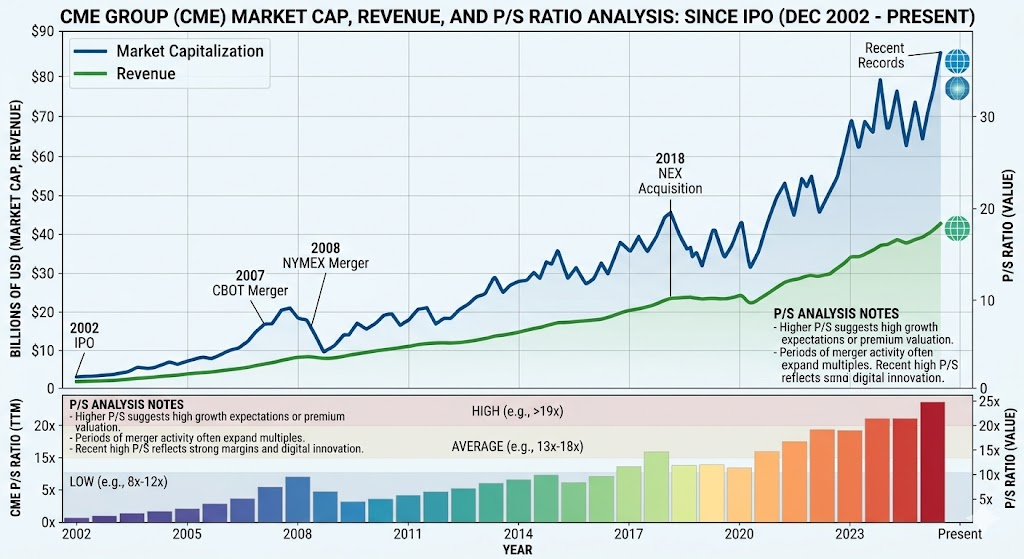
As of May 2026, CME Group maintains a dominant position in the global derivatives landscape, characterized by record-breaking activity and a strategy focused on technological integration and product precision.
Competitive Landscape 2026
CME Group faces a multi-faceted competitive environment consisting of traditional exchange rivals, emerging digital platforms, and specialized financial data providers.
- Traditional Exchange Rivals:
- Cboe Global Markets (CBOE): Remains a primary competitor in options and volatility products (VIX). Cboe continues to challenge CME in market innovation, particularly in retail-focused derivative suites.
- Intercontinental Exchange (ICE): A major rival in energy and fixed income. ICE’s deep integration of data services and clearing capabilities poses a direct threat to CME’s market share in energy and interest rate products.
- Nasdaq (NDAQ): A unique competitor-partner. While Nasdaq competes in equity index derivatives and technology services, it collaborates with CME on specific initiatives, such as the upcoming June 2026 launch of Nasdaq CME Crypto Index futures.
- Emerging Disruptors & Fintech:
- Crypto-native Platforms: Digital asset exchanges are evolving their infrastructure. CME is aggressively defending its turf by launching regulated, cash-settled futures that attract institutional capital, distinguishing itself from less regulated, volatile crypto-native venues.
- Financial Data Services: Companies like S&P Global and various fintech aggregators are increasingly providing high-frequency, real-time analytics. CME counters this by continuously setting record revenues in market data ($224M in Q1 2026) and enhancing its clearing-house value proposition.
Strategic Defensive & Growth Pillars
CME Group’s competitive strength is underpinned by three core “moats”:
- Capital Efficiency (The Margin Moat): In Q1 2026, CME provided over $85B in daily margin savings to clients via cross-margining across its diverse product suite. This capital efficiency is a significant deterrent for clients to switch to fragmented, single-asset competitors.
- “Risk-Always-On” Infrastructure: CME has successfully positioned itself as the “go-to” venue for navigating global volatility. By launching “precision tools”—such as Daily/Weekly options and Mid-curve dividend futures—CME allows traders to hedge specific macro events, cementing its utility for both institutional and active retail traders.
- Global Expansion: International participation hit record levels in early 2026, with non-U.S. ADV rising 30% year-over-year. Growth in APAC (33% jump) and EMEA (29% jump) demonstrates that CME is successfully scaling its benchmark products outside its domestic base.
Strategic Outlook for 2026
- Technological Innovation: CME is deepening its partnership with technology giants to optimize cloud-based trading workflows and data analytics.
- Product Diversification: The shift from traditional “buy-and-hold” to “active volatility management” is being met with a surge of short-dated products (weekly/daily expiries) across commodities and equity indexes.
- New Clearing Frontiers: The move to provide central clearing for U.S. Treasury and Repo transactions (expected later in 2026) is a major strategic push to capture more of the fixed-income ecosystem and reduce counterparty risk for institutional clients.
In summary, while CME faces pressure from specialized rivals and shifting market structures, its strategy of bundling “benchmark liquidity” with “capital-efficient clearing” allows it to command high operating margins (approximately 72.8% in Q1 2026) and maintain its lead as the primary global venue for risk management.
Source:
- https://www.sec.gov/Archives/edgar/data/1156375/000162828026020510/ars_2026.pdf
- https://www.cmegroup.com/media-room/press-releases/2026/4/08/cme_group_internationalaveragedailyvolumereachesrecord114million.html
- https://www.cmegroup.com/investor-relations/files/cme-group-investor-presentation.pdf
- https://www.cmegroup.com/media-room/press-releases/2026/4/22/cme_group_inc_reportsrecordrevenueadjustedoperatingincomeadjuste.html
- https://www.prnewswire.com/news-releases/cme-group-inc-reports-record-revenue-adjusted-operating-income-adjusted-net-income-and-adjusted-earnings-per-share-for-q1-2026-302749450.html
- https://marketchameleon.com/articles/b/2026/4/22/cme-group-delivers-record-q1-2026-results-volumes-revenue-highs
- https://fxnewsgroup.com/forex-news/exchanges/cme-group-books-record-q1-2026-revenue-of-1-9bn
- https://research.titanfx.com/glossary/what-is-cme-group
- https://en.wikipedia.org/wiki/CME_Group
- https://matrixbcg.com/blogs/brief-history/cmegroup
Back to CME page