
The development history of China CITIC Bank can be primarily divided into the following four key stages:
Founding and Early Stage (1987–2000)
Formerly known as CITIC Industrial Bank, the bank was founded in 1987 by Mr. Rong Yiren, making it one of the earliest comprehensive joint-stock commercial banks established after China’s reform and opening-up. Leveraging the strong background of CITIC Group during this period, the bank actively participated in China’s economic structural reforms, gradually establishing its market position in corporate banking and foreign exchange business.
Institutional Reform and Strategic Investment Stage (2001–2006)
Entering the 21st century, the bank initiated modern commercial banking institutional reforms to adapt to the financial market transformation following China’s accession to the WTO. In 2005, it was officially renamed “China CITIC Bank.” In 2006, it successfully introduced Banco Bilbao Vizcaya Argentaria (BBVA) of Spain as a strategic investor, significantly enhancing its internal risk control and international corporate governance.
Dual Listing and Rapid Expansion Stage (2007–2016)
In April 2007, China CITIC Bank successfully completed its simultaneous A+H share dual listing on both the Shanghai Stock Exchange and the Hong Kong Stock Exchange. Following the listing, the bank entered a golden era of rapid growth in asset size and network footprint, while establishing overseas branches in global financial centers such as London, New York, and Sydney, gradually transforming into a major commercial bank with international influence.
Strategic Transformation and Digital Development Stage (2017–Present)
In recent years, China CITIC Bank has pursued a strategic transformation centered on three core capabilities: wealth management, asset management, and comprehensive financing. The bank has invested heavily in financial technology, advancing its digital transformation and retail banking layout. Furthermore, it co-founded AiBank with Baidu, pioneering a brand-new operating model of “AI+Finance” and continuously maintaining its competitive edge in the industry.
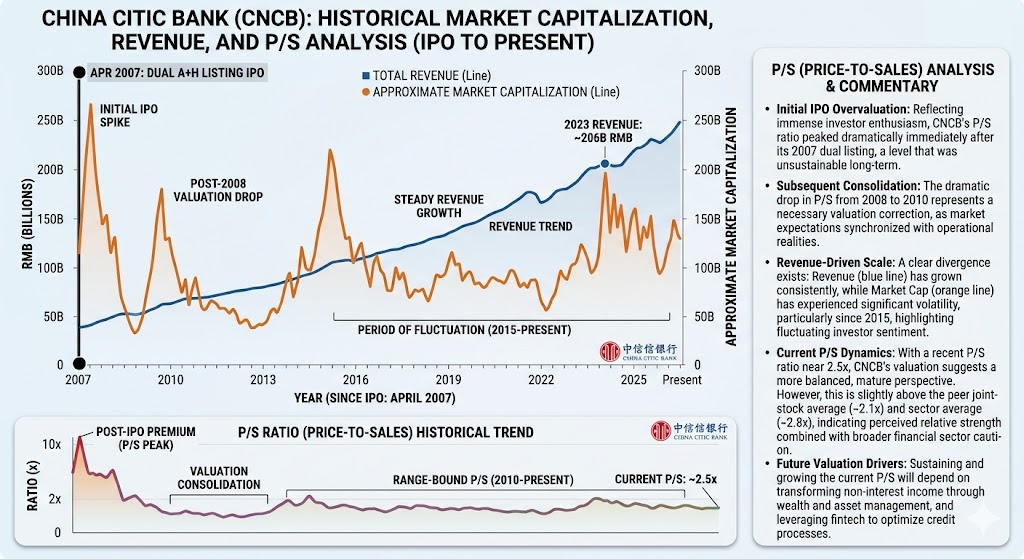
China CITIC Bank, as a leading national joint-stock commercial bank in China, operates within a multi-tiered and highly competitive market landscape. The following is an analysis covering its primary competitors, core competitive advantages, challenges, and future strategic focus:
Primary Competitors
The bank’s competitors can be categorized into three major fronts:
Peer Joint-Stock Commercial Banks (Direct Competition)
China Merchants Bank (CMB): The absolute leader in retail banking and wealth management with a massive retail AUM. It poses the greatest pressure in the wealth management track where China CITIC Bank is actively expanding.
Industrial Bank (CIB): Highly competitive in green finance and interbank services, competing directly with CITIC in institutional liquidity management and structured financing.
Ping An Bank: Leveraging the Ping An Group’s insurance, technology, and comprehensive financial ecosystem, it demonstrates aggressive capabilities in digital retail and cross-selling.
The “Big Four” State-Owned Banks (Scale and Cost Dominance)
State-owned giants such as Industrial and Commercial Bank of China (ICBC) and China Construction Bank (CCB) possess lower funding costs and massive branch networks. They hold overwhelming pricing power in large-scale infrastructure projects and massive syndicated loans for central and state-owned enterprises.
Internet Finance and Emerging Tech Platforms
Digital competitors like Ant Group and Tencent’s WeBank continuously encroach on the retail margins of traditional banks in daily payments, consumer micro-loans, and online wealth management.
Core Competitive Advantages of China CITIC Bank
Synergy and the CITIC Group Background
This represents the bank’s strongest moat. As the flagship financial subsidiary of CITIC Group, the bank achieves deep integration with the group’s financial and industrial sectors, including CITIC Securities (China’s leading investment bank), CITIC Trust, CITIC Pacific Special Steel, and CITIC Dicastal. This “Finance + Industry” synergy provides the bank with over a quarter of its corporate client base, granting a unique advantage in supply chain finance and mid-to-high-end wealth management.
Comprehensive Cross-Border and Integrated Financial Strength
Relying on China CITIC Bank International (CNCBI) in Hong Kong and its overseas branches in global financial hubs, the bank maintains a competitive edge in cross-border trade finance, foreign exchange businesses, and offshore wealth management.
Leading Technological Innovation and Layout
The bank consistently allocates over 4% of its operating revenue to technology investment. AiBank, a pure digital bank co-founded with Baidu, has provided CITIC with advanced practical experience in the “AI + Finance” sector.
Competitive Challenges
Net Interest Margin (NIM) Compression: Under a low-interest-rate environment and shifting credit market structures, maintaining profitability remains a common industry challenge.
Downmarket Expansion of Big Banks and Local Consolidation: State-owned mega-banks continue to expand into lower-tier markets (such as tier-3 cities and inclusive finance), while regional banks undergo consolidation under policy guidance. Both factors squeeze China CITIC Bank’s space in the mid-market segment.
Future Strategic Focus
Over the next few years, China CITIC Bank’s strategic core will center on transforming its three major capabilities: wealth management, asset management, and comprehensive financing. The bank aims to counter competition from both traditional peers and tech platforms by increasing the share of non-interest income (such as fee-based and commission income) and accelerating the application of AI and blockchain technologies in automated credit approvals for small and medium-sized enterprises (SMEs).
Source:
- https://www.citicbank.com/
- http://www.citic.com/
- http://www.hkexnews.hk/
- http://www.sse.com.cn/
- https://www.aibank.com/
- https://www.cncbinternational.com/
Back to CITIC Bank page