
CICC (China International Capital Corporation) occupies a unique and leading position in China’s securities industry and capital markets, belonging to the top-tier of Chinese investment banks (often referred to as one of the core members of the “Zhong San Zhong Yi Hua” elite group). Its market position and core strengths are primarily reflected in the following aspects:
- Leader in Cross-Border Investment Banking and Overseas Business: As China’s first joint-venture investment bank, CICC has long remained at the forefront of offshore bond underwriting, Hong Kong IPO sponsorship and underwriting, and cross-border M&A financial advisory. In the strategic context of Chinese enterprises “going global,” its cross-border capital operation and international project execution capabilities rank first among Chinese brokerages.
- High-End Clients and M&A Advisory Strengths: In large-scale state-owned enterprise restructuring, cross-border M&A, and complex capital operations, CICC enjoys exceptional brand recognition and market share. The scale and number of its M&A financial advisory transactions have consistently led the domestic and global Chinese-funded markets for years.
- Boutique Positioning and Institutional Transformation: Compared to traditional brokerages known for mass retail brokerage, CICC’s clientele leans heavily toward institutional investors, multinational corporations, and high-net-worth individuals. Through “CICC Wealth Management,” it has deepened its retail and wealth management footprint, building a robust competitive moat in capital intermediaries and institutional equity business.
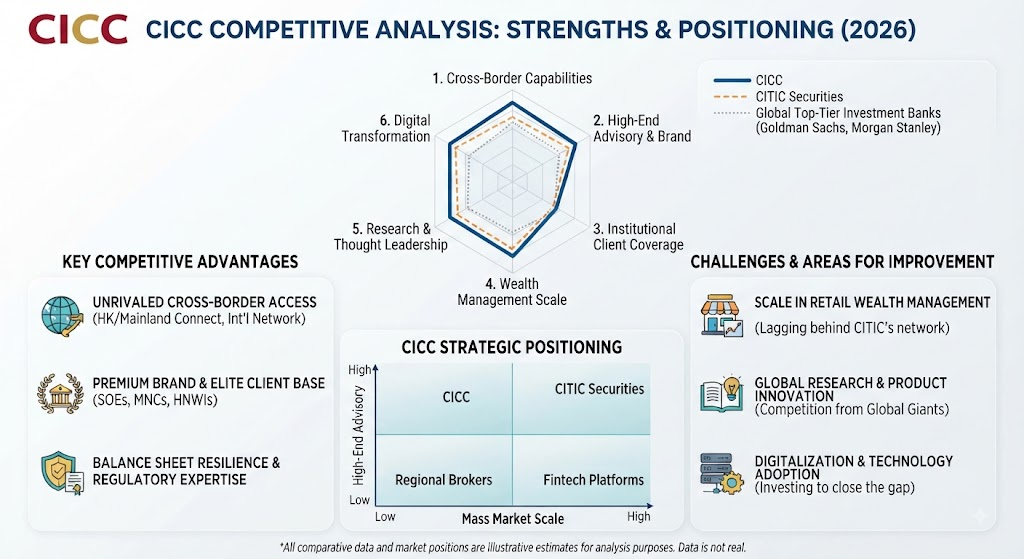
The competitive advantages and challenges of CICC (China International Capital Corporation) in the current market environment can be analyzed through the following dimensions:
Core Competitive Advantages
- International Operational Capability: Compared to domestic competitors like CITIC Securities, CICC has the deepest footprint in the Hong Kong capital market and possesses direct offshore investment capabilities. This provides a significant competitive moat in cross-border investment banking (such as overseas listings and cross-border M&A), making it relatively less susceptible to marginal fluctuations in domestic and international regulatory policies.
- High-End Client Coverage: As China’s first joint-venture investment bank, CICC maintains high brand recognition among large state-owned enterprises and multinational institutional investors. It has long dominated complex capital market projects and possesses strong pricing power for high-end advisory services.
- Balance Sheet Resilience: Recent market analysis indicates that when faced with tighter regulations on cross-border business (such as Total Return Swap/TRS), CICC has demonstrated superior defensive capabilities and earnings resilience compared to other brokerages that rely more heavily on cross-border liquidity, as its business model does not depend on lopsided risk exposure.
Major Competitors
- CITIC Securities: As China’s largest brokerage by assets, CITIC holds absolute dominance in domestic brokerage, fixed income, and retail wealth management. Its core strength lies in its extensive domestic branch network and business breadth, though it differs from CICC in terms of cross-border operational agility and the “elite” brand effect in high-end advisory services.
- Foreign Financial Institutions (e.g., Goldman Sachs, Morgan Stanley): Foreign investment banks remain leaders in international capital allocation, global research resources, and product innovation. CICC often competes with these global giants in these areas, leveraging its deep pool of international talent and cross-border project experience to benchmark against them.
Challenges in the 2026 Market Environment
- Cross-border Regulatory and Policy Shifts: While CICC possesses international advantages, the capital market regulatory environment—including policy orientations stemming from discrepancies in AI and technology investments between the U.S. and China—requires the firm to maintain a precise balance between adhering to national strategies and international standards.
- Digital Transformation and Technological Investment: As AI technology penetrates the financial industry, the “technology gap” in the investment banking market is becoming increasingly apparent. CICC must continuously increase its investment in data processing, AI trading algorithms, and financial technology infrastructure to compete with global financial giants that are further along in their digital transformation.
- Deepening Wealth Management Transformation: Following the completion of its “A+H” listing and business integration, the key to CICC’s future profit growth lies in how it extends its high-end investment banking capabilities to broader wealth management and maintains differentiated value while competing for retail market share against rivals like CITIC Securities.
In summary, CICC’s current strategic positioning focuses on “international depth” and “high-end advisory capabilities.” Its core competitiveness lies in its ability to navigate complex cross-border transactions, yet it must continuously consolidate its moat in technological investment and service models to compete effectively in the face of large-scale retail competition and technological iteration.
Source:
Back to CICC