
The development history of China Merchants Bank (3968.HK) can be divided into the following four key stages:
I. Establishment and Inception (1987-1994)
Established in Shekou, Shenzhen in 1987, China Merchants Bank was initiated by the China Merchants Group. It became the first joint-stock commercial bank in China to be owned by corporate legal entities. During this stage, the bank primarily served the Shekou Industrial Zone, establishing its foundational culture of market-oriented operations.
II. Retail Transformation and Modernization (1995-2005)
In 1995, China Merchants Bank launched the All-in-One Card (一卡通), which pioneered the digitalization and retail-oriented development of personal banking in China, establishing its core competitive advantage in retail business. In 2002, the company successfully listed on the Shanghai Stock Exchange, accelerating its capital expansion and branch network layout.
III. Capital Internationalization and Strategic Upgrading (2006-2015)
In 2006, China Merchants Bank was listed on the Hong Kong Stock Exchange, raising over 1.6B USD. Subsequently, the bank deepened its private banking and wealth management businesses and acquired Wing Lung Bank (now CMB Wing Lung Bank), completing its cross-border financial service footprint and securing its leadership in the high-end wealth management market.
IV. Digital Transformation and Refined Management (2016-Present)
In recent years, China Merchants Bank has comprehensively promoted digital transformation and introduced a light banking strategy. Through its two primary applications, China Merchants Bank and CMB Life, the bank has achieved full digitization of its business. At the same time, it has continuously optimized its asset-liability structure to adapt to changing financial environments, maintaining its leading competitiveness in the Chinese financial market.
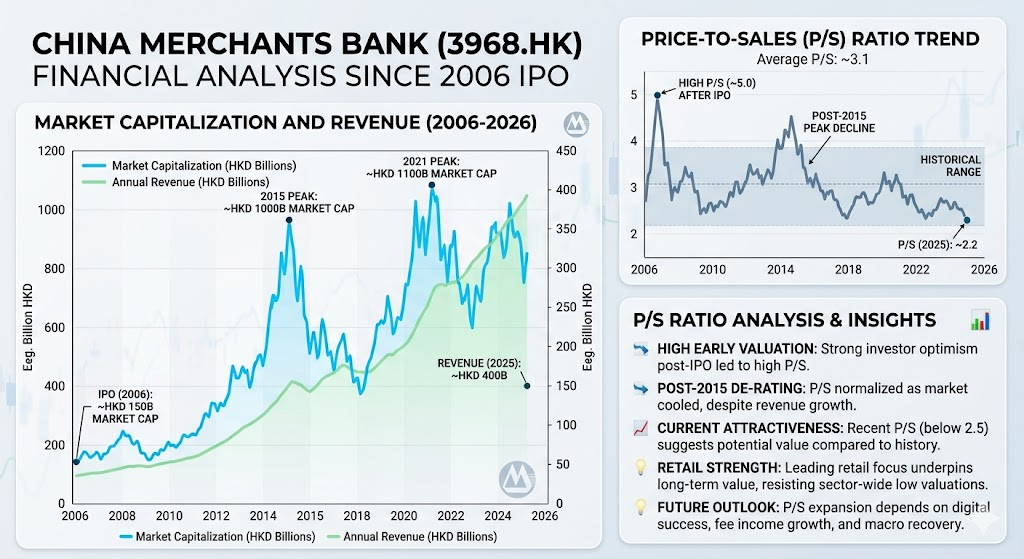
China Merchants Bank (3968.HK) is renowned as the King of Retail in the Chinese banking sector. Its competitive advantages and challenges can be analyzed across the following dimensions:
Core Competitiveness
- Retail Banking Leadership: The bank has long cultivated wealth management and retail credit, possessing a high-loyalty premium customer base and robust personal finance operations. It consistently ranks among the top in China for product quality, service experience, and Net Promoter Score (NPS).
- Digital Operational Capability: By building an ecosystem through its two major apps, China Merchants Bank and CMB Life, the bank holds a leading edge in digital transformation and online operations. Its deployment of large language models has also significantly enhanced internal operational and customer service efficiency.
- Asset Quality and Provisioning: Despite recent pressures on retail credit, the bank maintains market-leading asset quality due to its disciplined risk management culture. Its relatively high provision coverage ratio provides a strong buffer against risks.
Major Competitors
- The Big Six State-Owned Banks (ICBC, ABC, BOC, CCB, BoCom, PSBC): Compared to China Merchants Bank, these large state-owned banks benefit from larger asset scales, extensive nationwide branch networks, and government-backed business advantages. During periods of weak macroeconomic recovery, they have demonstrated extreme resilience by expanding credit allocation to offset narrowing interest margins.
- Joint-Stock Commercial Banks (e.g., Ping An Bank, Industrial Bank, CITIC Bank): These banks operate within the same system as China Merchants Bank, competing directly in the retail finance and high-end wealth management markets. They frequently contend with the bank regarding customer acquisition channels, interest rate pricing, and differentiated product development.
2026 Market Environment and Challenges
- Net Interest Margin (NIM) Pressure: Affected by the downward trend in the overall interest rate environment, the bank faces the challenge of narrowing NIM. Although marginal improvement was observed in Q4, maintaining a leading margin amidst declining asset yields and sticky liability costs remains a core task for management.
- Retail Asset Concerns: With rising non-performing loan ratios in retail credit, market expectations have shifted from high growth to cautious stability. The investment thesis is currently transitioning from a growth stock perspective to a value stock logic, with investors increasingly prioritizing cash flow returns and asset quality stability.
- Structural Transformation: Competition in the banking industry is shifting from pure scale expansion to maintaining profitability within a low-interest-rate cycle. The bank is actively adjusting its business strategy, transitioning from a reliance on the three major core cities to developing three major core regions to build a more balanced growth model.
Source:
- https://zh.wikipedia.org/zh-tw/%E6%8B%9B%E5%95%86%E9%93%B6%E8%A1%8C
- https://www.hkex.com.hk/Market-Data/Securities-Prices/Equities/Equities-Quote?sym=3968&sc_lang=zh-HK
- https://en.wikipedia.org/wiki/China_Merchants_Bank
- https://www.hkex.com.hk/Market-Data/Securities-Prices/Equities/Equities-Quote?sym=3968&sc_lang=en
- https://equitiesresearch.uobkayhian.com/Research/EquitiesItem?id=8d89c784-2dc0-4972-af0c-33a2925b9f02
- https://finance.biggo.com.tw/news/iKL6PZ0B-x-dxYpbiRLC
- https://www.moomoo.com/hant/news/post/69321178
- https://www.comparably.com/companies/china-merchants-bank/competitors
Back to China Merchants Bank page