
Market Position and Market Share
Carrefour is one of the world’s largest food and grocery retailers, operating an international network of hypermarkets, supermarkets, convenience stores, and cash-and-carry wholesale formats across Europe, Latin America, and franchise territories in the Middle East and Africa.
- Domestic Market (France): Carrefour holds the #2 position in the French mass retail market. Following the consolidation of Cora and Match stores as well as integrated former Casino assets, Carrefour’s market share in France reached 20.6% to 21.8% according to Kantar Worldpanel and NielsenIQ benchmarks, trailing only cooperative market leader E.Leclerc (23.5% to 24.2%) and remaining ahead of Groupement Les Mousquetaires/Intermarché (approximately 17.0% to 18.1%).
- Latin American Market (Brazil and Argentina):In Brazil, operating through Grupo Carrefour Brasil (including the Atacadão banner), Carrefour is the #1 food retailer and the largest private employer in the country. In the Brazilian cash-and-carry wholesale segment, Atacadão controls approximately 30% market share according to Nielsen data. In Argentina, Carrefour maintains a leading top-tier market share in modern food retail.
- European Presence (Excluding France): Carrefour holds the #2 market position in grocery retail in Spain (behind Mercadona) and operates sizable store footprints in Belgium, Poland, and Romania.
- Global Scale: On a consolidated basis, Carrefour generates between €84 billion and €85 billion in net annual sales (annual gross sales including VAT exceed €94 billion).
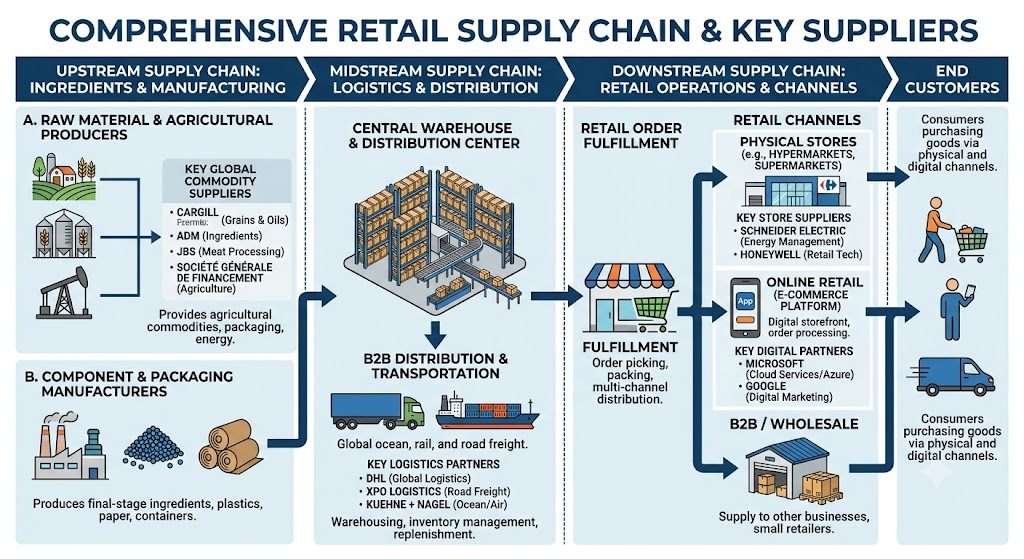
Upstream and Downstream Supply Chain Analysis and Key Suppliers
1. Upstream Supply Chain and Sourcing Mechanics
Carrefour’s upstream supply chain is segmented into global fast-moving consumer goods (FMCG), regional agricultural supply, and private-label manufacturing:
- Procurement Alliances and Purchasing Centralization: Carrefour executes large-scale upstream procurement through international purchasing hubs such as Eureka (formerly working across European purchasing alliances like Eureca and Envergure). These centralized entities negotiate volume terms, listing fees, and promotional budgets directly with tier-1 multinational suppliers.
- Key Multinational Suppliers: Key suppliers include consumer packaged goods (CPG) giants such as Nestlé, Unilever, Procter & Gamble, Mondelēz International, Danone, PepsiCo, The Coca-Cola Company, and L’Oréal. Price negotiations with these conglomerates dictate Carrefour’s cost of goods sold (COGS); contract deadlocks occasionally lead to temporary product de-listings during inflationary dispute cycles.
- Private-Label and Contract Manufacturers (Carrefour Quality Lines / Filière Qualité Carrefour): Private-label goods represent nearly 37% to 40% of Carrefour’s food sales. Upstream manufacturing is contracted to specialized co-packers, regional dairies, bakeries, and canners, as well as agro-industrial cooperatives. The company maintains direct long-term contracts with over 30,000 local farmers and agricultural producers under the “Filière Qualité Carrefour” framework to secure traceability, non-GMO feeding standards, and organic produce volumes.
2. Midstream Logistics and Inbound Distribution
- Warehousing Infrastructure: The company utilizes a tiered hub-and-spoke distribution network combining national distribution centers (NDCs) for slow-moving non-food and ambient items, and regional distribution centers (RDCs) located within 150 km to 200 km of store clusters for temperature-controlled fresh and ultra-fresh items.
- Logistics Automation: Core logistics operations are managed in partnership with major third-party logistics providers (3PLs) like Norbert Dentressangle/XPO Logistics, FM Logistic, and ID Logistics, integrating automated palletizing, high-bay automated storage and retrieval systems (ASRS), and dynamic warehouse management systems (WMS).
3. Downstream Supply Chain, Multi-Format Networks, and Distribution Channels
- Multi-Format Brick-and-Mortar Outlets: Downstream distribution encompasses over 14,000 stores across four primary operating models:
- Hypermarkets (Carrefour): Broad inventory (food and general merchandise/electronics) acting as anchor destinations.
- Supermarkets (Carrefour Market): High-frequency urban/suburban grocery.
- Convenience / Proximity (Carrefour Express, Carrefour Contact, Carrefour City): High-margin, small-footprint city stores operated largely under franchise contracts to reduce corporate asset intensity.
- Cash and Carry (Atacadão, Supeco): High-volume, pallet-based self-service formats serving both B2B professional buyers (restaurants, corner shops) and price-sensitive B2C households.
- Omnichannel and Last-Mile Fulfillment: Downstream digital distribution relies on three core delivery pipelines:
- Drive / Click-and-Collect: Store-picked drive stations, which capture a significant portion of digital grocery orders in suburban France.
- Centralized Customer Fulfillment Centers (CFCs): Automated urban fulfillment hubs handling dense home-delivery orders.
- Quick-Commerce / On-Demand: Last-mile courier integrations (partnered with platforms such as Uber Eats and Deliveroo) offering 30-minute delivery from local convenience nodes.
Competitor Analysis: Technical and Financial Comparison
1. Primary Competitors
- Cooperative and Independent Retailers:E.Leclerc (France market leader), Groupement Les Mousquetaires / Intermarché, and Système U.
- Regional Hard Discounters: Lidl (Schwarz Group) and Aldi.
- International Multi-Format Retailers: Mercadona (Spain), Tesco (UK/Europe), and Assaí Atacadista (Brazil).
2. Financial Metrics Comparison
- Revenue and Top-Line Scale: Carrefour operates with annual consolidated net revenues of roughly €84 billion to €85 billion. In France, Carrefour generates around €40 billion to €42 billion in net sales, competing closely with E.Leclerc’s retail sales of over €48 billion (including fuel).In Brazil, Grupo Carrefour Brasil generates over R$110 billion in annual gross billing, outpacing dedicated cash-and-carry competitors like Assaí Atacadista.
- Profitability and Operating Margins:
- Carrefour: Operates with recurring operating margins historically between 1.8% and 2.1% (with France recurring operating margins typically in the 1.6% to 1.9% range). Profitability reflects the operational drag of large non-food hypermarket footprints and competitive price cuts.
- E.Leclerc / Intermarché: Structured as independent cooperative groups with zero central dividend-distribution mandates to public shareholders. Their lower overhead allows them to function sustainably on razor-thin operating margins (often 1.0% to 1.5%), aggressively undercutting Carrefour on shelf pricing.
- Mercadona: Operates a lean corporate model with operating margins routinely reaching 3.0% to 3.5%, supported by an efficient, highly standardized private-label inventory.
- Tesco: Enjoys higher domestic operating retail margins (typically between 3.8% and 4.2%), benefiting from greater retail consolidation and scale in the United Kingdom.
- Capital Structure and Free Cash Flow Generation: Carrefour maintains an annual capital expenditure (CapEx) budget of approximately €1.7 billion to €1.9 billion, balancing investments across store modernizations, Cora/Match integration, and digital infrastructure. Annual net free cash flow before extraordinary items ranges from €1.2 billion to €1.4 billion. However, Carrefour carries net financial debt (typically between €4.5 billion and €5.4 billion excluding IFRS 16 lease liabilities), contrasting sharply with unlisted cooperative competitors who finance their independent stores via regional debt facilities.
3. Technological and Operational Comparison
- Supply Chain and Assortment Efficiency:
- Discounters (Lidl, Aldi) maintain strict SKU counts (typically 1,800 to 2,500 active SKUs), resulting in inventory turnover rates that are roughly 30% to 40% faster than Carrefour’s hypermarket environments (which exceed 30,000 to 50,000 SKUs).
- E.Leclerc leads France in “Drive” fulfillment efficiency through dedicated, semi-automated standalone warehouse docks, capturing roughly 45% of the national grocery drive-through segment. Carrefour relies predominantly on in-store picking for drive orders, which incurs higher variable labor costs per basket.
- Digital Infrastructure, Cloud, and Data Monetization:
- Cloud and Core Systems: Carrefour has executed a comprehensive infrastructure migration to public cloud providers (primarily Google Cloud), leveraging cloud-based demand forecasting, replenishment algorithms, and assortment localization.
- Retail Media and Monetization: Carrefour co-founded “Unlimitail”, an international retail media joint venture with Publicis Groupe. This platform monetizes first-party transactional customer data by serving programmatic advertising to CPG brand partners both on-site and in-store, creating a high-margin digital revenue stream.
- Artificial Intelligence and Traceability Implementation:
- Blockchain Traceability: Carrefour was an early retail adopter of the IBM Food Trust blockchain, offering QR-code-enabled product origin verification across its Filière Qualité Carrefour lines.
- Generative AI and Dynamic Pricing: Carrefour deploys computer vision in selected pilot stores (e.g., Carrefour Flash 10/10 checkout-free concepts) and utilizes automated shelf-monitoring cameras to identify out-of-stock items in real time. Competitors like Amazon and specialized regional grocers have explored similar checkout automation, but Carrefour focuses primarily on operational computer vision for inventory management rather than fully autonomous store cashier replacements due to capital expenditure constraints.
Sources
- https://www.carrefour.com/sites/default/files/2024-08/Carrefour%20-%20First%20Supplement%20to%20the%202024%20EMTN%20Programme%20Base%20Prospectus%20-%20with%20approval%20number%2810294408755.1%29.PDF
- https://www.kantar.com/inspiration/fmcg/grocery-spend-stands-still-in-france-as-shoppers-hunt-for-value
- https://www.retaildetail.eu/news/food/in-france-intermarche-carrefour-and-u-are-the-winners-of-2025/
- https://ri.grupocarrefourbrasil.com.br/en/our-businesses/cash-carry/
- https://en.wikipedia.org/wiki/Carrefour_Brazil
- https://companiesmarketcap.com/cad/carrefour/revenue/
Back to Carrefour