
Capital One (COF) released its latest quarterly financial results in late April 2026. Here is a summary of the key highlights:
Financial Highlights
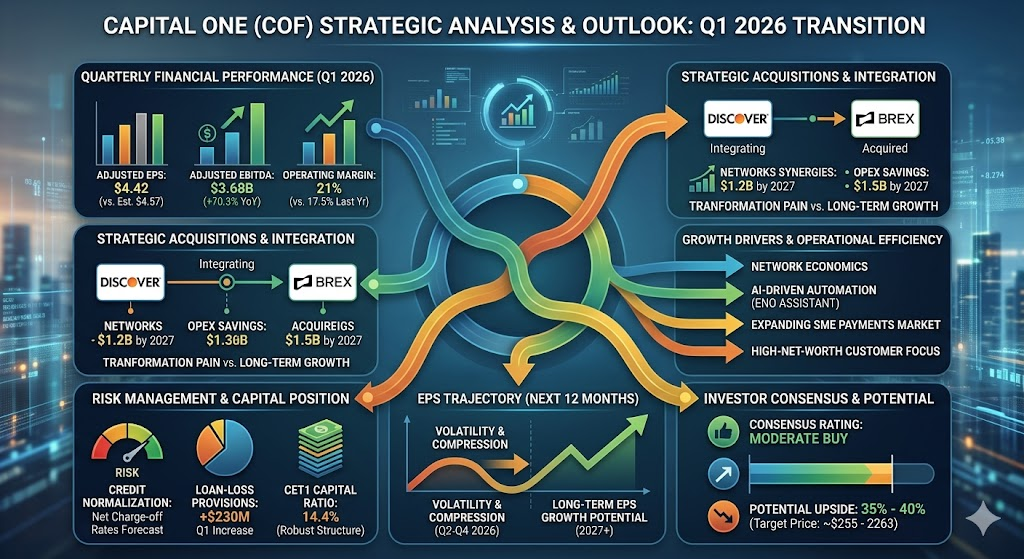
- Adjusted EPS: 4.42 USD, missing analyst expectations of 4.57 USD (a difference of approximately 3.3%).
- Adjusted EBITDA: 3.68B USD, representing a margin of 24.2% and a year-over-year increase of 70.3%.
- Operating Margin: 21%, improving from 17.5% in the same period last year.
Market Outlook
While the company showed improvements in certain operational efficiency metrics, the results were met with a lukewarm market response. This was largely due to both revenue and adjusted EPS figures falling short of consensus estimates, alongside investor concerns regarding the integration progress with Discover.
In the first quarter of 2026, Capital One (COF) implemented several strategic pivots centered on acquisition integration and structural recalibration:
1. Strategic Mergers and Integration
- Discover Integration Progress: Management confirmed that the Discover integration is proceeding according to plan, underscoring its long-term potential for business transformation. However, the current quarter was significantly impacted by amortization and integration costs related to the deal, which are reflected in the adjusted EPS figures.
- Brex Acquisition: The company confirmed the completion of its acquisition of the commercial payment platform Brex, aiming to expand its market share in the small-to-medium enterprise (SME) payments space.
2. Business Structure and Scale Adjustments
- Credit Portfolio Shifts: Credit card loan balances declined by 3% (approximately 9B USD), reflecting a more conservative credit deployment strategy in that sector. Conversely, consumer finance (specifically auto loans) and commercial banking loan balances grew by 2% and 1%, respectively.
- Cost Control: The company significantly curtailed expenses, with total non-interest expenses decreasing by 9% quarter-over-quarter. Within this, marketing expenses were cut by 23%, and operating expenses were reduced by 6%.
3. Risk Management and Capital Position
- Provisioning: Due to growth in auto and commercial loans and a downward revision in vehicle value outlooks, the company increased its provision for credit losses by 230M USD, bringing the overall coverage ratio to 5.28%.
- Capital Resilience: Despite the pressure from integration costs, the company maintained a robust capital structure, ending the first quarter with a Common Equity Tier 1 (CET1) capital ratio of 14.4%.
These strategic moves indicate that while Capital One is focused on executing major acquisitions, it is concurrently utilizing strict cost controls and heightened risk provisioning to navigate macroeconomic headwinds and the normalization of the credit environment.
Capital One’s growth trajectory for the upcoming quarter is primarily anchored in the synergy realization from its recent major acquisitions and its shift toward a tech-driven “unbank” model.
1. Discover Payment Network Synergy
This is the most critical driver for the near term:
- Network Economics: Capital One is actively migrating its credit and debit card portfolios to the Discover network. By processing transactions internally rather than relying on third-party networks like Visa or Mastercard, the company expects to reduce interchange expenses and improve net interest margins (NIM) over time.
- Migration Milestone: Approximately 8% of new originations are already on Capital One’s technology platform, with full migration for new accounts targeted by the end of Q3 2026. Phased conversion of the “back book” (existing accounts) will also begin in late 2026, though volume growth benefits from this will be realized on a lag.
2. Commercial Payments Expansion via Brex
The acquisition of Brex, completed in early April 2026, positions the company to aggressively capture market share in the small-to-medium enterprise (SME) sector:
- Vertical Integration: By combining Brex’s AI-native expense management software with Capital One’s underwriting scale and brand, the company aims to embed banking services directly into the operational workflows of growing businesses.
- Enablement Strategy: Rather than an immediate full integration, management is focused on an “enablement strategy” to drive growth, leveraging Brex’s fintech expertise to attract high-growth commercial clients.
3. Operational Efficiency and Tech Leverage
The company is moving into a period where its long-term investments in cloud and AI infrastructure are expected to provide meaningful operating leverage:
- Cost Structure: Despite the current impact of integration and amortization costs, Capital One is aggressively cutting non-interest expenses (which fell 9% sequentially in Q1).
- AI-Driven Automation: Technologies like the “Eno” assistant and AI agents for workflow automation are reducing manual review requirements, which should help compress the efficiency ratio as transaction volumes grow.
4. Risk and Headwinds
Investors are closely watching the “credit normalization” cycle:
- Provisioning: Capital One increased its provision for credit losses by 230M USD in Q1, primarily due to credit quality trends in the Auto and Commercial segments.
- Market Sentiment: The stock has faced pressure due to fears that elevated charge-offs—combined with the dilution and costs from the Discover and Brex deals—might dampen short-term earnings. The market is waiting for management to demonstrate that the combined platform can generate sustained, higher-quality returns on equity (ROE) as the integration progresses.
Summary for Investors:
The growth narrative is shifting from “organic credit expansion” to “platform transformation.” Success in the coming quarters will be measured by the pace of Discover’s network migration and the stabilization of credit charge-off rates, which are currently elevated but within manageable ranges.
The EPS outlook for Capital One (COF) over the next year is currently defined by a transition phase, with market sentiment characterized by caution following the recent Q1 earnings miss.
1. Short-Term EPS Trajectory (Next 3-4 Quarters)
Earnings in the immediate future are expected to remain volatile as the company absorbs the costs of integrating Discover Financial Services and scaling the Brex acquisition.
- Integration Pressure: Elevated amortization and restructuring expenses will continue to weigh on non-GAAP EPS.
- Consensus Caution: Following the Q1 2026 miss (EPS of $4.42 vs. the ~$5.08 consensus), several major financial institutions (including Morgan Stanley, Goldman Sachs, and UBS) have trimmed their price targets. Market sentiment is tempered by concerns over “credit normalization,” specifically rising net charge-off rates and increased provisioning for credit losses, which surged 72% year-over-year in the most recent quarter.
2. Longer-Term Outlook (2027 and Beyond)
The narrative for the next 12-24 months is centered on the realization of synergies.
- Synergy Targets: Capital One has projected significant run-rate synergies by 2027, including $1.5B in operating expense synergies and $1.2B in network synergies.
- Accretion Potential: Management expects the Discover transaction to be over 15% accretive to adjusted EPS by 2027.
- Growth Estimates: Despite current headwinds, long-term projections remain constructive. Analysts forecast high annual growth rates in earnings for the coming years as the platform transformation begins to generate operating leverage and reduced interchange costs.
3. Key Variables to Watch
- Credit Quality: The primary downside risk for EPS over the next year is a faster-than-expected deterioration in credit performance, particularly in the auto and credit card portfolios. Analysts have been adjusting their net charge-off forecasts higher (approaching 330 bps), which could necessitate further additions to loan-loss provisions.
- Network Migration: The pace of migrating Capital One’s massive purchase volume onto the Discover network is the key metric for 2027 EPS expansion. Successful execution here would fundamentally change the company’s cost-to-serve profile.
- Capital Allocation: The company’s CET1 ratio remains robust at 14.4%. Once integration costs stabilize, potential share buybacks and continued dividend growth are expected to support EPS accretion.
Current Market Standing
- Price: Approximately 187.79 USD (as of May 22, 2026).
- Relative Performance: The stock has faced significant pressure in 2026, declining by over 20% year-to-date and underperforming the broader market (S&P 500).
- Analyst Consensus: Despite the recent volatility, analyst sentiment remains cautiously optimistic. The average 12-month price target is approximately 255 USD – 263 USD, suggesting a potential upside of roughly 35% – 40% from current levels.
The Bull Case (Upside Potential)
- Synergy Realization: The integration of Discover and Brex is the primary long-term catalyst. Management projects 1.2B USD in network synergies and 1.5B USD in operating expense savings by 2027. Successfully executing this transition would significantly lower the company’s cost-to-serve and improve net interest margins.
- Platform Transformation: By moving to a vertically integrated payments model, Capital One is positioning itself to capture a larger share of the “interchange” value chain, traditionally dominated by networks like Visa or Mastercard.
- Undervaluation: Many valuation models, including Discounted Cash Flow (DCF) analyses, suggest the stock is trading significantly below its “intrinsic” or future cash flow value (estimates often range near 300+ USD), implying that the market has overly discounted the risks.
The Bear Case (Downside Risk)
- Credit Normalization: The most immediate threat is the rise in net charge-off rates. If credit quality among consumers and small businesses deteriorates faster than anticipated, the company will be forced to increase loan-loss provisions, which directly suppresses earnings per share (EPS).
- Integration Noise: The current “cloudy” expense trajectory—noted by firms like Deutsche Bank—continues to weigh on sentiment. Until the company can demonstrate a clear path to margin expansion, the stock may struggle to break out of its current range.
- Macroeconomic Sensitivity: As a consumer finance giant, COF is highly sensitive to the broader economic cycle. A slowdown in consumer spending or an increase in the unemployment rate could lead to further downward revisions in analyst price targets.
Expert Summary
Capital One is currently in a high-conviction transition phase.
- Short-Term Outlook: Expect continued volatility. The stock is likely to remain range-bound until the company provides further clarity on the Discover integration and shows stabilization in credit charge-off metrics.
- Investment View: The stock is increasingly viewed as a long-term “value” play rather than a growth-momentum stock. Its potential upside is substantial (35%+) if the integration succeeds, but investors must tolerate the “noise” of integration costs and the cyclical risk of the credit environment.
Strategic Monitoring Points:
- Charge-off Rates: Watch for stabilization; rising rates are the primary signal for further downside.
- Operating Efficiency Ratio: A downward trend here will confirm that the Discover network synergies are beginning to materialize.
- CET1 Capital Ratio: Maintaining the current robust 14.4% level is crucial for the company’s ability to withstand shocks and eventually resume aggressive capital returns (buybacks).
Disclaimer: This analysis is based on market data as of May 2026 and should not be construed as personalized financial advice. Please conduct your own due diligence before making investment decisions.
Source:
- https://www.forecastock.tw/article/cmoneyairesearcher-0ed58f10-433a-11f1-b205-90157b91562c
- https://statementdog.com/analysis/COF
Back to Capital One page