Company History
Phase 1: Foundation and Early Consolidation (1967–1975)
Founded on October 1, 1967, by Serge Kampf in Grenoble, France, as Sogeti (Société pour la Gestion de l’Entreprise et le Traitement de l’Information), the firm initially specialized in enterprise management and data processing. Following the acquisitions of CAP and Gemini Computer Systems in the early 1970s, the company rebranded as CAP Gemini Sogeti in 1975, establishing itself as a European leader in IT services.
Phase 2: Global Expansion and Management Consulting (1980s–2000s)
Throughout the 1980s and 1990s, the group scaled across Europe and North America through aggressive acquisitions. In 1996, the name was shortened to Cap Gemini. A pivotal turning point came in 2000 when the group acquired Ernst & Young’s consulting arm for approximately $11 billion, dramatically boosting its management consulting footprint in North America and establishing Capgemini Ernst & Young (later simplified to Capgemini).
Phase 3: Industrialization and Offshore Scale (2010s)
To maintain margin competitiveness against global rivals like Accenture and Infosys, Capgemini accelerated its “Rightshore” hybrid delivery strategy throughout the 2010s. It rapidly scaled its Indian delivery hubs to encompass over half of its total global headcount, integrating deep technical engineering with business process outsourcing.
Phase 4: Digital Transformation and Deep Tech Engineering (2020s–Present)
In 2020, Capgemini completed its acquisition of Altran for €3.6 billion, giving birth to Capgemini Engineering. This transformed the firm into a market leader in Intelligent Industry and physical-digital convergence. In recent years, Capgemini has pivoted heavily toward sovereign cloud platforms, enterprise quantum computing, and scalable generative AI.
Business Model and Strategy
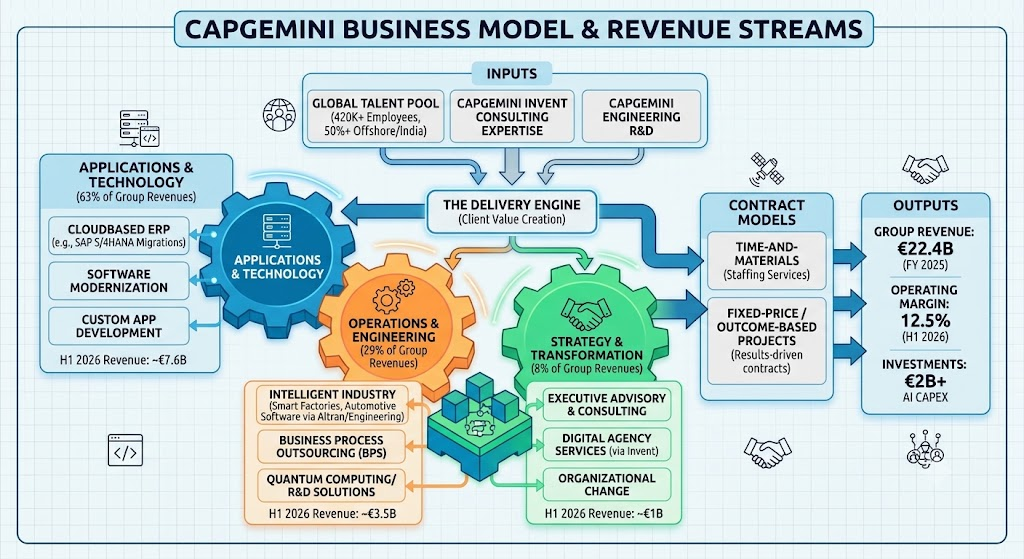
Capgemini operates as an end-to-end technology service provider. Its core business model revolves around monetizing high-value strategic consulting, long-term application management, and outsourced business operations through time-and-materials, fixed-price, or outcome-based contracts.
The company categorizes its revenue streams into three core business lines:
- Applications & Technology (63% of group revenues): The foundation of Capgemini’s business, driving revenue by modernizing legacy corporate IT architectures, migrating enterprise resource planning (ERP) systems to cloud environments (e.g., SAP S/4HANA), and building customized enterprise software.
- Operations & Engineering (29% of group revenues): Focuses on intelligent business operations, business process outsourcing (BPS), and high-tech engineering (e.g., smart factories, automotive software, aerospace design via Capgemini Engineering).
- Strategy & Transformation (8% of group revenues): Operating primarily through Capgemini Invent, this high-margin arm delivers executive advisory, digital agency services, and strategic organizational transformation.
Financially, Capgemini delivered €12.08 billion in revenues for the first half of 2026 alone (up 8.8% year-on-year), maintaining an operating margin of 12.5%. Geographic diversification is a key stabilizing driver: North America accounts for ~29% of annual revenue, Rest of Europe ~30%, France ~18%, the UK and Ireland ~13%, and Asia-Pacific/Latin America ~9%. Its strategic focus is anchored in “Intelligent Industry” (merging software with physical assets) and cross-selling deep technology expertise alongside strategy.
Sources
- https://investors.capgemini.com/en/publication/2026-h1-results/
- https://investors.capgemini.com/en/file/30106?download=1
- https://en.wikipedia.org/wiki/Capgemini
AI Strategy, Budget, and Partnerships
Capgemini’s Artificial Intelligence strategy focuses on transitioning enterprise clients from simple proof-of-concept AI experiments to fully scaled “agentic” tech stacks and custom generative AI models embedded directly into core business workflows.
Investment and Budget:
Capgemini has committed over €2 billion in capital expenditure and R&D dedicated to Data & AI initiatives over a multi-year investment horizon. This funding targets internal workforce upskilling—training hundreds of thousands of staff on generative AI tools—and scaling its dedicated Global Generative AI Labs and Applied Innovation Exchange networks.
Strategic Partnerships & Deployments:
- OpenAI (Frontier Alliance): Capgemini entered into a strategic enterprise partnership with OpenAI, joining its Frontier Alliance to co-develop, deploy, and manage custom AI agents and enterprise “AI coworkers” directly within global client infrastructure.
- Hyperscalers (AWS, Microsoft, Google Cloud): Capgemini works closely with Microsoft on Azure-based enterprise LLMs and digital sovereignty solutions. It also partners with Google Cloud and AWS to build industry-specific generative AI solutions and secure sovereign AI cloud infrastructures for public-sector and European enterprise clients.
- Hardware & Specialized AI: The firm maintains strategic technology integrations with NVIDIA to deploy enterprise-grade AI acceleration and generative design, as well as Mistral AI for secure, sovereign open-weight language models.
Concrete Application Case:
Capgemini designed and deployed a secure, Azure-based enterprise intelligence platform for industrial materials group Alleima, consolidating years of disparate operational documentation into an AI-queryable engine that accelerates field decision-making.
Back to Capgemini