
Development History of BYD
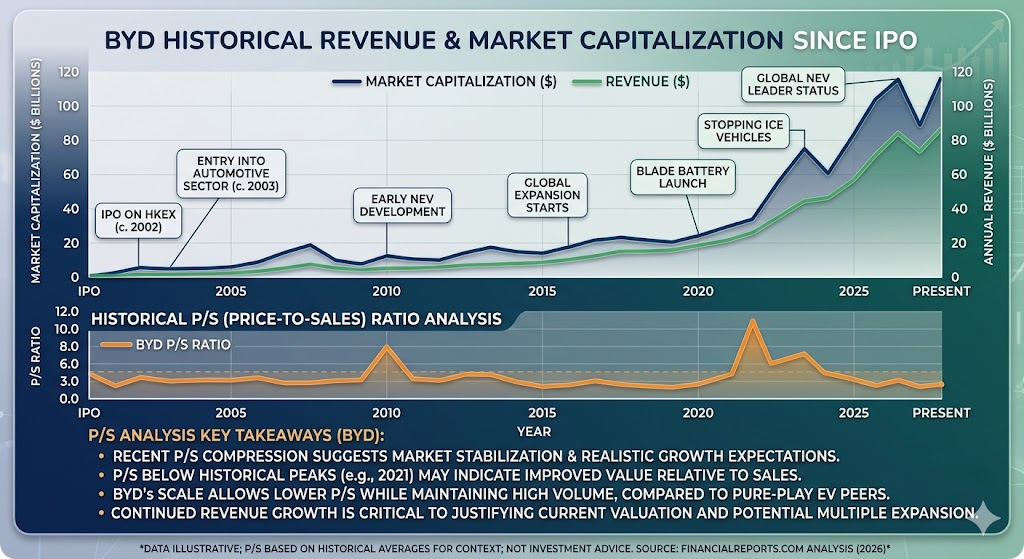
The development history of BYD can be divided into four major stages based on its core business transformation:
Phase 1: Entrepreneurship and Battery Dominance (1994–2002)
Founded by Wang Chuanfu in Shenzhen in 1994, BYD initially focused on the R&D and production of rechargeable batteries (NiCd and NiMH). Leveraging low-cost manufacturing advantages and vertical integration, the company quickly broke the monopoly held by Japanese manufacturers, becoming one of the world’s largest mobile phone battery suppliers and establishing a solid cash flow foundation for future expansion.
Phase 2: Automotive Entry and Diversification (2003–2009)
In 2003, BYD officially entered the automotive manufacturing sector through the acquisition of Xi’an Qinchuan Auto. During this phase, the company focused on building a complete automotive supply chain while making significant progress in mobile phone component assembly (BYD Electronic). This period established the company’s vertically integrated business model and marked the beginning of R&D into hybrid powertrain technologies.
Phase 3: Electrification Transformation and Technology Accumulation (2010–2021)
BYD shifted its strategic focus entirely toward new energy. The company promoted pure electric buses and taxis in the public transport sector and developed high-safety Blade Battery technology and DM-i hybrid technology. Despite market fluctuations, the company successfully built a technological moat for new energy vehicles through continuous R&D investment.
Phase 4: New Energy Leader and Global Expansion (2022–Present)
In 2022, BYD announced the total cessation of internal combustion engine vehicle production, becoming the first legacy automaker worldwide to reach this milestone. The company’s sales entered a period of explosive growth, and it began entering the global market with powerful technology platforms such as e-platform 3.0. Currently, BYD is committed to globalizing its entire industrial chain, from passenger vehicle exports to the construction of overseas factories, with the goal of becoming a key driver of global electrification.
BYD Competitive Analysis (2026)
The global automotive landscape has shifted significantly, with BYD emerging as a primary challenger to both traditional legacy automakers and EV pioneers like Tesla. Below is a competitive analysis based on current market dynamics.
1. Key Competitive Strengths
- Vertical Integration: Unlike most competitors, BYD maintains control over the entire supply chain, including battery cells (Blade Battery), power electronics, chips, and vehicle assembly. This allows for superior margin control and rapid production scaling.
- Price Ladder Strategy: BYD offers a diverse product portfolio ranging from entry-level economy models (Dolphin, Seagull) to luxury sub-brands (Yangwang), effectively capturing price-sensitive mass markets that Western OEMs struggle to address.
- Technological Innovation: Recognized by the Center of Automotive Management (CAM) as a top innovator in 2026, BYD excels in battery performance, charging speed (megawatt hyperchargers), and high-efficiency powertrain integration.
- Dual-Technology Path: By simultaneously mastering both Battery Electric Vehicles (BEV) and Plug-in Hybrid Electric Vehicles (PHEV), BYD provides consumers with flexibility, reducing the barrier to adoption in markets where charging infrastructure is still developing.
2. Major Competitive Rivalries
- Tesla:
- Core Difference: Tesla focuses on software monetization, autonomy (FSD/Robotaxi), and AI-driven margins. BYD focuses on industrial volume, hardware cost efficiency, and global market share.
- Current Status: While Tesla maintains a brand and software lead in developed markets, BYD has surpassed Tesla in global unit sales volume and offers a pricing structure that Tesla currently cannot match in many emerging markets.
- Traditional Legacy Automakers (Toyota, VW, Ford, etc.):
- Challenge: BYD is aggressively encroaching on legacy market share in regions like Australia, South America, and Europe. Its rapid expansion of production capacity and localized manufacturing strategies directly challenge the established dominance of brands like Toyota.
- Vulnerability: Legacy brands are often hindered by the transition from internal combustion engines to EV architectures, whereas BYD operates as a pure-play electrification company.
3. Market Expansion & Challenges
- Global Footprint: BYD is rapidly expanding beyond China, with significant success in Europe, Brazil, and Australia. In markets like the UK and Brazil, BYD has demonstrated high growth rates, often outperforming Tesla in registration numbers within specific periods.
- External Constraints:
- Geopolitical Barriers: Trade protectionism and tariffs in North America and parts of Europe remain the primary hurdles to BYD’s global ambitions.
- Market Stabilization: As the initial surge of EV adoption settles in some regions, BYD faces the challenge of sustaining its hyper-growth momentum amidst rising interest rates and macroeconomic volatility.
- Infrastructure Dependency: While BYD is investing in “Flash Charging” networks, the pace of global charging infrastructure deployment remains a critical factor for long-term growth.
Source:
- https://www.autoweek.com/news/a71233648/byd-gains-ground-globally/
- https://www.electrive.com/2026/04/23/cam-analysis-byd-tops-global-innovation-ranking-for-first-time/
- https://247wallst.com/investing/2026/05/19/tesla-vs-byd-which-stock-will-outperform-the-market-in-2026/
- https://www.carsguide.com.au/car-news/thats-an-issue-for-them-byd-has-emerged-as-the-most-likely-brand-to-finally-topple-toyota
Back to BYD page