History
Founding and Maritime Roots (1828–1900s)
Established in Antwerp, Belgium, as the “Bureau de Renseignements pour les Assureurs Maritimes” (Information Office for Maritime Insurers), the firm initially focused on providing information on ships and equipment to marine underwriters. It adopted the name Bureau Veritas in 1829 and relocated its headquarters to Paris in 1832, expanding into industrial classification and safety verification as global shipping grew.
Industrial Expansion and Global Footprint (1900s–1990s)
Throughout the 20th century, Bureau Veritas diversified beyond maritime classification. The company established dedicated divisions for construction, civil engineering, manufacturing, and consumer goods. During this period, it rapidly expanded its physical footprint across Asia, the Americas, and Africa, transitioning into a multi-sector technical compliance organization.
Public Listing and Corporate Consolidation (1990s–2020s)
Acquired by Wendel in 1995, Bureau Veritas underwent significant corporate restructuring and accelerated its strategic M&A activities to consolidate the fragmented global TIC market. In 2007, the company launched its Initial Public Offering (IPO) on the Euronext Paris exchange. It rapidly scaled its sustainability, environmental, and digital assurance capabilities.
Digital Transformation and LEAP | 28 Strategy (Present)
Under its modern operational strategy (LEAP | 28), Bureau Veritas focuses on expanding high-margin sustainability consulting, automated asset monitoring, and digital supply chain assurance. The group continues to prune underperforming subsegments while acquiring specialized niche providers in green building and energy transitions.
Business Model and Strategy
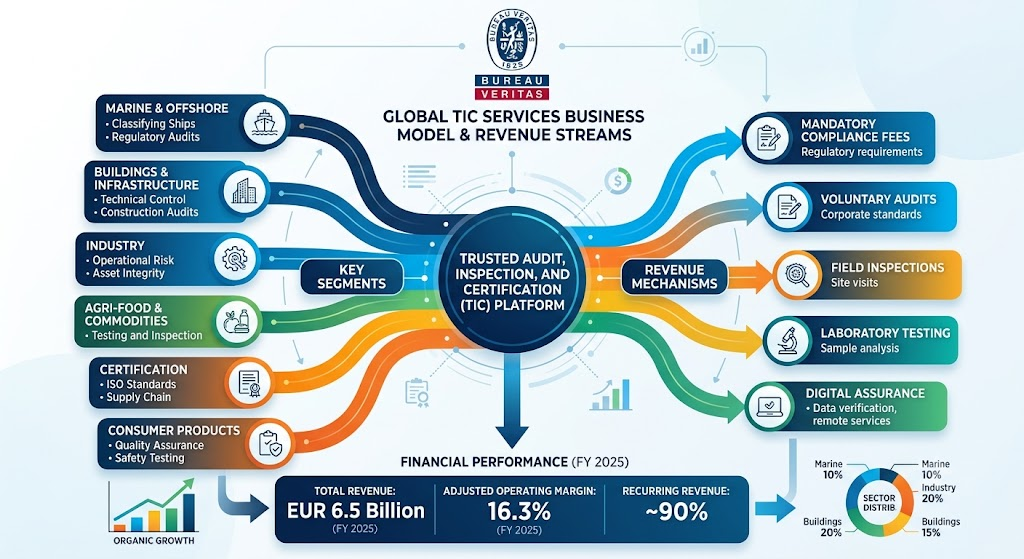
Bureau Veritas operates a volume-driven, recurring-revenue business model centered on risk management and regulatory conformity. The core monetization mechanism relies on charging fees for technical audits, field inspections, laboratory testing, and certificate issuance across several core business units: Marine & Offshore, Agri-Food & Commodities, Industry, Buildings & Infrastructure, Certification, and Consumer Products Services.
The revenue generation relies heavily on mandatory regulatory compliance (defensive revenue) and voluntary sustainability audits (growth revenue). For example, in H1 2026, the company generated revenues of EUR 3,258.4 million, reflecting 5.0% organic growth year-on-year. In FY 2025, the group achieved an adjusted operating margin of 16.3%, demonstrating strong pricing power across its specialized divisions.
The group’s growth strategy rests on two core operational pillars:
- Strategic Portfolio Reallocation and Targeted M&A: Bureau Veritas actively acquires specialized firms in high-margin sectors like energy transition and green building certifications (e.g., acquiring Sustainable Construction Services and Verte UK). Concurrently, it divests or exits volatile, lower-margin contracts, such as the planned exit from its EUR 185 million Government Services subsegment.
- CapEx Efficiency and Scalability: Bureau Veritas leverages its global network of laboratories and personnel to capture economies of scale. By expanding high-volume recurring services (Opex-related maintenance and compliance) over capital-expenditure-heavy greenfield projects, the business maintains strong cash flow generation.
Sources
- https://group.bureauveritas.com/newsroom/delivering-our-commitments-higher-sequential-organic-growth-q2
- https://www.nasdaq.com/press-release/bureau-veritas-sector-leading-organic-revenue-growth-65-fy-2025-strong-margin
- https://www.bvna.com/about-us/strategy
AI Strategy, Budget, and Partnerships
Bureau Veritas treats Artificial Intelligence both as an internal tool to optimize inspection throughput and as a distinct commercial compliance offering.
Enterprise AI Assurance Services
Bureau Veritas offers specialized independent AI risk assessment frameworks for enterprise clients facing regulatory mandates. Designed to target requirements like the EU AI Act, this offering audits systems across eight pillars: security, robustness, data privacy, governance, fairness, explainability, controllability, and transparency.
Strategic Partnerships and Technological Integration
To power its automated assessment framework, Bureau Veritas partnered with Amazon Web Services (AWS). The company integrated AWS AI Risk Intelligence (AIRI)—an automated governance tool developed by the AWS Generative AI Innovation Center—into its core audit workflow. By leveraging automated document review and direct code testing through AWS tools, Bureau Veritas reduced client audit cycle times from several weeks down to a few days.
Operational Strategy and Budget Deployment
Rather than developing base-level LLMs internally, Bureau Veritas directs its technology budget toward domain-specific digital integration, remote inspection tools (drones, IoT sensors), and automated data verification systems. The company applies a “risk-proportionate automation” framework internally: low-risk administrative data processing is fully automated via AI tools, freeing human experts to focus oversight on safety-critical industrial inspections.
Back to Bureau Veritas