
The Bristol Myers Squibb (BMY) Q1 2026 earnings report, released on April 30, 2026, exceeded market expectations. Below is the summary:
Q1 2026 Financial Highlights
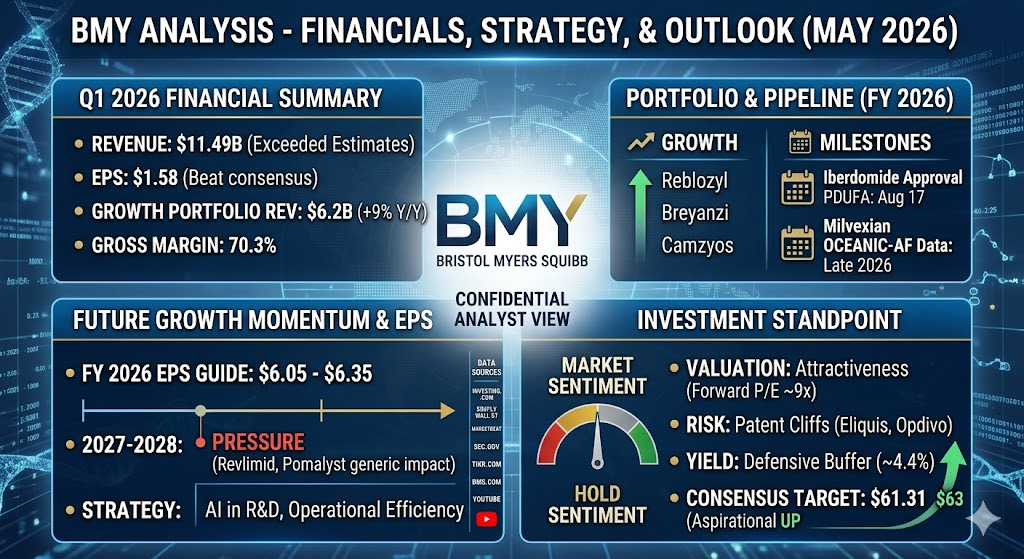
- Revenue: $11.49B, an increase of approximately 2.6% year-over-year, surpassing the consensus estimate of $10.93B.
- EPS: $1.58, beating market expectations of $1.42 by 11.27%.
- Gross Margin: 70.3%.
- Net Income: $2.7B.
- Growth Portfolio: Contributed $6.2B in revenue, marking a 9% year-over-year growth, driven primarily by products like Reblozyl and Breyanzi.
Operational and Strategic Outlook
- Full-Year Guidance: The company reaffirmed its 2026 full-year revenue guidance of $46.0B to $47.5B, with an expected EPS range of $6.05 to $6.35.
- R&D Progress:
- Continued integration of AI to optimize clinical trial efficiency and development timelines.
- Sotyktu received approval for the treatment of psoriatic arthritis; Opdivo received two additional approvals for classical Hodgkin lymphoma.
- Market Sentiment: Despite the strong quarterly performance, market analysts remain divided regarding long-term growth prospects due to looming patent cliffs. The current consensus rating is Hold, with an average price target of approximately $61.31.
Key developments for Bristol Myers Squibb (BMY) in the first quarter of 2026 are as follows:
Core Financial Shifts
- Earnings Beat: Q1 EPS of $1.58 surpassed the expected $1.42, demonstrating an 11.27% beat.
- Revenue Growth: Revenue reached $11.49B, a 1% year-over-year increase. While modest, it indicates steady performance despite looming patent cliffs.
- Growth Portfolio Performance: This was the standout segment, contributing $6.2B in revenue with 9% year-over-year growth, driven primarily by products like Reblozyl and Breyanzi.
- Gross Margin Pressure: Gross margin stood at 70.3%, representing a 280-basis-point decline, highlighting market concerns regarding the sustainability of the profit structure.
Strategic and R&D Progress
- AI-Driven R&D Efficiency: The company is aggressively integrating AI to optimize clinical trials and development processes. The goal is to improve candidate identification speed by 50% and shorten the overall drug development cycle by 30%.
- Pipeline Milestones:
- Sotyktu received regulatory approval in both the US and EU for the treatment of psoriatic arthritis.
- Opdivo secured two new indications for classical Hodgkin lymphoma.
- In the hematology space, Iberdomide received FDA Breakthrough Therapy designation and priority review, with a PDUFA date scheduled for August 17, 2026.
- AI Digital Transformation: The company entered a strategic partnership with Anthropic, establishing Claude Enterprise as its global shared intelligent platform to drive operational efficiency.
Outlook and Market Sentiment
- Reaffirmed Guidance: BMY maintained its full-year 2026 revenue guidance of $46.0B to $47.5B and EPS guidance of $6.05 to $6.35.
- Polarized Market View: Investor sentiment remains divided. Bulls highlight the strong profitability and the gradual realization of the R&D pipeline, while bears remain focused on long-term revenue pressure from patent expirations and the impact of evolving drug pricing policies on future margins.
The growth momentum for Bristol Myers Squibb (BMY) heading into the second quarter of 2026 and the remainder of the year is primarily driven by the continued ramp-up of its “Growth Portfolio” and key clinical milestones. Below are the core factors:
1. Scaling of the Growth Portfolio
The Growth Portfolio is the central pillar of BMY’s revenue strategy, contributing $6.2B in Q1 with a 9% year-over-year growth rate. Performance in Q2 and the second half of the year is expected to be driven by:
- Reblozyl: Sustained global demand for the treatment of anemia associated with myelodysplastic syndromes (MDS).
- Breyanzi: Benefiting from expanded indications and increased market penetration, the CAR-T cell therapy demonstrated a robust 53% growth in Q1.
- Camzyos: Strong global uptake for the treatment of obstructive hypertrophic cardiomyopathy (oHCM), with an accelerated focus on international market expansion.
- Opdualag & Cobenfy: Anticipated to continue gaining market share, providing consistent contributions to the overall portfolio.
2. Critical Clinical and Regulatory Milestones
The market is closely watching BMY’s “R&D transformation.” Several upcoming events will significantly impact market sentiment for the remainder of 2026:
- Iberdomide: Granted FDA priority review for the treatment of multiple myeloma. The PDUFA date is scheduled for August 17, 2026. A successful approval would serve as a major revenue engine for the second half of the year.
- Milvexian (OCEANIC-AF Study): This represents one of the most critical binary events for BMY’s long-term revenue trajectory. Data is expected by the end of 2026. The market will focus on its potential to reduce bleeding risk compared to Eliquis, which is essential for it to become a blockbuster therapy in atrial fibrillation.
- Alzheimer’s Disease Psychosis (ADEPT Study): Results are anticipated by the end of 2026. Positive data would significantly expand the company’s footprint in the neuroscience space.
3. Operational Efficiency and Capital Allocation
- Digital Transformation (AI Integration): The company is deepening its partnership with platforms like Anthropic to utilize AI for optimizing clinical trials and development timelines. Management aims to reduce R&D costs and shorten time-to-market through these efficiency gains.
- Financial Discipline: In the context of patent expiration pressures (e.g., Revlimid and Pomalyst generic competition), BMY has demonstrated strong cash flow generation (2025 free cash flow reached $12.8B). This provides a buffer to maintain strong dividends and continue investing in high-growth areas.
Market Outlook Indicators
- Revenue Consensus: Market analysts currently estimate Q2 2026 revenue to be approximately $11.81B, with an expected EPS of $1.66.
- Valuation Perspective: Wall Street consensus suggests that BMY’s short-term risk-reward balance hinges on whether the Growth Portfolio can fully offset the decline of legacy products losing patent protection. If the Growth Portfolio maintains double-digit growth while key pipeline assets deliver positive outcomes, it would support a path toward an average price target of approximately $63.
For Bristol Myers Squibb (BMY), the earnings per share (EPS) outlook over the next 12 to 24 months is characterized by a “stable in the near term, pressured in the long term” dynamic. Market analysts are currently balancing the company’s strong execution in its growth portfolio against the structural headwinds of patent expirations.
EPS Forecast Summary
- 2026 Full-Year Outlook: The consensus EPS estimate is approximately $6.28. This aligns with the company’s official guidance of $6.05 to $6.35. Following a strong Q1 performance (reporting $1.58 EPS, beating consensus of $1.46), investor confidence has been bolstered, though analysts have kept their full-year forecasts relatively steady.
- 2027 Outlook: Analyst estimates for 2027 generally hover around $6.01 to $6.15. This reflects a projected modest decline in earnings as the impact of patent cliffs on legacy products begins to outweigh the revenue contributions from newer assets.
- Long-Term Trajectory: Earnings are forecast to decline at an average annual rate of roughly 1% to 2% over the next few years, as the company navigates a transition period where generic competition for legacy drugs (such as Revlimid and Pomalyst) creates significant revenue pressure.
Key Factors Influencing EPS
- The “Patent Cliff” Offset: The core investment thesis centers on whether BMY’s “Growth Portfolio”—including products like Reblozyl, Breyanzi, and Camzyos—can scale rapidly enough to offset the loss of exclusivity for legacy blockbusters. While these products showed strong double-digit growth in Q1, they must maintain this momentum to protect future EPS.
- R&D Catalyst Calendar: Market sentiment is highly sensitive to the outcome of upcoming late-stage pipeline trials. Key readouts expected in late 2026, particularly for milvexian (Phase III data) and the ADEPT program, are viewed as binary events. Positive results could trigger upward revisions in EPS estimates and stock re-rating.
- Cost Discipline & Operational Efficiency: BMY has prioritized aggressive cost-cutting and the integration of AI (e.g., via the Anthropic partnership) to optimize clinical trial efficiency. This strategy is intended to protect profit margins and free cash flow, even as top-line revenue growth faces cyclical pressure.
- Market Sentiment: The current consensus rating for BMY is Hold, with an average price target of approximately $61.31. Bulls point to the company’s strong cash flow and dividend yield (currently around 4.4%) as a defensive cushion, while bears focus on the fundamental revenue contraction and the competitive landscape of the oncology and immunology sectors.
Summary Table: Consensus EPS Estimates
| Period | Consensus EPS Estimate (USD) |
| FY 2026 | $6.28 |
| FY 2027 | $6.01 – $6.15 |
| FY 2028 | $5.33 – $5.45 |
Note: Estimates are based on current Wall Street consensus and are subject to adjustment based on upcoming clinical data and quarterly earnings releases.
Price Outlook Overview
As of late May 2026, BMY is trading in the $57–$60 range.
- Average Analyst Target Price: Approximately $61.31.
- Upside Potential: Based on current levels, the consensus implies a modest upside of 3% to 5%.
- Forecast Range: Opinions are highly polarized, with price targets spanning from as low as $40 (bearish) to as high as $75 (bullish).
Investment Analysis Logic
1. Bullish Drivers (Potential Upside)
- Valuation Attractiveness: With a forward P/E ratio of approximately 9.3x, BMY trades at a significant discount compared to peers like Johnson & Johnson or Merck, offering a margin of safety for value investors.
- Growth Portfolio Execution: If key products like Reblozyl, Breyanzi, and Camzyos continue their double-digit growth and effectively offset the revenue decline from legacy products, the stock could see multiple expansion.
- Binary Catalysts: The second half of 2026 is critical. Key milestones, such as the Iberdomide regulatory approval (expected August 2026) and milvexian Phase III data (expected year-end 2026), serve as powerful re-rating triggers.
- Income Cushion: A dividend yield of roughly 4.4% provides a defensive floor for long-term holders.
2. Bearish Risks (Downside Pressure)
- Patent Cliffs: The primary structural threat. The market is deeply concerned about revenue gaps appearing once exclusivity for blockbusters like Eliquis and Opdivo begins to wane later in the decade. Any sign of sales stagnation in these core assets could trigger significant pullbacks.
- Regulatory Headwinds: The impact of the Inflation Reduction Act (IRA) and ongoing government drug pricing negotiations continue to weigh on long-term margin projections.
- Competitive Landscape: Investors remain wary of the concentration of risk in BMY’s oncology-heavy pipeline, especially as competitors advance their own immunology and neuroscience assets.
Expert Recommendation
BMY sits at a “multi-factor crossroads.” Your strategy should depend on your investment objective:
- For Income/Defensive Investors: The current valuation level serves as a reasonable entry point to capture the high dividend yield. It acts as a “value play” with limited downside support from its cash-generative core.
- For Growth/Event-Driven Investors: BMY is a “catalyst-dependent” stock. The focus is not on short-term technicals, but on the successful conversion of pipeline assets into revenue. If you aim to capture price appreciation, success in the milvexian and Iberdomide programs is non-negotiable.
Bottom Line: While the stock is not a “high-growth” candidate, it is well-positioned as a defensive component of a diversified portfolio, provided you are comfortable with the inherent risks of biotech R&D and long-term patent expirations.
Disclaimer: This analysis is based on market data as of May 2026 and does not constitute personalized financial advice. Pharmaceutical stocks are highly sensitive to clinical trial outcomes; always monitor PDUFA dates and trial data releases closely.
Source:
- https://www.investing.com/news/transcripts/earnings-call-transcript-bristol-myers-squibb-q1-2026-earnings-beat-expectations-93CH-4649698
- https://simplywall.st/stocks/us/pharmaceuticals-biotech/nyse-bmy/bristol-myers-squibb/news/bristol-myers-squibb-bmy-margin-strength-in-q1-2026-challeng
- https://www.marketbeat.com/instant-alerts/filing-bristol-myers-squibb-company-bmy-position-trimmed-by-associated-banc-corp-2026-05-24/
- https://www.youtube.com/watch?v=YkcQDkXYgO0
- https://investors.bms.com/Investors/
- https://www.sec.gov/Archives/edgar/data/14272/000001427226000008/q12026earningspresentati.htm
- https://www.tikr.com/blog/bristol-myers-squibb-made-its-pipeline-case-at-bofa-now-comes-the-proof
Back to BMS page