
Market Position and Market Share
Bank of Ireland Group plc(BOI)is one of Ireland’s “Big Two” pillar financial institutions, operating at the center of an effective domestic duopoly alongside Allied Irish Banks(AIB)following the market departures of Ulster Bank(NatWest)and KBC Bank Ireland.
- Overall Ranking: BOI ranks either #1 or #2 across all major retail and commercial banking categories in the Republic of Ireland, competing directly with AIB for the market leadership position.
- Mortgage Market Share:In new mortgage lending flow, Bank of Ireland holds approximately 42%(exceeding 40% of annual new lending drawdowns in Ireland). Following the acquisition and integration of KBC Bank Ireland’s c.€8 billion performing loan portfolio, BOI’s outstanding mortgage stock market share is estimated at approximately 37% to 40%.
- Deposits Market Share: BOI controls approximately 33% to 35% of total Irish household and non-financial corporate(NFC)deposit balances, supported by a retail and corporate deposit base exceeding €100 billion.
- Corporate and Business Banking: BOI holds a leading position in domestic corporate banking, financing over 50% of indigenous mid-market and SME loan volumes.
- Wealth & Insurance: Operating through its subsidiary New Ireland Assurance, BOI is the only domestic Irish retail bank with a fully integrated in-house life assurance and wealth management franchise, commanding roughly 20% to 25% market share in Irish life and pensions.
Upstream and Downstream Supply Chain Analysis and Key Suppliers
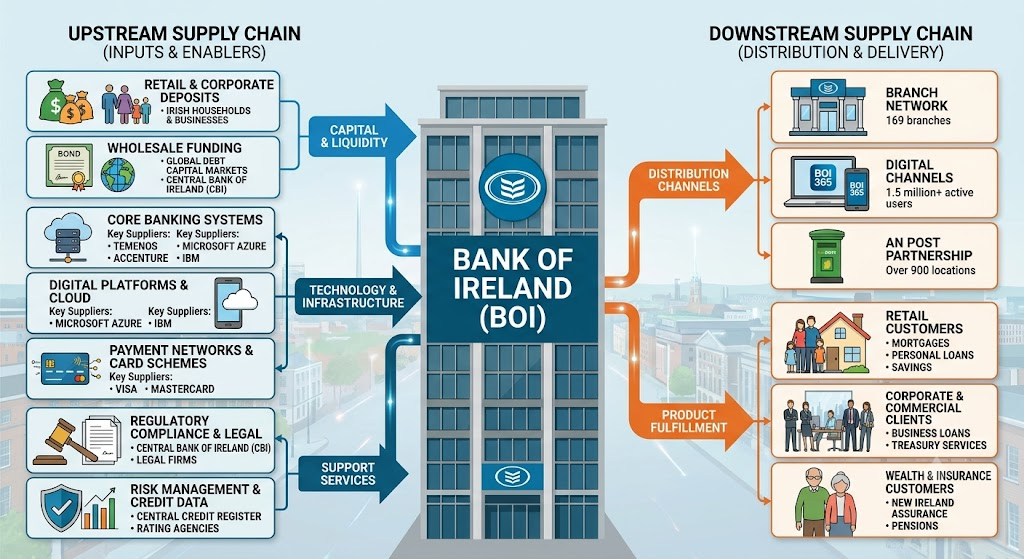
Because banking is a capital-, information-, and technology-intensive services industry, its supply chain spans raw capital procurement, technology/infrastructure sourcing, payment rail access, distribution, and product fulfillment:
1. Upstream Supply Chain(Inputs, Technology, and Capital Sourcing)
- Capital and Liquidity Sourcing: The primary raw input for a retail and commercial bank is low-cost liquidity. BOI’s upstream capital consists of customer deposits(household and corporate current accounts), wholesale debt issuances(MREL/senior preferred and subordinated bonds placed on European debt markets), and Central Bank facilities(European Central Bank refinancing operations).
- Core Banking and IT Infrastructure Vendors:
- Core Banking Software: BOI implemented Temenos(Temenos Transact/T24)to serve as a cornerstone platform for core retail and commercial banking operations, supported by legacy mainframe modernization programs.
- System Integration and Managed IT Services: Accenture is BOI’s multi-year primary strategic digital systems and systems integration provider; Capgemini serves as a major technology delivery and application management partner.
- Cloud & Workplace Infrastructure: Microsoft(Azure cloud framework and Microsoft Dynamics 365 for customer relationship management), alongside Amazon Web Services(AWS)for hybrid cloud application hosting.
- Enterprise Software: SAP for enterprise resource planning(ERP)and financial management.
- Payment Rails, Security, and Clearing Networks:
- Card schemes: Visa and Mastercard for scheme sponsorship, clearing, and consumer debit/credit issuance.
- Clearing networks: Central Bank of Ireland/European Central Bank(TARGET2/T2S and SEPA clearing rails), and SWIFT for international transaction messaging.
- Identity, compliance, and credit rating inputs: Central Credit Register(CCR)maintained by the Central Bank of Ireland, Experian, and specialized AML/KYC screening vendors(such as LexisNexis Risk Solutions).
2. Downstream Supply Chain(Distribution, Intermediaries, and End Markets)
- Direct Channels:
- Proprietary Branch Network: A physical network of 169 branches across the Republic of Ireland, as well as operations in Northern Ireland.
- Digital Channels: Mobile apps and the 365 Online web platform, handling over 85% of standard retail payment and account service transactions.
- Third-Party Intermediaries and Partnerships:
- An Post Partnership: An extensive agreement with Ireland’s national post office network(An Post), enabling Bank of Ireland customers to perform over-the-counter cash and cheque transactions across more than 900 post office locations nationwide.
- Mortgage Brokers: A significant portion of retail mortgage drawdowns is sourced via independent mortgage intermediary networks and broker agencies across Ireland.
- UK Co-branded / Niche Partnerships: In the UK market, BOI operates selective joint-venture distribution models(e.g., historical postal/financial partnerships and asset-backed corporate lending).
- End Customers:Retail consumers(mortgages, personal loans, credit cards, wealth), domestic SMEs, agricultural enterprises, and large corporate/multinational clients.
Competitor Analysis: Financial and Technological Comparison
The Irish retail and commercial banking landscape functions as a consolidated market dominated by Bank of Ireland and Allied Irish Banks(AIB), followed by Permanent TSB(PTSB)as a smaller third incumbent, alongside digital disruptors(Revolut).
1. Financial Comparison
- Profitability and Return on Tangible Equity(RoTE):
- Bank of Ireland:Delivered an underlying RoTE of approximately 16.8%(underlying profit before tax of c.€1.9 billion), supported by strong Net Interest Income(NII)of c.€3.2 billion.
- AIB: Achieved a comparable RoTE of 17% to 20%, slightly outperforming BOI in net interest margin(NIM)due to a higher proportion of non-interest-bearing corporate and retail current account deposits.
- PTSB: Trails significantly with an RoTE hovering around 8% to 10%, weighed down by a predominantly residential mortgage loan book, higher funding costs, and limited corporate fee income.
- Cost-to-Income Ratio(Efficiency):
- Bank of Ireland: Maintained a Cost-to-Income Ratio of approximately 46%, reflecting post-restructuring synergies from the KBC acquisition and ongoing branch rationalization.
- AIB: Operates at a Cost-to-Income Ratio of approximately 44% to 46%, benefiting from larger domestic fee capture and corporate lending margins.
- PTSB: Less cost-efficient, with an operating cost-to-income ratio exceeding 60% due to sub-scale infrastructure.
- Capital Adequacy(CET1 Ratio):
- Bank of Ireland: Reported a strong fully loaded Common Equity Tier 1(CET1)ratio of 14.6% to 15.1%, allowing it to execute progressive dividend payouts and multi-hundred million euro share buyback programs.
- AIB: Carries a CET1 ratio in the range of 15.0% to 15.5%. Both BOI and AIB operate substantially above regulatory minimums.
- PTSB:Maintains a CET1 ratio around 14.0%, but with less surplus organic capital generation capacity.
- Asset Diversification and Balance Sheet:
- BOI possesses greater non-Irish diversification through its legacy UK loan book and international corporate lending niches, reducing geographic concentration compared to AIB, which is heavily concentrated in the Republic of Ireland.
2. Technological and Digital Comparison
- Core Modernization and Legacy Tech:
- Bank of Ireland: Embarked on a multi-year IT transformation(“Project Omega”, investing over €500M)to deploy Temenos core modules, modernize legacy architecture, and overhaul front-end platforms. While reliability has improved, legacy integration challenges remain visible during peak transaction loads.
- AIB: Began digital transformation slightly earlier, modernizing front-end customer onboarding and core cloud services. AIB’s digital customer app consistently earns slightly higher user sentiment scores in Irish App Store and Google Play reviews relative to BOI.
- PTSB: Operates on older legacy banking stacks with comparatively lower capital expenditure budgets, making digital onboarding and automated loan underwriting slower.
- Fintech and Digital Disruption Threat(Revolut):
- The Revolut Challenge: Revolut has secured more than 2.5 million users in Ireland, capturing everyday debit transactions and peer-to-peer payments.
- BOI’s Response: BOI has expanded its digital feature set(in-app card freezes, card controls, biometric authentication, instant payments)and relies on its captive mortgage, wealth, and commercial lending franchises—segments where digital neobanks cannot yet compete on scale or balance sheet breadth.
Information Sources
- https://investorrelations.bankofireland.com/app/uploads/D15699-BOI-FY-2025-Annual-Results-Announcement-Web-Feb26-FINAL-np-1.pdf
- https://investorrelations.bankofireland.com/app/uploads/Annual-Report-HoldCo-2024-Web.pdf
- https://www.centralbank.ie/statistics/data-and-analysis/credit-and-banking-statistics/retail-interest-rates
- https://www.investing.com/news/transcripts/earnings-call-transcript-bank-of-ireland-q4-2025-reveals-strong-growth-but-stock-dips-93CH-4534067
- https://strivesearch.ie/blog/aib-bank-of-ireland-and-permanent-tsb-look-to-bank-their-huge-share-price-gains/
- https://www.fintechfutures.com/ai-in-fintech/accenture-and-capgemini-to-work-on-bank-of-ireland-s-tech-revamp
- https://www.appsruntheworld.com/customers-database/customers/view/bank-of-ireland-ireland
- https://psf.ie/2025/10/31/what-does-the-sale-of-ptsb-mean-for-consumers/
back to Bank of Ireland