
History of AXA Group
Phase 1: Foundation & Early Growth(1817-1881)
- 1817: AXA’s earliest predecessor, Ancienne Mutuelle, was founded in Rouen, France, initially operating as a small mutual fire insurance firm.
- Mid-to-Late 19th Century: Steadily built its footprint in the French domestic market, expanding into diverse lines of insurance and establishing a solid financial foundation.
Phase 2: Expansion & The Birth of “AXA”(1958-1985)
- 1958: Claude Bébéar joined the firm, later taking the helm to orchestrate an ambitious series of mergers and acquisitions.
- 1982: Merged with Groupe Drouot, becoming one of France’s largest private insurance institutions.
- 1985: Officially adopted the short, memorable name “AXA” to facilitate international brand recognition.
Phase 3: Global Expansion & Scale(1990-2000)
- 1991: Acquired a controlling stake in the US-based financial firm The Equitable, securing a major foothold in North America.
- 1996: Acquired its French rival UAP(Union des Assurances de Paris), elevating AXA into a top-tier global insurance giant.
- Late 1990s: Expanded aggressively across Asia and the Americas, cementing its position in both insurance and asset management.
Phase 4: Portfolio Transformation & Refocusing(2008-2018)
- Post-2008 Financial Crisis: Reallocated capital away from market-sensitive financial products to return to its core insurance strengths.
- 2018: Acquired XL Group for $15.3 billion(creating AXA XL), significantly bolstering its global dominance in commercial Property & Casualty(P&C) and specialty lines.
- Carve-Out of Non-Core Assets: Spun off its US life insurance operations(AXA Equitable Holdings) to focus on higher-margin, technical risk underwriting and health sectors.
Phase 5: Digital Innovation & Sustainability(2018-Present)
- Digitalization: Integrated AI, big data, and insurtech solutions to streamline underwriting and claims management.
- ESG & Climate Strategy: Committed to phasing out investments in coal and high-carbon industries, integrating climate risk into the core of its investment and underwriting framework.
- Payer to Partner Shift: Transformed its business model from a traditional claim “Payer” to an active health and protection “Partner” for clients.
AXA Business Model & Strategy
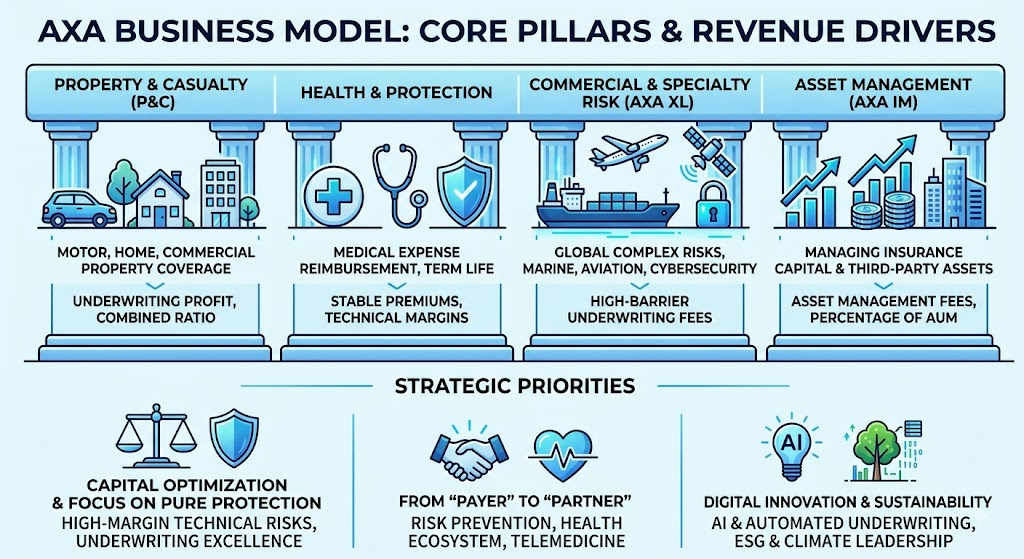
I. Business Model: Core Pillars & Revenue Drivers
AXA has shifted from a traditional, interest-sensitive insurer into a capital-light entity focused primarily on underwriting profits and fee income.
1. Property & Casualty(P&C) Insurance
- Mechanism: Provides motor, home, and commercial property risk coverage for individual and corporate clients.
- Revenue Source: Underwriting profits(measured by Combined Ratio) after subtracting claims and operational expenses from earned premiums.
2. Health & Protection Insurance
- Mechanism: Delivers health reimbursement, critical illness, and term life coverage, while reducing reliance on capital-intensive savings products.
- Revenue Source: Long-term stable premiums and technical underwriting margins, requiring lower capital backing and providing predictable cash flow.
3. Commercial & Specialty Risk(AXA XL)
- Mechanism: Offers specialized coverage for complex global risks, including marine, aviation, cybersecurity, and climate catastrophes.
- Revenue Source: High-barrier specialty underwriting fees and reinsurance margins.
4. Asset Management(AXA Investment Managers)
- Mechanism: Manages internal insurance capital alongside third-party institutional and individual assets.
- Revenue Source: Recurring asset management fees calculated as a percentage of Assets Under Management(AUM).
II. Strategic Priorities: Core Growth Engines
1. Capital Optimization & Focus on Pure Protection
- Underwriting Excellence: Shift away from rate-sensitive savings products toward high-margin technical risks, health coverage, and commercial P&C.
- Portfolio Rebalancing: Exit non-core or sub-scale markets to redeploy capital into core European, North American, and high-growth niche markets.
2. From “Payer” to “Partner”
- Proactive Risk Prevention: Utilize IoT, telematics, and corporate risk monitoring to transition from reactive claims handler to proactive risk prevention partner.
- Health Ecosystem: Offer telemedicine services, wellness apps, and dedicated care networks to boost customer retention and curb claims ratios.
3. Digital Innovation & Sustainability
- AI & Automation: Deploy AI and big data analytics for automated underwriting, dynamic risk pricing, and accelerated claims processing.
- ESG & Climate Leadership: Integrate climate risk into underwriting criteria and decarbonize investment portfolios, driving green finance initiatives worldwide.
Source:
- https://www.axa.com/en/about-us/our-story
- https://www.axa.com/en/about-us/strategy-and-business-model
- https://www.axa.com/en/investor/annual-reports
Back to AXA