
Company History
Foundation and Public Predecessors (1720–2000)
The roots of the group date back to 1720 with the establishment of N.V. Maatschappij van Assurantie, Discontering en Beleening der Stad Rotterdam, one of the oldest insurance enterprises in the world. Over nearly three centuries, regional mutuals and commercial underwriters consolidated across the Netherlands, culminating in the late 20th-century merger between Stad Rotterdam Verzekeringen and AMEV to form the ASR group.
Fortis Conglomerate and Nationalization (2000–2008)
In 2000, Belgian-Dutch banking and insurance giant Fortis acquired ASR, integrating it into its domestic retail network. During the 2008 global financial crisis, Fortis collapsed under solvency pressure caused by its debt-funded consortium takeover of ABN AMRO. To prevent systemic contagion, the Dutch government intervened and nationalized Fortis’s Dutch banking and insurance assets, splitting the entities and rebranding the insurer as ASR Nederland under state stewardship.
Restructuring and Stock Exchange IPO (2008–2016)
Under state ownership, ASR executed an extensive rationalization plan. The group shed non-core international liabilities, consolidated disparate legacy IT platforms, and returned to disciplined, profitable underwriting. In June 2016, NL Financial Investments (NLFI) floated ASR on Euronext Amsterdam, fully divesting the state’s remaining equity stake by late 2017.
Consolidation and Transformational Expansion (2018–Present)
ASR adopted an aggressive domestic consolidation strategy, acquiring Loyalis (2019) and Veherex (2020). In July 2023, ASR finalized the transformational €4.9 billion acquisition of Aegon Nederland, absorbing Aegon’s Dutch insurance, pension, and mortgage businesses while granting Aegon a ~30% shareholding. In subsequent years, the group completed back-office mergers, sold off non-core assets (such as digital banking platform Knab), and cemented its position as a dominant Dutch multi-line market leader.
Business Model and Strategic Financial Engine
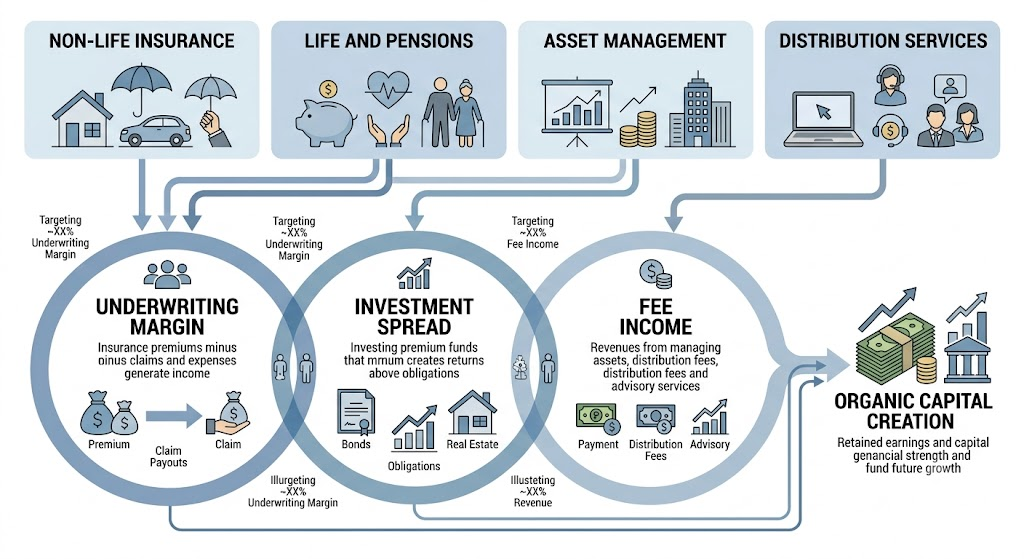
ASR generates earnings across four primary operating divisions: Non-life (P&C and Disability), Life and Pensions, Asset Management, and Distribution & Services. Its profitability is anchored on three core pillars: disciplined underwriting margin, net investment spread, and capital-light fee generation.
- Underwriting Margin & Expense Discipline: In Non-life, ASR consistently targets an operating combined ratio below 94%. For FY 2024, the Non-life combined ratio stood at 91.9% on €3.97 billion of P&C and Disability premium income, supported by strict pricing power against inflation. In H1 2025, operating profit in Non-life reached €261 million with an improved combined ratio of 91.0%.
- Pension DC and Buy-out Migration: As the Netherlands transitions from Defined Benefit (DB) to Defined Contribution (DC) systems under the Future of Pensions Act, ASR captures large capital inflows. Pension DC assets under management surpassed €27 billion by 2025, while specialized pension buy-outs generated single-transaction inflows of over €1.6 billion to €2.8 billion.
- Organic Capital Creation (OCC) and Solvency: Capital management focuses on free cash generation rather than pure accounting net profit. Group OCC reached €1,193 million in FY 2024 and expanded by 9.4% to €721 million in H1 2025, driving towards its medium-term run-rate target of €1.35 billion. As of mid-2025, its Solvency II ratio stood at 203% (operating ROE at 14.4%), enabling consistent capital return via dividends and share buybacks.
- Fee-based Asset Management and Mortgage Servicing: Generating low-capital fee revenue through ASR Real Estate, mortgage origination (€4.5 billion generated in H1 2025), and third-party institutional asset mandates.
Sources
- https://www.asrnl.com/investor-relations/annual-report-most-recent
- https://www.asrnederland.nl/-/media/files/asrnederland-nl/investor-relations/jaarverslagen/2025/2025-annual-report-asr.pdf
- https://www.asrnl.com/-/media/files/asrnederland-nl/investor-relations/financiele-publicaties/2025/2025-hy-interim-report-asr.pdf
- https://www.asrnl.com/-/media/files/asrnederland-nl/investor-relations/financiele-publicaties/2024/2024-fy-analist-presentation-asr.pdf
Artificial Intelligence Strategy, Budget, and Implementations
Strategic Governance and Organizational Enablement
ASR shifted AI from speculative experimentation to operational acceleration under COO/CTO Ingrid de Swart. Early governance began at the executive level: in January 2025, the Management Board and Supervisory Board completed a dedicated multi-day artificial intelligence immersion curriculum at INSEAD. This established a top-down mandate focusing on internal capability building, ethical data compliance (aligned with the Dutch Association of Insurers’ Ethical Framework for Data Applications), and strategic workforce adaptation.
Deployment Use Cases and Operational Impact
- Smart Claims Assistant (SCA): Developed in-house to support personal injury claims adjusters. Given the domestic shortage of specialized claims handlers, the tool scans and extracts unstructured legal and medical case files, generating verifiable summaries and citation indices. This has reduced cycle times and repetitive administrative file reviews without replacing human underwriting judgment.
- Health Knowledge Assistant: Implemented across the health insurance segment as an intelligent natural language Q&A engine. The platform provides policy coverage answers directly to customer service agents and intermediaries, contributing to higher service resolution speeds and raising interaction Net Promoter Scores (NPS).
- Fraud Analytics and Automated Underwriting: Integrated profiling and machine learning models process straightforward P&C policy applications and low-severity claims automatically, reserving human adjusters for complex, high-touch claims.
Investment Scale and Ecosystem Partners
- Budget Allocation: ASR incorporates AI and digital transformation expenditure within its core IT and change-management envelope, where technology investments specifically offset OCC growth by tens of millions of euros annually. The company accelerated software development productivity through low-code platforms and modern web-cloud architectures.
- Partners and Academic Collaborations: ASR collaborates with INSEAD for executive and workforce AI literacy, aligns with Verbond van Verzekeraars (Dutch Association of Insurers) on ethical algorithm guidelines, participates in i-CERT for threat-led cyber testing around algorithmic pipelines, and leverages standard enterprise hyperscaler cloud infrastructures to host its internal language and predictive models.
Back to ASR Nederland