
The development history of Anhui Conch Cement (0914.HK) can be divided into the following three main stages:
I. Founding and Foundation (1997 – early 2000s)
The predecessor of Conch Cement was the Ningguo Cement Plant in Anhui Province. In 1997, the company was restructured into Anhui Conch Cement Company Limited and listed on the Hong Kong Stock Exchange in the same year. During this stage, the company established its “T-shaped Strategy,” leveraging the logistical advantages of the Yangtze River to build clinker bases in the upper reaches where limestone resources are abundant, while constructing grinding stations along the coast and the river. This successfully created a low-cost, high-efficiency logistics and distribution system.
II. Rapid Expansion and Scaling (Mid-2000s – mid-2010s)
Relying on its unique cost advantages and expansion model, Conch Cement grew rapidly during the consolidation period of the Chinese cement industry. The company aggressively acquired local cement enterprises, significantly increasing its production capacity. It not only solidified its position as the largest cement producer in China but also gradually ranked among the world’s largest cement manufacturers. During this period, the company focused on developing waste heat power generation technology, which not only reduced production costs but also established the company as a technical benchmark for energy conservation and emission reduction in the industry.
III. Transformation, Upgrading, and Green Development (Late 2010s – present)
Facing the slowdown in China’s real estate market and shifts in environmental policies, Conch Cement accelerated its transformation. The company has been actively expanding its entire industrial chain, branching into aggregates, ready-mixed concrete, and environmental industries (such as using cement kilns for collaborative waste disposal). Simultaneously, the company has increased its investment in digital transformation, intelligent manufacturing, and new energy. It is committed to evolving from a traditional cement manufacturer into an integrated provider of green building materials and energy services to address industrial challenges in the context of carbon neutrality.
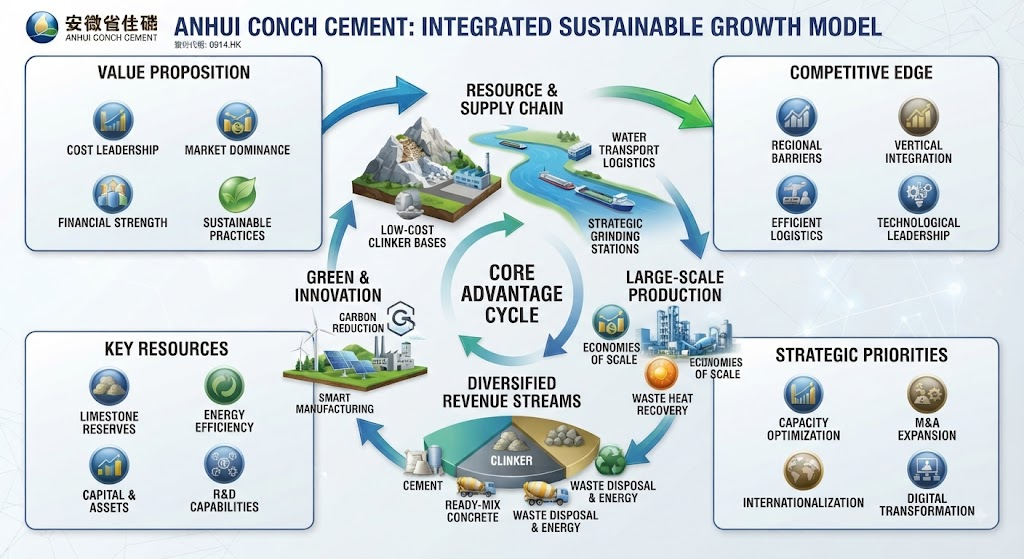
Anhui Conch Cement (0914.HK) focuses its business model and core strategy on cost advantages, economies of scale, and vertical integration of the industrial chain:
I. Business Model
- Cement and Clinker Production and Sales: Core revenue is derived from the large-scale production and sales of high-quality cement and clinker, meeting the demands of infrastructure and real estate markets through efficient capacity allocation.
- “T-Shaped Strategy” Logistics Advantage: Leveraging the shipping advantages of the Yangtze River waterway, the company establishes clinker production bases in upstream regions rich in limestone resources, and sets up grinding stations in major consumer markets along the river and coast, significantly reducing transportation costs and building strong regional barriers.
- Vertical Industry Chain Extension: Expanding operations from traditional cement manufacturing into aggregates, ready-mixed concrete, and environmental businesses (such as co-processing waste in cement kilns), transforming industrial waste into alternative fuels or raw materials to open up diversified revenue streams.
II. Core Strategies
- Cost Leadership Strategy: Continuously lowering unit production and energy consumption costs through large-scale production, advanced kiln technology, and waste heat recovery power generation systems, enabling the company to maintain stable profitability and cash flow during industry downturns.
- Green Transition and Sustainable Development: Actively responding to carbon reduction policies, enhancing energy efficiency through technological upgrades, and lowering carbon emissions to ensure compliance and competitive advantages under increasingly stringent environmental regulations.
- Prudent Capital and M&A Strategy: Maintaining a robust net cash position and consolidating regional markets through mergers and acquisitions and capacity replacement during industry cycle fluctuations, phasing out inefficient capacity to further solidify its industry leadership.
Source:
Back to Conch Cement