
Market Position and Market Share
Alstom SA is the world’s second-largest rail transport manufacturer and systems provider by revenue, positioned directly behind China’s state-owned CRRC Corporation and leading the market outside of mainland China.
- Global Ranking: #2 worldwide overall; #1 in Europe and across accessible/contestable international markets.
- Global Market Share: Across the total global rolling stock and railway technology market, Alstom commands an estimated 15% to 18% share. Within accessible markets—excluding China’s captive domestic market, which is predominantly served by CRRC—Alstom’s market share exceeds 30% to 33%, competing closely with Siemens Mobility.
- Financial Baseline (FY 2024/25):The company generated annual sales of €18.5 billion, booked order intake of €19.8 billion, and maintained an order backlog surpassing €90 billion, providing multi-year operational visibility.
Supply Chain Analysis and Critical Suppliers
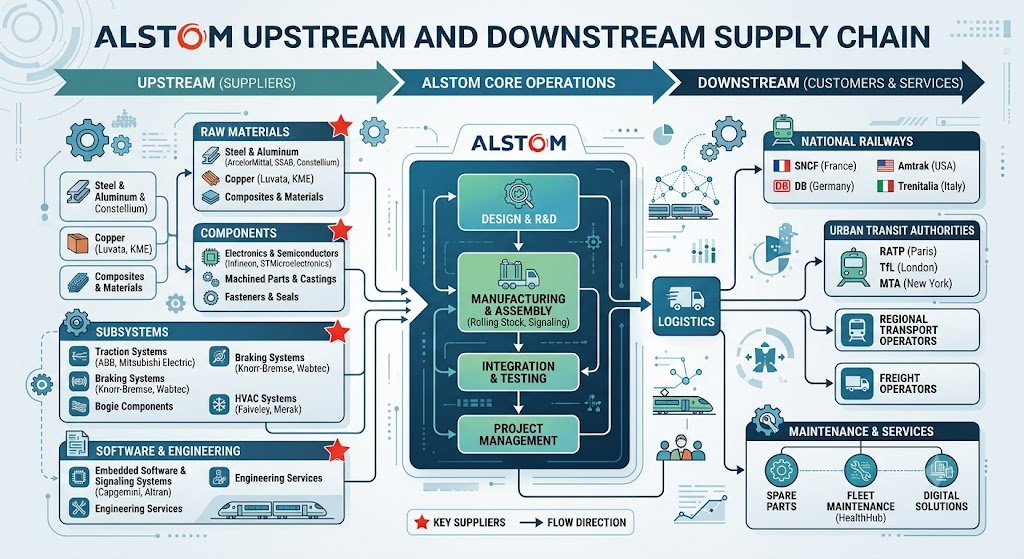
Alstom’s supply chain is highly complex and Tier-delineated, transforming raw metallurgical inputs and embedded electronic modules into fully integrated rolling stock, digital signaling infrastructure, and turnkey systems.
Upstream Tier-2 and Raw Materials:
- Structural Metallurgy: Large-scale procurements of specialized structural steel and lightweight aluminum extrusions for carbody shells and bogies. Primary suppliers include ArcelorMittal, SSAB, and Constellium.
- Traction and Electrical Components: High-power insulated-gate bipolar transistors (IGBTs), power converters, transformers, and copper winding assemblies sourced from ABB, Mitsubishi Electric, and Infineon Technologies.
- Pneumatics and Braking Systems: Critical safety brake systems, bogie suspension units, and pneumatic controls provided primarily by Knorr-Bremse and Wabtec.
Tier-1 Subsystems and Digital Architecture:
- Propulsion and Auxiliary Systems: Traction drives and high-voltage distribution networks engineered either in-house or integrated via specialized sub-assemblies.
- Onboard and Trackside Digital Control: Train Control and Management Systems (TCMS), ETCS/ERTMS Level 2 and Level 3 onboard units, and European vital computers, utilizing industrial computing hardware from Kontron, Advantech, and bespoke European silicon partners.
- Interiors and Mechanical Sub-assemblies: Composite paneling, HVAC systems (e.g., Faiveley Transport/Wabtec, Merak), and modular cab assemblies engineered for crashworthiness under European TSI standards.
Downstream Integration and Client Channels:
- Assembly and Commissioning: Final assembly is carried out across Alstom’s specialized global manufacturing sites (e.g., La Rochelle, Valenciennes, Chorzów, Derby, Hornell).
- Direct End Customers: National railway operators (e.g., SNCF, Deutsche Bahn, Amtrak), regional municipal transport authorities (e.g., RATP, Transport for London, MTA New York), and private concessionaires operating turnkey infrastructure.
- Lifecycle Support (Aftermarket): Downstream operations heavily leverage predictive fleet maintenance software (HealthHub) to monetize 15-to-30-year long-term service agreements (LTSA).
Competitor Analysis: Technical and Financial Comparison
Alstom primarily contends with four major global and regional peers: CRRC (China), Siemens Mobility (Germany), Stadler Rail (Switzerland), and CAF (Spain).
1. Technological Comparison:
- Alstom: Holds leadership in distributed traction very high-speed rail (Avelia Horizon / TGV M) and pioneering commercial hydrogen fuel-cell rail (Coradia iLint). In signaling, its Atlas and Urbalis platforms compete directly at ETCS Level 2/3 and CBTC standards. However, integration complexities resulting from the Bombardier Transportation acquisition created software legacy friction that required extensive remediation.
- Siemens Mobility: Leads the industry in software-defined rail infrastructure, digital interlocking, and autonomous train operation (ATO) via its Railigent X IoT architecture. Siemens’ Velaro (very high-speed) and Mireo (regional) platforms exhibit superior standardized modularity compared to Alstom’s custom platform variations.
- CRRC: Operates at unmatched scale with its Fuxing Hao high-speed platforms and maglev prototypes. While backed by state financing and massive manufacturing throughput, its proprietary signaling and systems face regulatory and geopolitical hurdles in North American and Western European markets.
- Stadler & CAF: Highly agile niche-to-mainstream competitors. Stadler excels in tailor-made regional rolling stock (FLIRT, KISS) and alternative traction (battery and hydrogen FLIRT), while CAF dominates mid-market light rail (Urbos) and regional contracts with lower overhead costs.
2. Financial Comparison:
- Revenue Scale:CRRC leads globally (~€32B+ annual revenue), followed by Alstom (€18.5B in FY 2024/25) and Siemens Mobility (~€10.5B to €11B). Stadler (~€4.0B) and CAF (~€3.8B) operate at smaller balance sheet scales.
- Operating Margins (Adjusted EBIT): Siemens Mobility consistently delivers higher margins (~8.0% to 8.5%) due to strict platform standardisation and a high software/signaling mix. Alstom historically lagged (~5.0% to 5.7%) due to low-margin legacy Bombardier contracts, though operational execution targets ~6.5% to 7.0%. Stadler and CAF operate in the 5.0% to 6.0% range.
- Balance Sheet and Cash Flow: Alstom completed a €2.4 billion deleveraging plan (including a €1 billion rights issue and asset divestments) to stabilize its investment-grade rating and eliminate negative free cash flow drags. In contrast, Siemens Mobility operates with negligible standalone debt leverage, supported by the broader Siemens AG parent structure.
Sources
- https://www.alstom.com/finance
- https://railway-news.com/alstom-reports-solid-fy-2024-25-financial-results/
- https://catalogue.unife.org/company/alstom/
- https://www.railwaypro.com/wp/global-rolling-stock-market-sees-11-growth/
- https://www.researchandmarkets.com/report/rolling-stock
Back to Alstom