
Company History
Foundation and Industrial Conglomerate Era(1928–1997)
Alstom originated in 1928 as Alsthom through the merger of Compagnie Française Thomson-Houston and Société Alsacienne de Constructions Mécaniques. For several decades, the entity operated as a diversified heavy industrial group covering electrical power generation, transmission equipment, marine shipbuilding(Chantiers de l’Atlantique), and rail transport. In 1981, Alsthom achieved worldwide prominence by commercializing France’s high-speed TGV rail network.
Corporate Crises and Restructuring(1998–2014)
Rebranded as Alstom in 1998, the company floated on public exchanges following the exit of its parent conglomerates Alcatel and GEC. The early 2000s were marked by severe financial distress caused by technical defects in heavy gas turbines, prompting a massive state-backed rescue package in 2003–2004. Subsequent years required major divestments, including its shipbuilding unit, to restore operational viability while preserving core power generation and transport lines.
The Pure-Play Rail Pivot(2014–2020)
Facing capital constraints, Alstom sold its energy division(power generation and grid assets) to General Electric in 2015 for approximately €12.4 billion, redirecting its focus exclusively to railway transport. In 2019, a proposed merger with Siemens Mobility was blocked by the European Commission over antitrust concerns in high-speed rail and signaling. Alstom pivoted by acquiring Bombardier Transportation for an enterprise value of approximately €5.5 billion in January 2021, instantly doubling its industrial capacity and installed base.
Post-Merger Integration and Deleveraging(2021–Present)
Integrating Bombardier proved operationally challenging due to unprofitable legacy contracts, complex software alignment, and surging debt, which caused ratings agencies to lower its credit outlook. In response, Alstom implemented a comprehensive deleveraging and turnaround roadmap, executing a €1 billion rights issue, disposing of non-core assets(such as its US conventional rail signaling business), and refocusing on higher-margin services and digital signaling.
Business Model and Growth Strategy
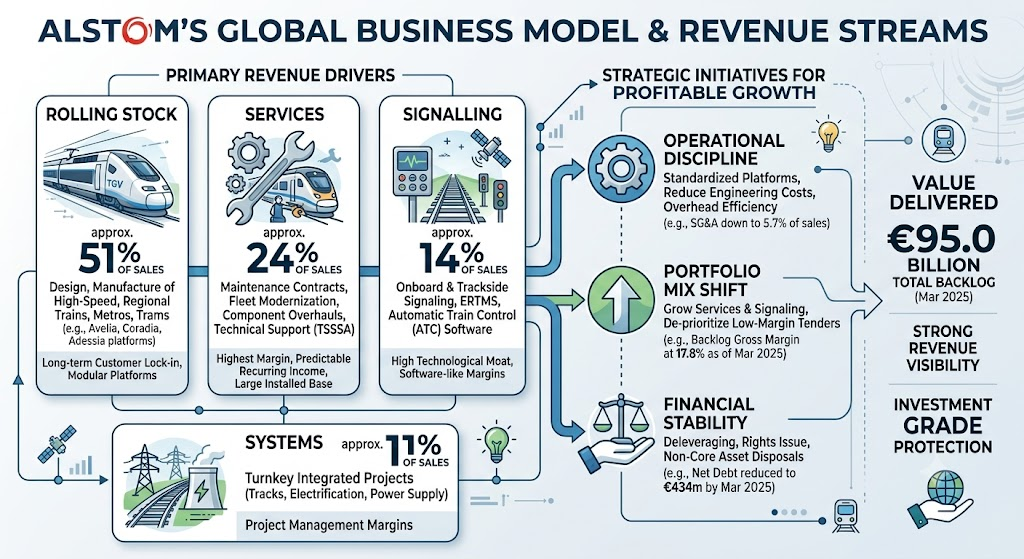
Alstom monetizes its business across four primary reporting segments: Rolling Stock, Services, Signalling, and Systems. In FY 2024/25, Alstom recorded total sales of €18.5 billion, supported by an order intake of €19.8 billion and an aggregate backlog of €95.0 billion.
Segmental Monetization Architecture
- Rolling Stock(approx. 51% of sales; €9.5 billion in FY 2024/25): Focuses on the design and manufacturing of very high-speed trains, regional trains, metros, and light rail vehicles. Rolling stock serves as the primary gateway for long-term customer lock-in, though it generates lower operating margins due to fixed-price design and manufacturing risks.
- Services(approx. 24% of sales; €4.5 billion in FY 2024/25): The highest-margin and most predictable revenue stream. Alstom capitalizes on its installed base of over 36,000 vehicles worldwide through long-term maintenance contracts, fleet modernization, component overhauls, and Technical Support and Spares Supply Agreements(TSSSA).
- Signalling(approx. 14% of sales; €2.6 billion in FY 2024/25): Supplies proprietary onboard and trackside electronic signaling, European Rail Traffic Management System(ERTMS) solutions, and Automatic Train Control(ATC) software. This segment features software-like gross margins and high technological moats.
- Systems(approx. 11% of sales; €1.8–€1.9 billion in FY 2024/25): Provides integrated, turnkey rail transit packages covering electrification, tracks, power supply, and station mechanical installations, capturing systemic project management margins.
Strategic Roadmap for Profitable Growth
- Portfolio Mix Shift: Alstom is selectively de-prioritizing low-margin vehicle manufacturing tenders to grow its Services and Signalling segments, where gross margins regularly exceed 20%. The gross margin embedded in its backlog rose to 17.8% as of March 2025.
- Operational Discipline and Margin Recovery: The group focuses on standardized modular vehicle platforms(e.g., Coradia Stream, Adessia) to reduce non-recurring engineering costs. Its overhead efficiency measures brought Selling, General, and Administrative(SG&A) expenses down to 5.7% of sales by March 2025.
- Deleveraging to Protect Investment Grade: Following negative free cash flow cycles during peak Bombardier integration, Alstom reduced its net debt position from €2.99 billion to €434 million by March 2025 using disposal proceeds, equity reinforcement, and operating cash generation.
Sources for Business Model
- https://www.alstom.com/press-releases-news/2025/5/fy-202425-alstom-delivers-solid-profit-and-cash-medium-term-ambitions-confirmed
- https://www.alstom.com/sites/alstom.com/files/2025/05/14/20250514_PR_Alstom_FY_%202024_25_Annual_Results_EN_1.pdf
- https://railway-news.com/alstom-reports-solid-fy-2024-25-financial-results/
- https://www.alstom.com/solutions/services/flexcare-perform-rail-maintenance-services-all-types-assets
AI Strategy, Budget, and Ecosystem Partnerships
Alstom’s digital roadmap positions Artificial Intelligence as a foundational driver for operational efficiency, predictive maintenance, and autonomous train operation(ATO). The company reinvests approximately 3.8% of its total annual sales into research and development, representing an annual R&D expenditure of roughly €700 million, with digital signaling, cloud architectures, and AI algorithms capturing an increasing portion of this allocation.
Key Application Pillars and Real-World Implementations
- Predictive Maintenance via HealthHub and Digital Twin: Alstom deploys its proprietary HealthHub platform and TrainScanner portals, which utilize computer vision, vibration sensors, and machine learning models to analyze component degradation in real time. Applied to wheelsets, brake pads, and pantograph contact strips, these models reduce train maintenance downtime by up to 20–30% and eliminate fixed-schedule component replacements.
- Autonomous Mobility and ATO Systems: Alstom develops algorithmic solutions for driverless transit ranging from Grade of Automation 2(semi-automated) to GoA 4(unattended train operation). Operational deployments such as Paris RER Line A utilize Alstom’s automatic driving systems to cut headway intervals down to 2 minutes and 20 seconds, simultaneously reducing traction energy consumption by up to 45% through predictive speed curve optimization.
- Augmented Workforce and Engineering 4.0: In engineering and tender processes, Alstom applies generative AI models to parse complex contract requirements and technical specifications. This tool evaluates requirement quality and automatically flags inconsistencies, which Alstom reports has improved overall specification quality by 25% and reduced non-quality rework costs.
Strategic Cloud and Technology Partnerships
- Microsoft: Alstom entered into a strategic collaboration with Microsoft to build enterprise applications leveraging Microsoft Azure, Azure OpenAI Service, and GitHub Copilot. This infrastructure supports large-scale processing of technical documentation, code refactoring, and AI-assisted maintenance manuals across global sites.
- Amazon Web Services(AWS) and Devoteam: In collaboration with Devoteam, Alstom built its cloud-native EBISense Onboard Platform on AWS. The platform aggregates and processes high-frequency sensor streams(temperature, humidity, vibration, and pressure) using AWS-hosted machine learning models to detect failure patterns before field breakdowns occur.
- Innovation Hubs and Academic Ecosystems: Alstom operates dedicated technology centers, including its Innovation Station in Singapore and facilities in Saint-Ouen, France, collaborating with rail operators like SNCF, Deutsche Bahn, and ProRail to test edge-AI computer vision for obstacle detection on mixed-traffic tracks.
Back to Alstom