
Market Position and Market Share
Ajinomoto Co.,Inc.(TYO:2802) holds a monopolistic to dominant global position across two distinct core sectors: advanced semiconductor packaging materials and amino acid-based food/biochemical products.
In advanced semiconductor materials, Ajinomoto produces Ajinomoto Build-up Film(ABF), an essential dielectric insulating film used in high-density build-up substrates for central processing units(CPUs), graphics processing units(GPUs), high-performance computing(HPC) chips, and network ASICs. Ajinomoto commands virtually a near-monopoly with approximately 90% to 95% global market share in the advanced FC-BGA(Flip Chip-Ball Grid Array) dielectric film segment. The company ranks #1 globally with no direct peer matching its production scale or qualification depth across advanced node packaging(e.g., chiplet architectures and 2.5D/3D packaging packaging ecosystems like TSMC’s CoWoS and Intel’s EMIB).
In amino acids and food seasonings, Ajinomoto is the world’s largest producer of monosodium glutamate(MSG), holding an estimated 20% to 25% share of the global commercial MSG market and ranking #1 worldwide. In pharmaceutical-grade and specialty amino acids for cell culture media and bioprocessing, Ajinomoto ranks among the top three suppliers globally alongside Evonik and Kyowa Hakko, capturing over 25% global market share in specialty pharmaceutical amino acids.
Supply Chain Analysis and Key Suppliers
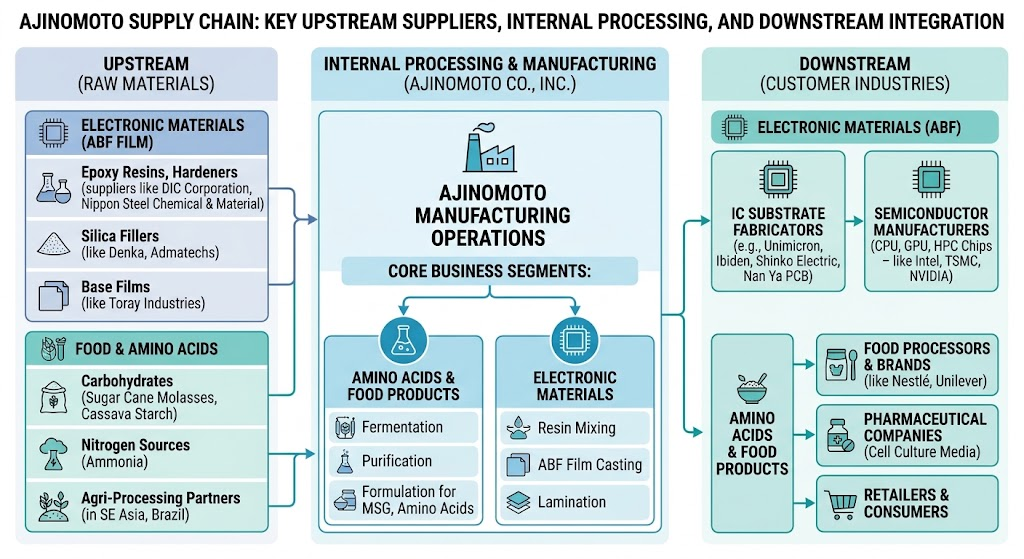
Ajinomoto operates two primary supply chains: electronic materials(functional materials) and bio-fermentation/food ingredients.
Upstream Supply Chain and Key Suppliers:
For the electronic materials division(ABF), raw materials comprise specialized epoxy resins, thermosetting hardeners, inorganic micro-fillers(such as nano-scale silica particles), and polymer additives.
- Epoxy and specialized resins: Sourced from high-grade Japanese chemical manufacturers including DIC Corporation, Nippon Steel Chemical & Material, and Mitsubishi Chemical.
- Inorganic silica fillers: Sourced from suppliers like Denka Company Limited and Admatechs, which provide high-purity, spherical sub-micron silica essential for low thermal expansion coefficient(CTE) properties.
- Base films and release liners: Sourced from film manufacturers such as Toray Industries and Toyobo.For the food and amino acid division, the primary feedstocks are agricultural carbohydrates:
- Carbon sources: Sugar cane molasses, cassava starch, and corn-derived dextrose/glucose, secured through agricultural processing partners in Thailand, Brazil, Indonesia, and North America.
- Nitrogen sources: Ammonia and ammonium salts procured from industrial chemical suppliers.
Downstream Integration and Channel Architecture:
- ABF Downstream: Ajinomoto supplies raw ABF film rolls directly to leading global IC substrate fabricators. The primary Tier-1 substrate makers include Unimicron Technology, Ibiden, Nan Ya PCB, Kinsus Interconnect Technology, Shinko Electric Industries, and AT&S. These fabricators process ABF into multi-layer FC-BGA substrates before delivering them to OSATs(e.g., ASE Technology Holding, Amkor) or integrated device manufacturers/fabless chip designers(TSMC, Intel, AMD, NVIDIA).
- Bio/Food Downstream: Products flow to B2B food processors(Nestlé, Unilever), animal feed formulators, contract development and manufacturing organizations(CDMOs), biopharma firms(cell culture media), and directly to retail consumers via global retail supermarket distribution networks.
Competitor Analysis: Technical and Financial Comparison
Technical Comparison:
In the semiconductor dielectric material sector, Ajinomoto’s ABF relies on a proprietary composite formulation of thermoset epoxy resin, cyanate ester, and precisely dispersed spherical silica nanoparticles. Its technical barrier centers on three parameters: extremely low coefficient of thermal expansion(CTE, matching silicon and copper), ultra-low dielectric loss(Df) and dielectric constant(Dk) at high frequencies(vital for 5G, 6G, and PCIe 6.0/7.0 signals), and defect-free micro-via formation via laser drilling down to 20-30 microns.
- Competitors: Resonac Holdings(formerly Showa Denko/Hitachi Chemical) produces liquid dielectric and dry film alternatives; Sekisui Chemical produces thermosetting resin sheets; and Taiwan-based companies like Eternal Materials and Elite Material Co.(EMC) have attempted to develop alternative build-up films.
- Technical Moat: Competitors struggle with mechanical warpage control at layer counts exceeding 16 to 20 layers and reliability qualification cycles that take 3 to 5 years with chipmakers(NVIDIA, AMD, Intel) and foundries(TSMC). Ajinomoto remains the default reference material written into the design rules of major EDA and chip architecture specs.
In specialty biopharma amino acids and animal nutrition:
- Competitors include Evonik Industries, CJ CheilJedang, and Fufeng Group. While Chinese and South Korean competitors(CJ, Fufeng) compete aggressively on volume and cost for commodity-grade amino acids(feed-grade lysine, standard MSG), Ajinomoto differentiates through high-purity cGMP medical grade amino acids, patent-protected chiral chemistry, and biomanufacturing formulations for mRNA vaccines and regenerative medicine.
Financial Comparison:
- Operating Margin: Ajinomoto’s Functional Materials segment(which houses ABF) routinely delivers operating profit margins exceeding 30% to 35%, substantially higher than its consolidated corporate operating margin of approximately 10% to 11%. In comparison, diversified chemical competitors like Resonac operate at consolidated margins typically between 4% and 7%, while food/commodity fermentation peers like CJ CheilJedang achieve operating margins between 5% and 8%.
- Return on Equity(ROE): Ajinomoto targets and maintains an ROE in the range of 11% to 13%, outperforming Resonac(which has experienced volatility due to semiconductor cycle downturns and restructuring) and traditional commodity chemical producers.
- Capital Expenditure and R&D: Ajinomoto allocates over 20% of its capital expenditures to expanding ABF capacity(notably across its Gunma and domestic production facilities) and sustains an R&D-to-revenue ratio of approximately 2.5% to 3.0% overall, with electronic materials and healthcare commanding the highest marginal reinvestment rate relative to sales.
Sources
- https://www.ajinomoto.com/ir
- https://www.ajinomoto.com/rd/our_innovation/abf
- https://www.resonac.com/products/electronics
- https://www.bloomberg.com/quote/2802:JP
- https://www.reuters.com/markets/companies/2802.T
back to Ajinomoto