
Air Liquide holds a position as one of the top three global giants in the industrial and healthcare gas industry(alongside Linde plc and Air Products).
Global Market Position and Scale
- Industry Leadership: It is a global leader in gases, technologies, and services for industry and health, generating annual revenues approaching €27 billion.
- Global Footprint: Operating across nearly 60 countries, Air Liquide employs around 65,000 people and serves over 4.3 million customers and patients worldwide.
- Oligopolistic Market Structure: The global industrial gas sector is highly consolidated. Air Liquide and Linde together command a major share of the global market, acting as each other’s primary competitors across key economic regions.
Key Market Segment Performance
- Electronics and Semiconductor Specialty Gases: Holds a critical market-leading position in ultra-high purity gases for advanced semiconductor nodes, continuing to expand market share across Asia(e.g., through strategic acquisitions like DIG Airgas in South Korea) and North America driven by AI chip and foundry expansion.
- North America and Europe: Solidified its top-tier market leadership in European and North American industrial gas supply and retail distribution networks through decades of footprint development and major acquisitions(such as Airgas in the US).
- Healthcare and Home Care: Ranks as a market benchmark with significant global market share in medical gas supply and chronic patient Home Healthcare services, particularly across Europe and major international markets.
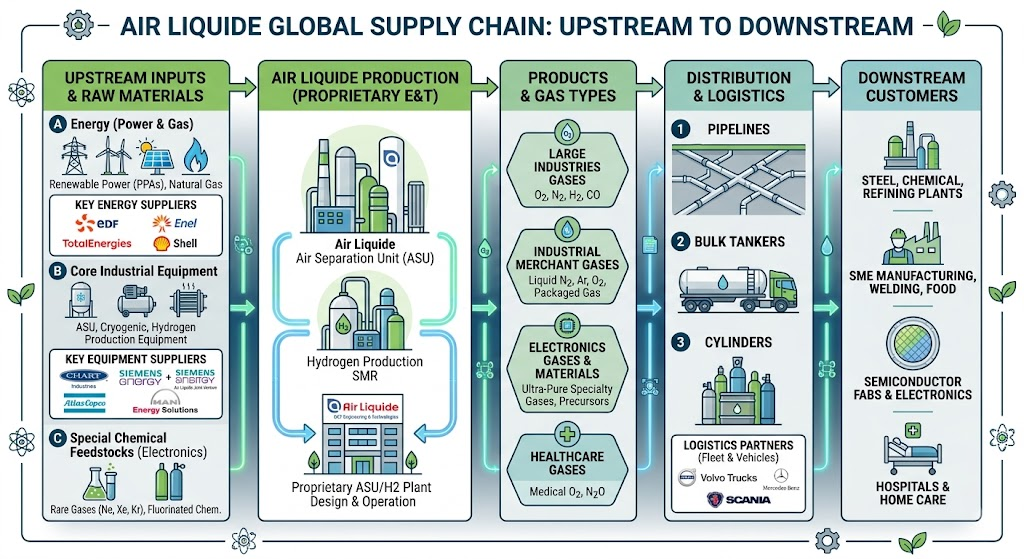
Air Liquide’s supply chain structure is highly specialized. A key competitive edge lies in its proprietary Engineering & Technologies (E&T) division, which enables the company to design, engineer, and build many of its own Air Separation Units (ASUs) and decarbonization technologies, thereby minimizing reliance on third-party EPC (Engineering, Procurement, and Construction) contractors.
The four core components of Air Liquide’s supply chain and its key suppliers include:
1. Energy & Utilities (Power & Natural Gas)
Air Separation Units (ASUs) and water electrolysis for hydrogen production are extremely energy-intensive, making electricity the single largest operating cost for the group.
- Key Inputs: Air (free atmospheric source), electricity, natural gas (for steam methane reforming), and water.
- Key Suppliers:
- Utilities & Renewable Energy Developers (PPA Partners): Major international power producers such as EDF, TotalEnergies, and Enel, which sign long-term Power Purchase Agreements (PPAs) to supply renewable electricity.
2. Core Industrial Equipment & Technology Partners
While Air Liquide handles significant design work via its E&T unit, it collaborates with global industrial OEMs for heavy machinery, cryogenic components, and electrolyzer stacks.
- Electrolyzers & Hydrogen Technology Partners:Siemens Energy. The two companies established a joint venture in Berlin to mass-produce gigawatt-scale Proton Exchange Membrane (PEM) electrolyzer modules.
- Cryogenic Equipment:Chart Industries. Supplies critical low-temperature gas processing equipment, including cryogenic storage tanks, cold boxes, and brazed aluminum heat exchangers.
- Compressors & Rotating Machinery:Atlas Copco, MAN Energy Solutions, and Siemens. They supply high-pressure industrial gas compressors and expanders.
3. Semiconductor & High-Purity Specialty Chemical Feedstocks
For its Electronics division, Air Liquide relies on upstream sources for raw specialty gas precursors and noble gases.
- Key Suppliers: Global refiners and producers of rare/noble gases (such as krypton, xenon, and neon), fluorochemical producers, and semiconductor-grade chemical manufacturers.
4. Logistics & Distribution Infrastructure
Once produced, gases are delivered via pipelines, bulk tankers, or gas cylinders.
- Pipelines: Air Liquide directly owns and operates thousands of kilometers of dedicated industrial gas pipelines globally.
- Transport Fleet: Vehicle manufacturers like Volvo Trucks, Mercedes-Benz, and Scania provide heavy-duty tractor units and cryogenic trailers, with ongoing transitions toward hydrogen fuel-cell truck fleets.
Sources:
- https://engineering.airliquide.com/large-electrolyzer
- https://www.airliquide.com/group/activities/engineering-technologies
- https://www.chartindustries.com/
Air Liquide operates in a highly consolidated, oligopolistic market structure within the global industrial gas industry. Its primary competitors include global leader Linde plc, US-based Air Products and Chemicals, and Japan-based Nippon Sanso Holdings.
Below is a detailed competitive analysis across financial performance and technological capabilities:
1. Financial Comparison
Revenue Scale & Margin Structure
- Revenue Scale: Air Liquide generates around €27 billion (approx. $29 billion) in annual revenue, making it the second largest globally behind Linde ($33 billion) and ahead of Air Products ($12 billion).
- Profitability:
- Linde: Leads the industry in operational efficiency with operating margins around 28%–29%, supported by strong price pass-through mechanisms and asset optimization.
- Air Liquide: Maintains operating margins around 19%–20%. Under its “ADVANCE” strategic plan, it is driving steady margin expansion (targeting a +460 bps increase). Its gross margin exceeds 56%, higher than both Linde and Air Products.
- Air Products: Generates operating margins around 22%–24%, though short-term margins face volatility due to massive capital expenditure commitments in clean energy mega-projects.
Capital Allocation & ROCE
- Air Liquide: Maintains a recurring ROCE of over 10%. It follows a balanced capital allocation approach, distributing CapEx across electronics, healthcare, and energy transition assets rather than over-concentrating in single projects.
- Linde: Applies strict capital discipline, prioritizing share buybacks and high cash-flow conversion.
- Air Products: Pursues a high-risk, high-reward mega-project strategy, committing significant capital to large-scale green and blue hydrogen projects in North America and the Middle East.
2. Technical & Operational Capabilities
Proprietary Engineering & Equipment (Proprietary E&T)
- Air Liquide: Features a dedicated Engineering & Technologies (E&T) division that designs and builds proprietary Air Separation Units (ASUs) and cryogenic equipment, reducing reliance on third-party EPC contractors.
- Linde: Operates Linde Engineering, which commands a significant market share in industrial gas and decarbonization engineering worldwide.
- Air Products: Divested its LNG process technology and equipment business to focus more closely on core industrial gas operations and large hydrogen facilities.
Hydrogen & Decarbonization Strategy
- Air Liquide: Takes a ecosystem-driven, partnership approach. It established a joint venture with Siemens Energy to operate a Gigafactory in Berlin producing PEM electrolyzer modules, alongside extensive Carbon Capture and Storage (CCS) projects.
- Air Products: Follows a self-owned mega-facility model, directly developing large-scale low-carbon hydrogen and ammonia production facilities.
- Linde: Holds strong patent barriers in high-pressure hydrogen storage, distribution, and refueling technology.
Electronics & Specialty Materials
- Air Liquide: Holds a market-leading stance in ultra-high purity specialty gases, advanced deposition precursors, and on-site gas management services for leading foundries like TSMC, Samsung, and Intel.
- Nippon Sanso: Maintains strong regional leadership and technical competitiveness in semiconductor specialty gases across Asia.
- Linde: Holds a major market share in bulk and specialty gas supply for semiconductor fabrication plants globally.
3. Competitive Matrix Summary
| Category | Air Liquide | Linde plc | Air Products |
| Market Position | Global #2 | Global #1 | Global #3 |
| Core Strengths | Electronics gases, Healthcare, Hydrogen ecosystem | Industrial bulk gases, Operating margins, Capital efficiency | Large-scale hydrogen & blue ammonia mega-projects |
| Financial Style | Steady growth, resilient recurring revenue, expanding margins | Strong pricing power, high cash flow & returns | Aggressive CapEx, long-term energy transition bets |
| Tech Edge | In-house E&T engineering, PEM electrolyzer mass production, specialty materials | Cryogenic separation, high-pressure hydrogen logistics | Large-scale gas reforming & hydrogen production facilities |
Back to Air Liquide