
With over a century of history, Air Liquide’s development can be divided into four key stages:
1. Foundation and Technological Breakthroughs(1902–1920s)
- 1902: Co-founded in Paris, France by physicist Georges Claude and entrepreneur Paul Delorme, mastering key air liquefaction and fractionation technologies.
- Early Internationalization: Rapidly expanded gas supply to other European countries as well as overseas markets including Japan and Canada, laying the foundation for globalization.
2. Post-War Expansion and Diversification(1950s–1980s)
- Pipeline Networks: Pioneered the construction of industrial gas pipeline networks, directly connecting major steel mills and chemical parks to significantly reduce transportation costs.
- Healthcare and Aerospace: Entered the medical gas market and participated in European aerospace programs, providing liquid hydrogen and liquid oxygen technologies for rocket propellants.
3. Global M&A and High-Tech Transformation(1990s–2010s)
- Entry into Semiconductors: Established an Electronics business unit to provide high-purity specialty gases and on-site management services specifically for semiconductor and display fab plants.
- Major Acquisition: Acquired US gas giant Airgas for approximately $13.4 billion in 2016, substantially consolidating its market leadership in North American industrial gas and retail distribution channels.
4. Green Transition and Hydrogen Strategy(2020s–Present)
- Hydrogen Ecosystem: Actively driving the global carbon neutrality transition by accelerating green hydrogen production, large-scale water electrolysis facilities, and hydrogen mobility applications.
- Sustainable Technology: Focusing on Carbon Capture and Storage(CCS) and industrial decarbonization technologies, aiming to achieve net-zero carbon emissions by 2050.
Air Liquide’s core business model and development strategy are outlined below:
Business Model(How the Company Makes Money)
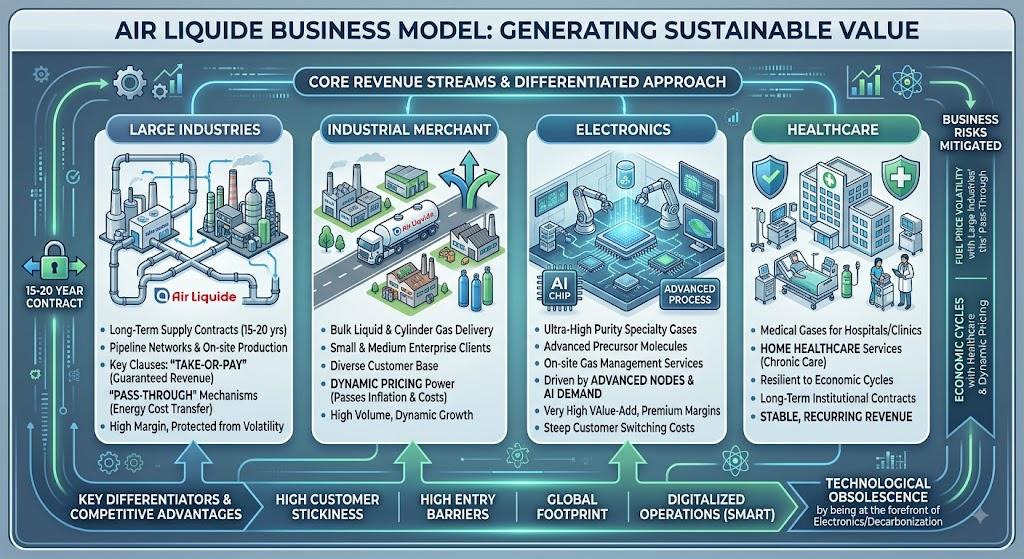
Air Liquide generates revenue primarily through four main business lines, relying on long-term contracts, high customer stickiness, and differentiated pricing strategies:
- Large Industries: Supplies pipeline gas or builds dedicated on-site production facilities for major steel, chemical, and refining plants. Revenue is anchored by 15-to-20-year long-term contracts featuring “Take-or-Pay” clauses and “Pass-Through” mechanisms for energy costs. This structure secures guaranteed baseline revenue regardless of customer capacity utilization and insulates the business from fuel price volatility
- Industrial Merchant: Provides bulk liquid gases via tankers or packaged cylinders to small and medium-sized manufacturers, food processors, and fabricators. With a large and diversified customer base, the company exercises dynamic pricing power, passing inflation and cost increases to end-customers to protect profit margins.
- Electronics: Supplies ultra-high purity specialty gases, advanced precursor molecules, and on-site gas management services to semiconductor foundries and display manufacturers. Driven by advanced nodes and AI chip production, these high-value-added products command premium margins and carry steep switching costs for customers
- Healthcare: Delivers medical gases to hospitals and clinics alongside Home Healthcare services and hygiene ingredients. Revenue streams stem from long-term institutional contracts and ongoing chronic patient care, making this segment highly resilient to economic cycles
Development Strategy
The group’s growth path is anchored by its “ADVANCE” strategic plan, aligning financial performance with sustainability:
- Capitalizing on High-Growth Sectors and Technical Barriers: Accelerating capital expenditure in semiconductor specialty gases and materials to capture global fab expansion and AI chip demand, ensuring a higher proportion of high-margin business
- Leading the Hydrogen Ecosystem and Decarbonization: Investing heavily in low-carbon and green hydrogen production, large-scale water electrolysis facilities, and hydrogen mobility solutions. Additionally, providing heavy industry clients with Carbon Capture and Storage(CCS) technologies to create new decarbonization revenue streams.
- Operational Efficiency and Dynamic Pricing: Leveraging SMART digital operation centers for remote facility management and energy optimization globally, alongside portfolio discipline and precise pricing to continually expand operating margins
Source:
- https://www.airliquide.com/group/air-liquide-brief
- https://www.airliquide.com/group/strategy
- https://www.airliquide.com/stories/group/performing-impact-create-long-term-value
Back to Air Liquide