
Market Position and Market Share
AIB Group plc operates as one of the two pillar retail and commercial banks anchoring the Irish banking system. Following the complete market departures of Ulster Bank and KBC Bank Ireland, the Irish banking landscape consolidated into an effective duopoly between AIB Group and Bank of Ireland, with PTSB operating as a smaller third tier.
- Retail Lending and Deposits: AIB maintains a market share above 30% in Irish retail lending and customer deposit balances, alternating with Bank of Ireland for the No. 1 or No. 2 position depending on seasonal balance sheet drawdowns.
- Mortgage Origination: AIB commands an estimated 30% to 33% share of new mortgage lending in the Republic of Ireland, competing against Bank of Ireland (~38% to 40%) and PTSB (~20% to 25%).
- SME and Business Banking: AIB holds the No. 1 market position in SME and commercial accounts with a market share hovering in the mid-40s (~45%).
- Current Accounts:The group handles more than 30% of total primary personal current account volumes in Ireland.
Upstream and Downstream Value Chain Analysis
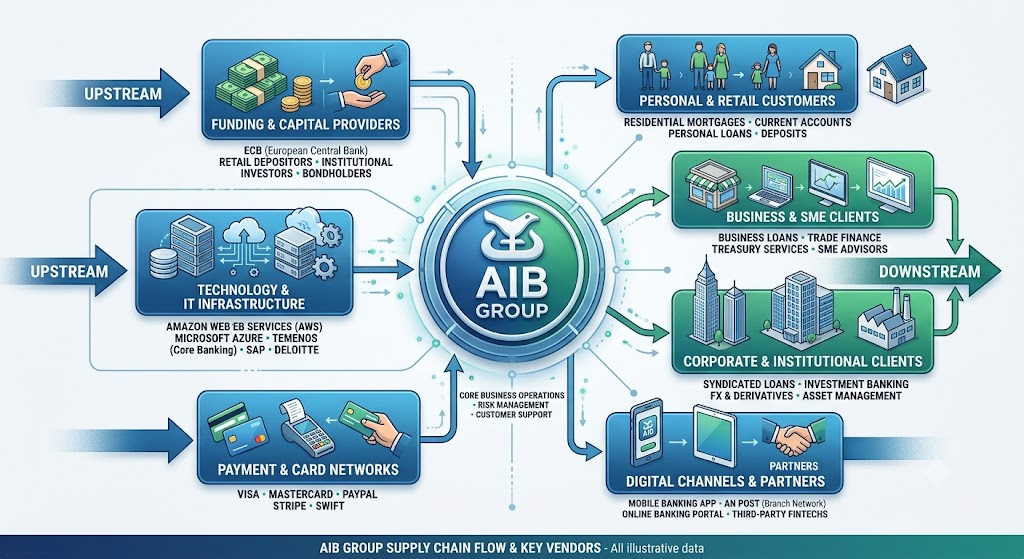
Because AIB Group operates as a universal financial services institution, its supply chain structure is mapped across upstream capital, technology, and regulatory inputs down to customer distribution endpoints.
- Upstream Inputs:
- Liquidity and Capital Providers: The primary raw material of a commercial bank is capital and funding. AIB’s upstream funding is anchored by retail customer deposits, wholesale repo markets, institutional debt syndication (MREL and senior non-preferred issuance), and the European Central Bank (ECB) refinancing facilities.
- Key Core Technology Suppliers: Core banking infrastructure and cloud architecture are critical inputs. AIB relies on Amazon Web Services (AWS) and Microsoft Azure for cloud computing pipelines, Temenos / Fiserv / proprietary legacy architectures for core transaction processing, and specialized vendors like Salesforce (CRM) and ServiceNow for workflow automation.
- Payment Networks and Card Infrastructure: Upstream clearance and interchange settlement rails are powered by Visa and Mastercard, as well as the Single Euro Payments Area (SEPA) and Target2 networks overseen by the Eurosystem.
- Risk and Compliance Architecture: Credit scoring algorithms, AML screening, and regulatory compliance rely heavily on Experian, FICO, and Moody’s Analytics.
- Downstream Delivery and Distribution:
- Omnichannel Branch Network: AIB operates a dense physical branch network across Ireland, supplemented by a long-term strategic agency agreement with An Post (the Irish postal service), enabling customers to execute cash handling and everyday banking across over 900 post office locations.
- Digital Channels: Mobile and internet banking apps serve as the primary conduit for daily transactions, consumer credit origination, and personal line drawdown.
- Broker Intermediaries: For residential mortgage distribution, AIB leverages both direct branch channels and independent mortgage brokers (such as EBS broker channels and third-party financial advisors).
- Corporate End Users: Downstream corporate products are delivered directly through dedicated corporate, institutional, and treasury coverage teams servicing domestic enterprises, agricultural businesses, and multinationals based in Ireland.
Competitor Analysis
AIB’s primary domestic rivals are Bank of Ireland Group plc (BOI) and PTSB (Permanent TSB Group Holdings plc), alongside emerging digital challenger neobanks like Revolut.
- Financial Comparison:
- Profitability and Net Interest Margin (NIM):AIB and Bank of Ireland both sustained strong profitability during the ECB rate-tightening cycle, with AIB posting annual net profits in the ~€2.0 billion range, on par with Bank of Ireland’s ~€1.9 to €2.0 billion pre-tax run rates. Both institutions hold structurally low cost of funding relative to continental peers due to the high proportion of non-interest-bearing or low-yielding current accounts.
- Asset Quality (NPE/NPL Ratio):AIB significantly cleaned up its balance sheet from post-crisis highs (>20%), bringing its Non-Performing Exposure (NPE) ratio to roughly 3.0%–3.4%, matching Bank of Ireland’s credit profile and outperforming historical domestic distress metrics.
- Capital Adequacy (CET1): AIB maintains a fully loaded Common Equity Tier 1 (CET1) ratio typically above 15.5%–16.0%, providing a substantial surplus above regulatory requirements and supporting recurring share buybacks and dividends. BOI operates at comparable capital levels (15%–15.5%), while PTSB operates with thinner capital headroom.
- Technological Comparison:
- Versus Bank of Ireland: Bank of Ireland underwent a multi-billion-euro core banking system replacement over recent years. While AIB has executed progressive modernization and API-first modular integrations rather than a single monolithic core overhaul, AIB’s customer-facing mobile banking interface generally maintains higher consumer ratings and faster adoption speeds for everyday retail services.
- Versus PTSB: PTSB historically lagged in IT investment and digital onboarding due to capital constraints, though it is upgrading systems following its acquisition of Ulster Bank asset packages. AIB holds a significant digital scale advantage in automated underwriting and straight-through processing for personal lending.
- Versus Fintechs (Revolut): Neobanks have taken substantial market share in daily consumer card spending and micro-transfers in Ireland. In response, traditional players launched shared initiatives (such as Synch Payments / Yuno), but AIB’s defense rests on retaining the primary sticky salary account, residential mortgages, and SME relationship lending, areas where neobanks face structural balance sheet and regulatory limitations.
Sources
- https://www.fitchratings.com/research/banks/aib-group-plc-19-10-2022
- https://thebanks.eu/banks/14901
- https://www.aib.ie/content/dam/aib/investorrelations/docs/credit-ratings/s-and-pgr-upgrades-three-irish-banks.pdf
- https://strivesearch.ie/blog/aib-bank-of-ireland-and-permanent-tsb-look-to-bank-their-huge-share-price-gains/
- https://www.goodbody.ie/company-descriptions/
Back to AIB