Market Position and Market Share
Ahold Delhaize is one of the world’s largest food retail groups, holding leading positions across the United States and Western Europe.It operates through 19 local banner brands (including Food Lion, Stop & Shop, Giant Food, Hannaford, Albert Heijn, and Delhaize), serving over 60 million customers weekly.
- Global Ranking:Ranks among the top 10 food and grocery retailers globally by revenue, generating approximately €88 billion to €89 billion (~$95 billion) in annual sales.
- U.S. Market Position:Ranks as the #4 largest traditional grocery retailer in the U.S. (behind Walmart, Kroger, and Costco), holding an estimated 4.5% to 5.0% share of the total U.S. grocery market.However, along the U.S. East Coast, it holds a dominant #1 or #2 market share position across key metropolitan regions.
- European Market Position:
- Netherlands (Albert Heijn): Undisputed #1 market leader with approximately 37% market share.
- Belgium (Delhaize): Strong #2 market position with roughly 21% to 22% market share, competing closely with Colruyt.
- Overall regional dominance:Across its operating markets, 96% of net sales come from regions where Ahold Delhaize holds a #1 or #2 position.
Upstream and Downstream Supply Chain Analysis
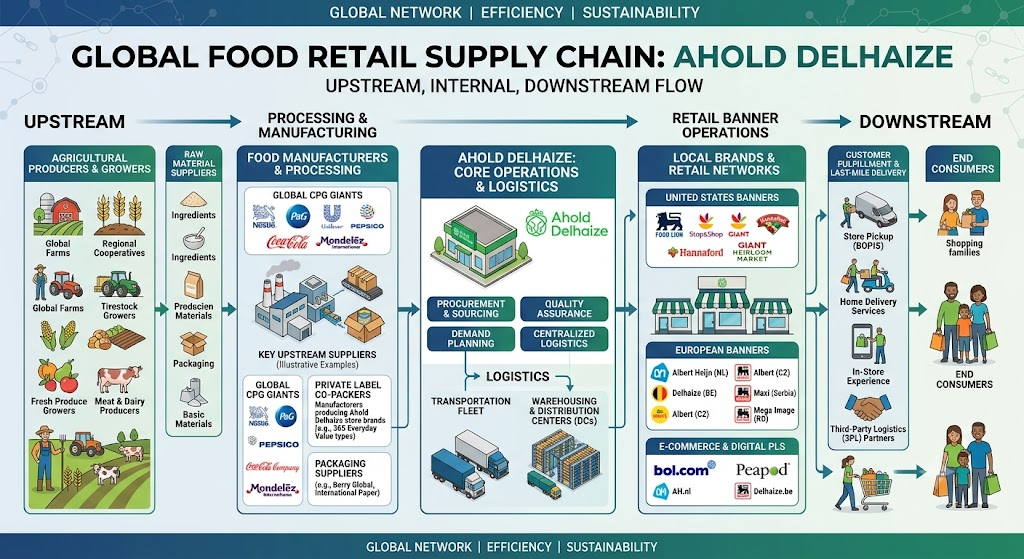
Ahold Delhaize’s supply chain relies on a hybrid decentralized model that balances localized regional sourcing with centralized group procurement efficiencies.
- Upstream Supply Chain & Key Suppliers:
- FMCG & CPG Giants: The upstream network relies heavily on global Fast-Moving Consumer Goods (FMCG) manufacturers for national brands. Primary suppliers include Nestlé, Procter & Gamble, Unilever, PepsiCo, Mondelez, and The Coca-Cola Company.
- Agricultural & Fresh Sourcing: Sourcing for fresh produce, meat, and dairy is highly localized to ensure supply chain resilience and fresh quality. Strategic regional supplier partnerships handle raw agricultural procurement.
- European Procurement Alliances: In Europe, Ahold Delhaize participates in retail purchasing alliances (such as EWA Retail / Everest) to combine buying power against global suppliers for lower wholesale pricing.
- Own-Brand Supply Base: Private-label products make up over 35% to 40% of sales. Ahold Delhaize contracts directly with private-label co-packers and contract manufacturers globally to produce store-branded items (e.g., 365 Everyday Value equivalents, Albert Heijn house brands).
- Downstream Supply Chain & Logistics:
- Fulfillment Networks: Operates an extensive network of automated Distribution Centers (DCs) integrated with automated micro-fulfillment centers (built in partnership with technology providers like Swisslog and AutoStore).
- Omnichannel & Last-Mile Logistics: Downstream fulfillment is divided into store-replenishment logistics and direct-to-consumer e-commerce. It utilizes proprietary online platforms (bol.com in the Netherlands, Peapod Digital Labs in the U.S.) alongside third-party last-mile delivery partnerships (e.g., DoorDash, Instacart) to handle e-commerce orders.
Competitor Analysis
Ahold Delhaize competes in two core geographical markets—the United States (accounting for ~60% of revenue) and Western Europe (accounting for ~40% of revenue).
- Primary Competitors:
- United States:Walmart, The Kroger Co., Albertsons Companies, Target, Trader Joe’s, and Amazon/Whole Foods.
- Europe:Carrefour, Tesco, Colruyt Group, Schwarz Group (Lidl/Kaufland), and Aldi.
- Technology Comparison:
- Ahold Delhaize:Focuses on proprietary e-commerce platforms (bol.com), media monetization (PRISM/Edge platforms for retail media), and micro-fulfillment automation. It employs AI models for demand forecasting, dynamic pricing, and localized customer loyalty hyper-personalization.
- Walmart & Kroger: Walmart leads the industry in supply chain automation, proprietary logistics technology, and advanced AI-driven inventory tracking. Kroger leverages a massive deep-data analytics engine (84.51°) and partnered with Ocado for large-scale automated customer fulfillment centers (CFCs).
- Discounters (Aldi/Lidl): Utilize minimalist, standardized IT infrastructures designed purely for low operational overhead and rapid checkout throughput, rather than complex personalized omnichannel ecosystems.
- Financial Comparison:
- Margins & Profitability: Ahold Delhaize consistently delivers an industry-leading underlying operating margin (EBIT margin) of 3.8% to 4.1%, outperforming traditional peers like Kroger (~2.8% to 3.2%) and Albertsons (~2.5% to 3.0%), though lower than warehouse models like Costco.
- Revenue Scale:Walmart generates over $640B annually, Kroger generates ~$150B, while Ahold Delhaize operates at the ~$95B scale.
- Free Cash Flow Generation:Ahold Delhaize maintains an exceptionally strong Free Cash Flow profile (typically generating €2.0B+ annually), allowing for stable 40–50% dividend payout ratios and routine share buybacks.
Information Sources
- https://aholddelhaize.com/investors/shareholder-information/
- https://strategy.transforml.co/ahold-delhaize-strategy-cascade-analysis
- https://www.owler.com/company/ahold/competitors
- https://www.globaldata.com/companies/top-companies-by-sector/retail-wholesale/global-food–grocery-retailers-by-sales/
- https://companiesmarketcap.com/largest-companies-by-revenue/
Back to Ahold Delhaize