
Corporate History
The Precursor and Conglomerate Era (1824–2007)
The foundation traces back to Assurances Générales (AG), founded in Belgium in 1824. In 1990, AG merged with the Dutch insurer AMEV and VSB Bank to establish Fortis, pioneering the bancassurance model in the Benelux region. Throughout the 1990s and early 2000s, Fortis expanded into a top-20 global financial conglomerate across retail, private banking, and insurance.
The Crisis and Dissolution of Fortis (2007–2009)
In 2007, Fortis joined a consortium with Royal Bank of Scotland and Banco Santander to acquire ABN AMRO. The leveraged transaction coincided with the 2008 global financial crisis, triggering severe liquidity runs and solvency shortfalls. The Benelux governments intervened with an €11.2 billion rescue package. The Dutch government subsequently nationalized Fortis Bank Nederland and ABN AMRO assets, while the Belgian banking operations were sold to BNP Paribas, leaving behind a standalone legal entity holding insurance assets and legacy liabilities.
Rebranding and Strategic Pivot to Ageas (2010–2020)
In April 2010, Fortis Holding was formally renamed Ageas SA/NV to distance the entity from the crisis. During this decade, management settled protracted legacy litigation (notably the €1.3 billion Fortis settlement approved in 2018), streamlined non-core operations, consolidated its Belgian market leadership via AG Insurance, and scaled bancassurance partnerships across Asia.
Strategic Consolidation and Elevate27 (2020–Present)
Ageas executed strategic plans including “Impact24” and launched “Elevate27” to drive higher technical margins, cash generation, and digital transformation. In late 2025, Ageas bought out the remaining 25% minority stake in AG Insurance to take 100% control, while BNP Paribas increased its strategic stake in Ageas to 22.5%, locking in long-term bancassurance distribution stability.
Business Model and Strategic Direction
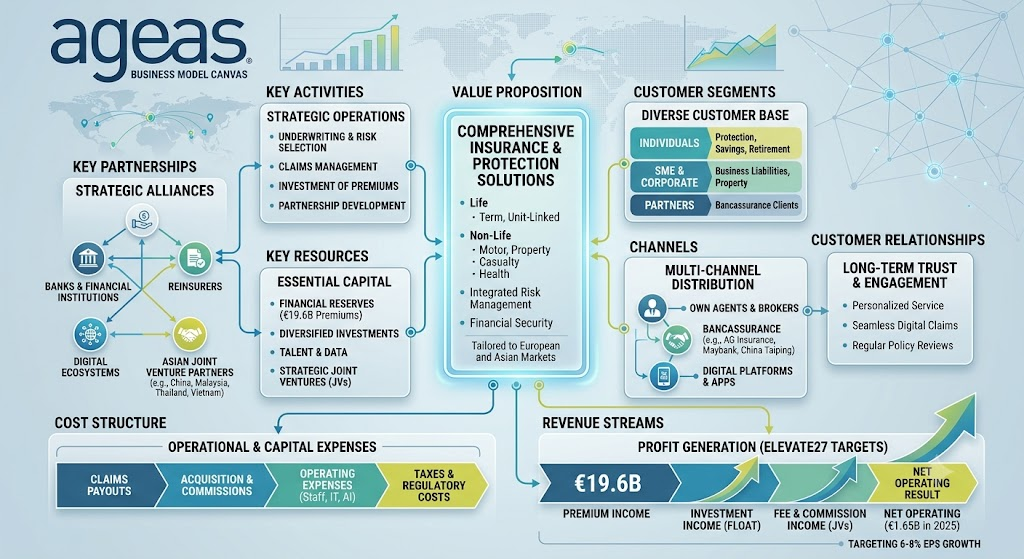
Ageas operates primarily as a multi-line insurance underwriter and capital allocator, generating profit through three main mechanisms: technical underwriting margins, investment spread on policyholder float, and fee/dividend income from non-consolidated partnerships.
In its consolidated European markets (primarily Belgium, Portugal, and the UK), Ageas writes comprehensive Life (guaranteed-rate and unit-linked) and Non-Life (motor, property, casualty, and health) products. Underwriting profit is driven by maintaining a combined ratio below 95% in non-life segments, balancing claims and operational costs against net earned premiums. In life insurance, profit stems from the margin between returns earned on invested float and guaranteed policy yields, as well as recurring administrative fees on unit-linked assets.
In Asia, Ageas operates an asset-light joint-venture model. Rather than deploying capital into wholly owned operations, it partners with leading domestic financial institutions (such as China Taiping in China, Maybank in Malaysia, and Muang Thai in Thailand). Ageas monetizes these partnerships through equity-method earnings, receiving substantial dividend streams without bearing 100% of the balance-sheet volatility.
Financially, the group recorded total premium inflows of €19.6 billion in 2025, while its net operating result climbed to €1.65 billion. Under its Elevate27 strategic framework, Ageas targets an average annual EPS growth rate of 6% to 8%, cumulative holding free cash flow exceeding €2.6 billion, and over €2.2 billion in cumulative shareholder remuneration (dividends and buybacks) through 2027. The strategic direction focuses on expanding protection products for aging demographics, enhancing non-life pricing discipline, and increasing direct ownership of key cash-generating assets.
Sources for Business Model Information
- https://ageas.com/en/annual-report-2025
- https://www.ageas.com/en/newsroom/ageas-reports-full-year-2025-results
- https://www.ageas.com/en/about-us/strategy
- https://en.wikipedia.org/wiki/Ageas
AI Strategy, Budget, and Partnerships
Ageas has integrated artificial intelligence as a core pillar of its Elevate27 strategic roadmap under the “Tech, Data & AI” priority, shifting IT deployment from cost maintenance to direct loss-ratio reduction and workflow acceleration. Rather than developing foundational models in-house, Ageas employs an open-ecosystem approach by partnering with specialized vertical AI vendors and cloud hyperscalers.
In claims management, Ageas became the first major insurer in the UK to deploy deep learning computer vision in production through a multi-year partnership with Tractable. Policyholders upload photos of damaged vehicles via smartphone at first notification of loss (FNOL). Tractable’s algorithms inspect component-level damage, determine repairability versus total loss, and calculate automated labor and parts cost estimates within minutes. This has reduced claim cycle times from several days to under ten minutes on non-structural vehicle damage, processing thousands of claims per month and significantly containing loss adjustment expenses (LAE).
For enterprise infrastructure and underwriting, Ageas partners with Microsoft (Azure AI) and specialized data consultancies like Artefact to modernize legacy core mainframes into unified cloud data lakes. This modernization enables dynamic risk modeling and fraud detection algorithms that cross-reference historical underwriting metrics in real time. In agricultural and specialty insurance lines across international operations, Ageas utilizes AI-driven satellite imagery analysis to assess crop damage and calibrate parametric risk payouts.
While Ageas embeds AI expenditures within broader multi-million-euro digital transformation budgets rather than reporting a standalone research line item, executive management ties AI investments directly to operational benchmarks: reducing operational expense ratios, maintaining top-quartile Net Promoter Scores (NPS), and expanding straight-through processing (STP) capabilities across personal line claims by 2027.
Back to Ageas