
Market Position and Market Share
Adyen is a global financial technology platform that provides enterprise-grade payment processing, acquiring services, and financial products across online, mobile, and in-store channels.
- Market Share: Adyen commands approximately 9.26% of the global payment management market. It ranks second among independent digital payment processing platforms behind Stripe (which holds roughly 25.32%), but holds a dominant market position in the enterprise omnichannel and cross-border payment segment.
- Processed Volume:In full-year 2025, Adyen processed €1,394.3 billion (~$1.5 trillion) in total transaction volume.In H1 2026, the company processed €804 billion in transaction volume.
- Financial Scale:For H1 2026, Adyen reported €1.3 billion in net revenue (up 19% year-over-year) and €642 million in EBITDA, maintaining a industry-leading EBITDA margin of 49%–50%.
- Enterprise Focus:Rather than targeting SMBs, Adyen captures massive market share among global tech giants and multi-national retailers, powering payment infrastructures for Uber, Microsoft, Spotify, Meta, McDonald’s, and eBay.
Supply Chain Analysis and Key Suppliers
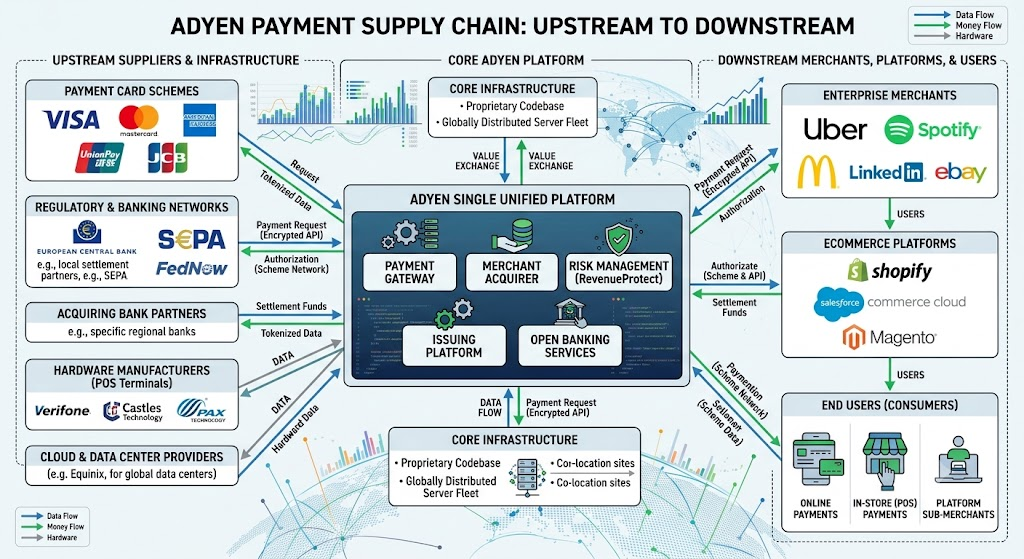
Adyen operates as an end-to-end payment service provider (PSP), payment gateway, merchant acquirer, and licensed banking entity. Its operation spans a distinct multi-layered value chain:
- Upstream Supply Chain:
- Payment Card Networks: Card schemes such as Visa, Mastercard, American Express, UnionPay, and JCB supply transaction authorization standards and network routing.
- Banking Infrastructure & Central Banks: Local banking partners and central clearing houses (e.g., SEPA in Europe, FedNow/ACH in the US) provide settlement capabilities. Adyen holds European banking licenses to clear and settle transactions directly without relying on middleman financial institutions.
- Hardware OEMs: Physical POS terminals (desktop, mobile, unattended) are manufactured by hardware suppliers like Verifone, Castles Technology, and PAX Technology.
- Cloud & Data Centers: Physical co-location facilities (e.g., Equinix) and private cloud networks supply latency-critical processing infrastructure.
- Core Processing Stack:
- Unlike legacy payment processors that bundle third-party gateways and acquiring systems, Adyen’s entire infrastructure is built organically on a single codebase. It incorporates gateway processing, acquiring, risk management (RevenueProtect), and card issuing in one unified environment.
- Downstream Supply Chain:
- Enterprise Merchants & Global Retailers:Multi-channel corporations (e.g., airline, retail, ride-sharing, digital media) that process over $10M+ in annual volume.
- Platform & E-Commerce Partners: Software ecosystem partners including Shopify Enterprise, Salesforce Commerce Cloud, Adobe Commerce (Magento), and SAP, which integrate Adyen as an embedded payment engine.
- Key Suppliers:
- Visa & Mastercard: Critical scheme network providers for card rails.
- Equinix & Hardware OEMs: Data center host providers and terminal manufacturers (Verifone/Castles).
- Telecom Carriers: Cellular data providers (4G/5G) for mobile POS connectivity.
Competitor Analysis
Adyen competes directly with Stripe, PayPal (Braintree), Checkout.com, Worldpay, and Fiserv in the global merchant acquiring and payment gateway landscape.
- Technical Comparison:
- Single Unified Platform vs. Fragmented Architectures: Adyen’s core structural advantage is its single proprietary stack built entirely in-house. Competitors like Worldpay or Fiserv rely on legacy systems stitched together via M&A. This single platform allows unified customer tokenization across online and physical stores (Omnichannel/Unified Commerce).
- Developer Experience vs. Scale Optimization:Stripe leads the market in developer tooling, API design, and rapid self-serve onboarding for SMBs/startups.In contrast, Adyen focuses on enterprise-level routing optimization (Revenue Accelerate), direct local acquiring in over 50 markets, and enterprise ERP/CRM integration.
- Pricing Model:Stripe primarily charges a flat-rate fee (2.9% + $0.30) for standard volume.Adyen utilizes an Interchange++ pricing model (passing actual card scheme fees plus a small markup of ~0.6% + €0.11), making it significantly cheaper for high-volume enterprise merchants.
- Financial Comparison:
- Processed Volume (2025):Stripe processed $1.9 trillion (+34% YoY);PayPal processed $1.79 trillion; Adyen processed €1.394 trillion (~$1.5 trillion).
- Profitability & Margins: Adyen is significantly more profitable than its competitors. Adyen generates an EBITDA margin of 49%–50% (H1 2026 EBITDA of €642 million), whereas legacy acquirers operate at lower margins and Stripe has only recently reached overall profitability.
- Operational Efficiency:Adyen processed €1.39+ trillion with approximately 5,020 employees (~€277M volume per employee).By comparison, Stripe manages $1.9 trillion with roughly 8,000 employees (~$237M volume per employee), demonstrating Adyen’s superior software leverage and operational cost structure.
Information Sources
- https://futurumgroup.com/insights/adyens-h1-2026-results-highlight-strategic-growth-and-market-positioning/
- https://www.alphaspread.com/security/aex/adyen/investor-relations/earnings-call/q2-2026
- https://valueaddvc.com/blog/stripe-vs-adyen-vs-braintree-enterprise-payment-processing-compared-in-2026
- https://www.hubifi.com/blog/adyen-vs-stripe-revenue
- https://apiscout.dev/guides/stripe-vs-paypal-vs-adyen-vs-square-2026
- https://wise.com/zh-cn/blog/adyen-payment-processing
- https://help.shopify.com/zh-TW/manual/payments/third-party-providers/adyen-gateway
Back to Adyen