
Market Position and Market Share
Advantest Corporation (TYO: 6857) is the global number one supplier in the semiconductor Automated Test Equipment (ATE) industry, forming a duopoly alongside US-based Teradyne.
- Overall ATE Market Rank and Share:Advantest ranks #1 worldwide in the semiconductor ATE market, holding an estimated 55% to 60% global market share (estimate based on calendar 2025 industry shipments and company disclosures).In fiscal year 2025 (ended March 31, 2026), Advantest reported record consolidated net sales of ¥1,128.6 billion (a 44.7% YoY increase) and an operating profit of ¥499.1 billion, driven by the explosive expansion of AI computing and High Bandwidth Memory (HBM).
- SoC/Logic Test Systems: Advantest ranks #1 globally with an estimated market share exceeding 60% in high-performance computing (HPC) and artificial intelligence logic testing. In FY2025, Advantest’s SoC test system revenue surged 74.3% YoY to ¥767.4 billion, representing 68% of total company sales. Its V93000 platform has become the de facto reference standard for AI accelerators (such as Nvidia GPUs and custom hyperscaler ASICs).
- Memory Test Systems: Advantest ranks #1 worldwide with an estimated 55% to 65% market share in high-speed memory ATE. The company holds a near-monopoly position in high-speed DRAM and HBM3E/HBM4 wafer and package testing through its T5503HS2 and T5833 platform series. Memory test systems generated ¥171.5 billion in FY2025.
Supply Chain Analysis and Key Suppliers
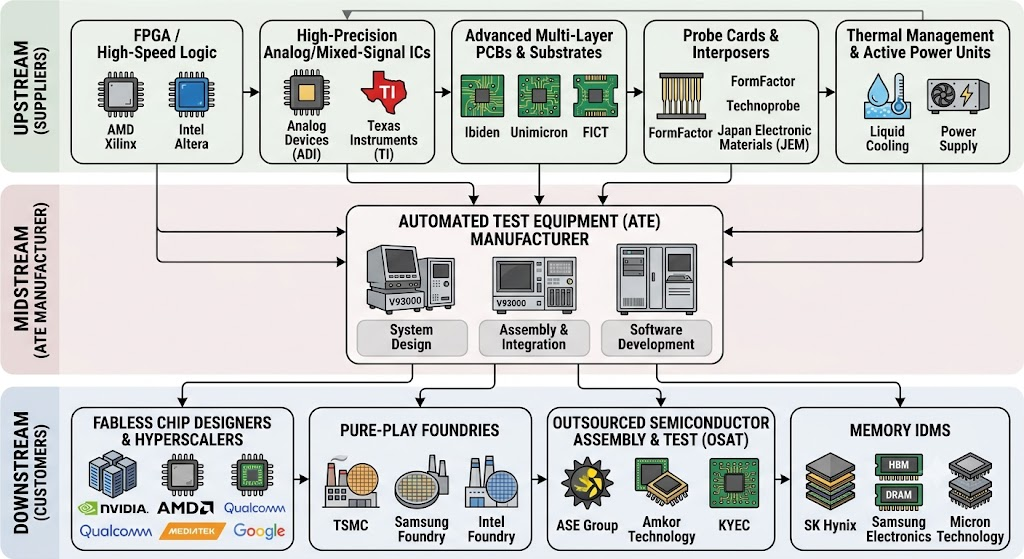
Advantest operates primarily under a fab-lite, high-precision assembly model, relying on specialized component vendors upstream and serving IDMs, foundries, and OSATs downstream.
Upstream Supply Chain and Key Component Suppliers
- Field-Programmable Gate Arrays (FPGAs) & High-Speed Logic: The digital pin electronics and pattern generators within test heads require top-tier reprogrammable silicon to emulate device patterns at gigahertz frequencies. Key suppliers include AMD (Xilinx UltraScale+ / Versal) and Intel (Altera).
- High-Speed Mixed-Signal ICs, ADCs, and DACs: High-precision Analog-to-Digital and Digital-to-Analog Converters, parametric measurement units (PMUs), and high-voltage drivers are sourced from Analog Devices (ADI) and Texas Instruments (TI).
- Advanced Multi-Layer Printed Circuit Boards (PCBs) and Substrates: ATE instrument cards and test heads require ultra-dense, low-loss PCBs exceeding 40 to 60 layers with strict impedance tolerance. Key suppliers include Ibiden, Unimicron, and FICT (formerly Fujitsu Interconnect Technologies).
- Probe Cards and Interposers (Co-development Ecosystem): Wafer-level testing requires advanced vertical probe cards and micro-cantilevers capable of handling tens of thousands of pins simultaneously. Advantest partners tightly with FormFactor, Technoprobe, and Japan Electronic Materials (JEM).
- Thermal Management and Active Power Units:With modern AI chips dissipating 700W to over 1,500W during testing, Advantest integrates active liquid cooling and massive power supply modules (such as the XPS256 and DPS150AE delivering over 1,000A) sourced from specialized Japanese and international precision thermal engineering providers.
Downstream Supply Chain and Key Customers
- Fabless Chip Designers and Hyperscalers: Direct architecture qualification takes place at leading chip design houses. Advantest’s primary driver is Nvidia, followed by AMD, Qualcomm, MediaTek, and hyperscalers developing proprietary AI silicon (Google TPU, Amazon Trainium/Inferentia).
- Pure-Play Foundries: Wafer acceptance testing (WAT) and early wafer sort operations are integrated into TSMC, Samsung Foundry, and Intel Foundry. TSMC’s advanced packaging lines (CoWoS, SoIC) utilize Advantest test cells extensively.
- Outsourced Semiconductor Assembly and Test (OSAT): OSATs purchase and operate the largest volume of test equipment. Major buyers include ASE Technology Holding (including SPIL), Amkor Technology, King Yuan Electronics (KYEC), and Powertech Technology (PTI).
- Memory IDMs: For DRAM, NAND, and stacked HBM modules, Advantest’s core downstream customers are SK Hynix, Samsung Electronics, and Micron Technology.
Competitor Analysis: Technical and Financial Comparison
The primary global competitor to Advantest is US-based Teradyne, Inc., with secondary niche competitors including Cohu, Chroma ATE, and Keysight Technologies.
Technical Architecture and Product Differentiation
- Advantest (V93000 EXA Scale & T5503 Series):
- Strengths: The V93000 platform features a modular, universal “tester-per-pin” architecture. The EXA Scale system uses custom high-speed digital engines (Pin Scale 5000) and power delivery cards capable of managing thousands of power domains and native high-speed SerDes (PCIe Gen 5/6, PAM4 at 112 Gbps). It features superior software integration (SmarTest 8) and early co-optimization with Nvidia’s automated design-for-test (DFT) flows. In memory, Advantest’s tester speed and parallel testing capabilities for HBM microbumps remain unreached by competitors.
- Weaknesses: Long delivery lead times due to capacity constraints during demand surges; software transition barriers between older legacy tester operating systems and SmarTest 8.
- Teradyne (UltraFLEXplus & J750 Series):
- Strengths: Teradyne’s UltraFLEX series excels in mixed-signal, RF (Wi-Fi, 5G cellular), and complex microcontroller/automotive testing. Teradyne has historically dominated Apple’s mobile application processors (A-series, M-series) and maintains deep design ties with Qualcomm. Its IG-XL software environment is widely praised across test engineering communities for rapid test program development.
- Weaknesses: Teradyne reacted slower to the extreme thermal and parallel-power inflection of 1,000W+ AI accelerators, ceding significant market share to Advantest in the AI data center server segment between 2023 and 2025. Teradyne’s presence in dedicated HBM/high-speed DRAM testing is substantially smaller than Advantest’s.
- Secondary Competitors (Cohu, Chroma ATE, Keysight):
- Cohu: Focuses on RF, mixed-signal, and integrated thermal handlers (e.g., Diamondx and Eclipse platforms), but lacks the scale to displace the duopoly in high-end logic.
- Chroma ATE: Excels in specialized power IC, battery management, and system-level test (SLT), but does not compete directly in cutting-edge 2nm/3nm wafer sort ATE.
Financial Comparison
- Revenue and Scale (FY2025):Advantest delivered ¥1,128.6 billion (approximately $7.5 billion USD) in revenue, growing 44.7% YoY. In contrast, Teradyne’s total annual revenues hovered between $2.8 billion and $3.1 billion USD, as softness in mobile consumer electronics and industrial robotics dampened its overall top-line expansion.
- Operating Margins and Profitability:Advantest posted an operating margin of 44.2% in FY2025 (reaching 46.7% in Q4 FY25), demonstrating operating leverage from high-margin AI test instrumentation. Teradyne’s semiconductor test segment operates around 25% to 28% operating margins, but its consolidated margin has been weighed down by its Industrial Automation division (Universal Robots, MiR).
- Return on Equity (ROE) and Capital Efficiency:Advantest generated an ROE exceeding 35% in FY2025, driven by pure exposure to the AI hardware buildout, compared to Teradyne’s ROE in the 18% to 22% range.
Sources
- https://www.advantest.com/document/en/investors/ir-library/investors-guide/Investors_Guide_2604E.pdf
- https://www.advantest.com/en/news/2026/a81o6o0000000hgw-att/E_FR_FY2025_FN.pdf
- https://www.advantest.com/en/investors/financial-highlights/review/
- https://www.investing.com/news/company-news/advantest-fy25-slides-record-margins-as-ai-testing-demand-surges-93CH-4639589
- https://dataintelo.com/report/memory-test-equipment-market
- https://dataintelo.com/report/automated-test-equipment-market
- https://www.astuteanalytica.com/industry-report/semiconductor-automated-test-equipment-market
- https://www.grandviewresearch.com/industry-analysis/automated-test-equipment-market
Back to Advantest