
Corporate History
Origins and Global Expansion (1824–2006)
The bank’s roots trace back to the establishment of the Nederlandsche Handel-Maatschappij (NHM) in 1824, chartered by King William I. Through continuous financial consolidations, NHM merged with Twentsche Bank in 1964 to form Algemene Bank Nederland (ABN), while Amsterdamsche Bank merged with Rotterdamsche Bank to create Amsterdam-Rotterdam Bank (AMRO). In 1991, ABN and AMRO merged to form ABN AMRO Bank N.V. During the 1990s and early 2000s, the institution pursued aggressive international expansion across the Americas, Asia, and global corporate financing, operating as one of Europe’s largest cross-border universal banking conglomerates.
Hostile Takeover, Crisis, and Nationalization (2007–2009)
In October 2007, ABN AMRO was acquired for €71 billion in a hostile takeover by a consortium consisting of the Royal Bank of Scotland (RBS), Fortis, and Banco Santander—the largest banking takeover in history. The subsequent onset of the 2008 global financial crisis severely crippled Fortis and RBS. To prevent systemic collapse, the Dutch government intervened in late 2008 by nationalizing Fortis Bank Nederland, which held ABN AMRO’s Dutch assets, subsequently merging them into a newly restructured state-owned entity known as ABN AMRO Group N.V.
Restructuring and Return to Public Markets (2010–Present)
Following nationalization, management carried out a multi-year turnaround centered on derisking, reducing non-core offshore desks, and building domestic retail and SME capabilities. The Dutch state conducted an initial public offering (IPO) in November 2015, floating a minority stake on Euronext Amsterdam while retaining controlling ownership. In recent years, the government has steadily reduced its equity stake below 40%. The bank also initiated a comprehensive wind-down of non-European corporate and institutional banking (CIB) activities, refocusing on core European banking, digital integration, and wealth management.
Business Model and Strategic Direction
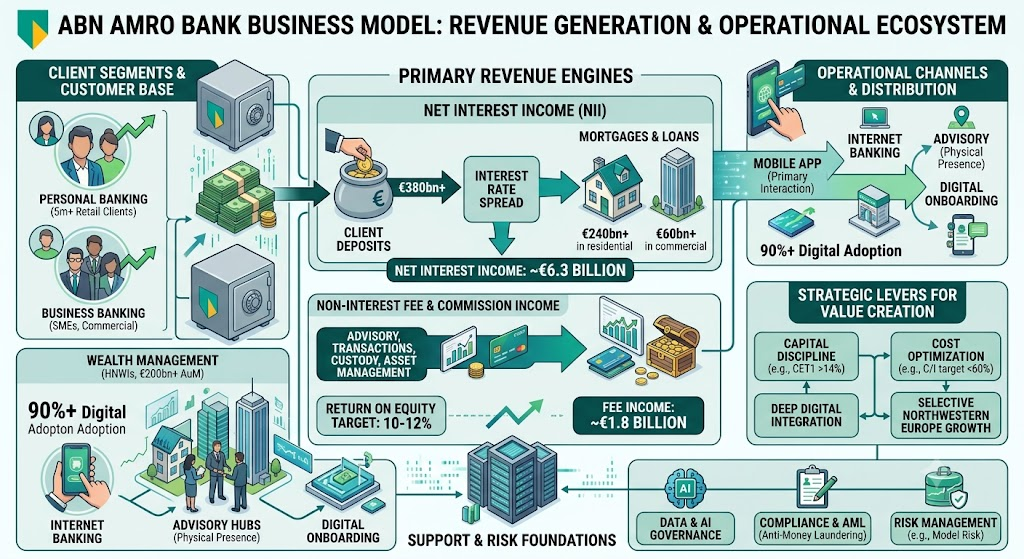
ABN AMRO generates revenue primarily through two core mechanisms: net interest income (NII) derived from financial intermediation spreads, and non-interest fee and commission income across banking, custody, clearing, and advisory services.
Revenue Engine and Financial Profile
- Net Interest Margin (NIM) Intermediation: The bank collects retail and commercial deposits and deploys capital into residential mortgages, corporate term facilities, and sustainability-linked commercial loans. In financial year 2024, ABN AMRO delivered a net profit of €2.28 billion, driven primarily by total operating income of approximately €8.7 billion. Net interest income contributed approximately €6.3 billion (accounting for over 72% of operating income), demonstrating strong earnings generation during elevated central bank policy rates, balanced against non-interest fee income of approximately €1.8 billion.
- Core Operating Segments:
- Personal & Business Banking (P&BB): Serves roughly 5 million Dutch retail clients and local entrepreneurs, generating high-volume interest income from residential mortgages and transactional banking fees.
- Wealth Management: Provides private banking and discretionary wealth services across Northwestern Europe, managing more than €200 billion in client assets under management (AuM) and generating fee-based advisory, management, and custody revenues.
- Corporate & Institutional Banking (CIB): Focuses selectively on corporate lending, trade finance, debt capital markets, and ABN AMRO Clearing—a global clearing franchise delivering market-volatility-driven fee revenues across worldwide exchanges.
Strategic Development Focus
- Capital Discipline and Target Profitability: Management maintains strict cost-to-income objectives (targeting 60% or lower) and an targeted Return on Equity (RoE) of approximately 10–12%, supported by a Common Equity Tier 1 (CET1) ratio maintained above 14% to enable consistent share buybacks and dividend distributions.
- Targeted Regional Consolidation: Following the divestiture of distant corporate desks, the bank executes targeted bolt-on acquisitions in key adjacent European markets (such as the acquisition of NIBC’s retail franchise and wealth acquisitions in Germany) to build scale in Northwestern Europe.
- Digital Migration and Distribution Efficiency: Physical branch density has been trimmed to fewer than 30 advisory hubs across the Netherlands, shifting more than 90% of routine retail interactions and onboarding workflows to digital self-service channels.
Sources
- https://www.abnamro.com/en/investor-relations/financial-results
- https://www.abnamro.com/en/about-abn-amro/annual-report
- https://www.afm.nl/downloadregisterfile.aspx?type=openbaarmaking-voorwetenschap&enc=7Rpj0BBaMD5lzfwUlyQ9TIe+XbKYS1JE7+GVfXY2PxNqAT3NVNKp3QCQcI2WUb5gS/PYmhvg5EA+E7FpgiengZj0NLAMUDbP/oPnUtKH27VA0/CZGu7E4hLGdYYwwWpdumtgpvAq5mn2h5Km1m8B36nyFcMvAU+ZRtixQxCJkyN0n7eTdcRdZ8ts8B3eYh0kcw/DmHdFk6nMb1cBIc+D/IwStEdJ6Sp0bWgWksilCiyYcZOY7GJQpEt3LieSwLuhy5SUpmS77gxJ6PaGRt8L5RFoPDMIk0TiM/NIc+dqgA/qC4Eoj5d+y81qiaPwdh5yLgjrVrEDDIFxdbm0qkfWSQ==
- https://www.abnamro.com/en/news/abn-amro-presents-outcome-of-strategy-review-and-hosts-virtual-investor
Artificial Intelligence Strategy, Budget, and Ecosystem
ABN AMRO’s technology strategy centers on its operating vision of “a personal bank in the digital age”. Rather than developing foundational models in-house, the bank relies on a hybrid enterprise architecture that embeds frontier AI platforms into internal workflows and customer touchpoints.
Enterprise Architecture and Strategic Partnerships
- Microsoft Azure & Copilot Studio: The foundation of ABN AMRO’s conversational AI stack is anchored on Microsoft Azure and Microsoft Copilot Studio. The bank migrated its conversational platforms to Copilot Studio, leveraging Azure Conversational Language Understanding (CLU) and Azure OpenAI Services for semantic entity extraction and intent recognition.
- Azure Databricks Lakehouse & Data Mesh: To eliminate isolated data silos, the bank deployed Azure Databricks on a centralized data mesh architecture. This platform federates hundreds of terabytes of transactional data across disparate business lines, serving over 500 internal data scientists, ML engineers, and quantitative analysts to accelerate machine learning pipeline deployments.
- Specialized Security and Anti-Fraud Partnerships: In compliance and threat detection, the bank leverages corporate venture investments and integration partnerships through entities like Quantexa (contextual decision intelligence for AML) and Hadrian (automated offensive security and attack surface monitoring).
Deployment Scale and Concrete Implementations
- Conversational AI (“Anna” and “Abby”): ABN AMRO’s primary customer-facing agent, “Anna,” processes more than 3.5 million interactions annually (comprising over 2 million digital text chats and 1.5 million inbound voice sessions). Anna handles automated verification, ATM limit modifications, and unblocking procedures without manual handoffs. Internally, the bank operates “Abby,” a generative assistant supporting staff inquiries and HR/IT operational routing.
- Agent Assist in Contact Centers: Generative AI solutions summarize customer conversations in real time, extract action items, and populate CRM records, covering 100% of contact center frontline agents to reduce handling times and improve documentation compliance.
- Risk Modeling and Transaction Monitoring: Machine learning models process payments to identify anomalous transaction graphs, cross-referencing global sanctions lists and reducing false-positive rates in suspicious activity reports (SARs).
Investment Scale and Venture Allocation
- Technology Expenditure: ABN AMRO directs roughly €1 billion annually toward group-wide IT operating expenses, infrastructure modernization, and cloud migrations. Approximately €200–250 million of this annual allocation is deployed into software digitalization, automated credit-decisioning systems, and data/AI governance.
- ABN AMRO Ventures: The bank manages a dedicated strategic corporate venture capital fund capitalized at €150 million. The fund actively backs fintech and deep-tech enterprises specializing in digital infrastructure, AI verification, automated mortgage processing (e.g., Oper), and decentralized ledger tools, ensuring early access and commercial alignment with emerging financial technology.
Back to ABN AMRO