
The history of Anheuser-Busch InBev(AB InBev) is a saga of mergers and acquisitions, which can be divided into four key stages:
1. Foundation and Local Expansion(14th Century-1980s)
- Origins and Early Mergers: The company’s roots trace back to 1366 at the Den Hoorn brewery in Leuven, Belgium. In 1987, two historic Belgian breweries, Artois and Piedboeuf, merged to form Interbrew, consolidating its European foundation.
- Rise of the US Leader: Anheuser-Busch was established in the United States in 1852 and grew into the largest American brewer, propelled by its flagship Budweiser brand.
2. Cross-Border M&A and Globalization(1990s-2008)
- International Expansion: Interbrew aggressively expanded worldwide, acquiring breweries across Central Eastern Europe and Latin America.
- Creation of InBev(2004): Interbrew merged with Brazilian beverage giant AmBev to form InBev, uniting European tradition with South American market momentum.
- The Megamerger(2008): InBev acquired Anheuser-Busch for $52 billion, forming AB InBev and becoming the world’s largest brewing company.
3. Consolidation of Global Dominance(2012-2016)
- Grupo Modelo Acquisition(2013): AB InBev acquired full ownership of Mexico’s Grupo Modelo, bringing Corona into its portfolio.
- SABMiller Combination(2016): Acquired its chief rival, SABMiller, in a deal exceeding $100 billion. This expanded its footprint in Africa and Latin America and secured nearly 30% of global beer market share.
4. Digital Transformation and Premiumization(2017-Present)
- Premium Brand Focus: Prioritized growth in global flagship brands like Budweiser, Corona, and Stella Artois, alongside investments in craft beer and non-alcoholic beverages.
- B2B Digital Platform(BEES): Launched BEES, a proprietary B2B e-commerce platform that connects millions of retail partners directly, transitioning the company into a tech-enabled CPG powerhouse.
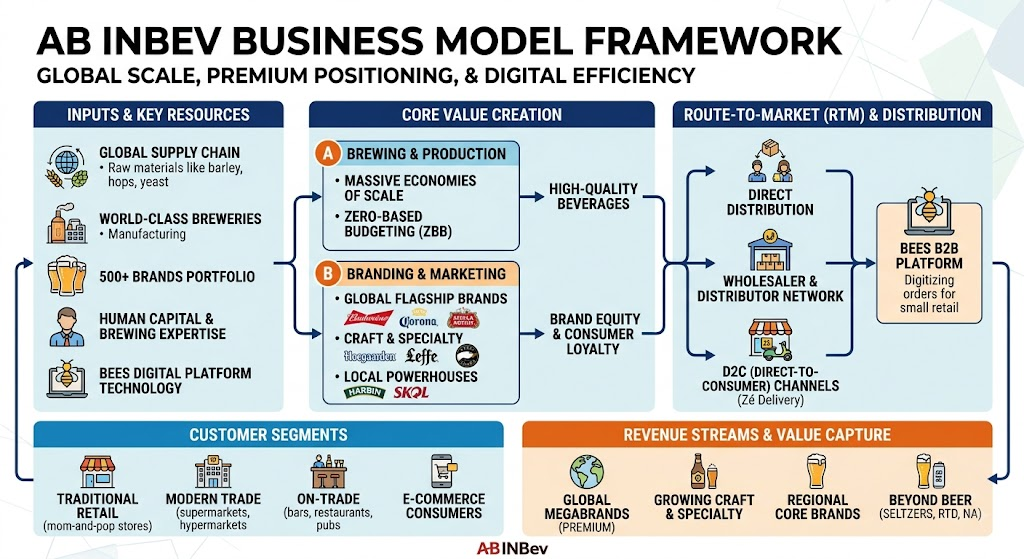
The business model and growth strategy of Anheuser-Busch InBev(AB InBev) center on global volume scale, premium brand positioning, and digital platform distribution:
1. Business Model
- Revenue Streams: Generates sales through three core tiers: Global Megabrands(Budweiser, Corona, Stella Artois), Fast-Growing Craft & Specialty Brands(Hoegaarden, Leffe, Goose Island), and Regional Core Powerhouses(e.g., Harbin in China, Skol in Brazil, Cass in South Korea).
- Cost Advantage & Operational Efficiency: Leverages massive economies of scale in procurement, raw materials, and logistics. Utilizes Zero-Based Budgeting(ZBB) to aggressively cut overhead and maximize operating margins.
- Route-to-Market(RTM): Direct distribution combined with an extensive third-party wholesaler/distributor network ensures deep market penetration across traditional retail, modern trade, and direct-to-consumer(D2C) channels.
2. Strategic Growth Pillars
- Lead Category Growth(Premiumization): Drives revenue expansion by shifting consumers toward higher-margin premium and super-premium portfolios, outperforming standard mainstream beer volume declines in mature markets.
- Digital Ecosystem Transformation(BEES & D2C): Scale BEES, a proprietary B2B e-commerce platform that digitizes small retail store ordering, inventory management, and promotional routing. Simultaneously expands D2C platforms(like Zé Delivery in Brazil) to capture real-time consumer purchasing data.
- Beyond Beer Portfolio Expansion: Diversifies product offerings beyond traditional beer into fast-growing adjacent segments, including hard seltzers, ready-to-drink(RTD) canned cocktails, non-alcoholic brews(e.g., Corona Cero), and functional beverages.
- Financial Discipline & Optimization: Focuses on deleveraging the balance sheet following major historic acquisitions, returning value to shareholders, and reallocating capital into high-ROI digital infrastructure and marketing.
Anheuser-Busch InBev(AB InBev) positions itself as a technology-enabled CPG company. Its artificial intelligence and machine learning(AI/ML) strategies span its entire value chain from “seed to sip.” A breakdown of its AI deployment, partnerships, and investment scope includes:
1. Key AI Deployment Areas
- Smart Agriculture(Smart Barley): Integrates satellite imagery, drone data, and machine learning models to analyze soil moisture and weather conditions, helping partner farmers predict barley yields and optimize fertilizer usage to reduce water and chemical consumption.
- Smart Brewing & Quality Control(SenseAI): Deploys machine learning models during the filtration(K Filter) and brewing stages to monitor liquid turbidity and pressure variations in real time, increasing filtration efficiency(by up to 60%) and ensuring consistent taste.
- Commercial Channels & B2B Personalization(BEES AI): Employs machine learning algorithms within the BEES B2B platform to provide personalized inventory recommendations and dynamic pricing to millions of small retail stores, boosting B2B sales volume by approximately 3%.
- Demand Forecasting & Supply Chain Optimization: Uses AI algorithms to optimize capacity allocation, inventory placement, and automated replenishment across 250+ breweries worldwide, significantly lowering inventory holding costs.
- AI-Driven Marketing & Product Innovation: Operates innovation labs that developed “Beck’s Autonomous,” one of the world’s first beers created with recipe formulations, branding, and marketing campaigns generated entirely by AI.
2. Key Partners
- Microsoft(Microsoft Azure): Primary cloud and AI strategic partner. AB InBev centralized its global data platforms on Microsoft Azure, leveraging Azure AI models for enterprise analytics, conversational bots, and smart agronomy developments.
- Google Cloud & Pluto7: Partners on brewery production line optimizations, utilizing Google Cloud Platform(GCP), BigQuery, and TensorFlow machine learning frameworks to build predictive beer filtration models.
- o9 Solutions & Gurobi Optimization: Deploys high-performance mathematical optimization engines and AI decision systems for end-to-end global supply chain planning and logistics routing.
- SoftServe Business Systems: Collaborates on AI-driven retail execution and image recognition technologies for sales teams and store shelf auditing.
- Beer Garage: Serves as the company’s global innovation hub in Silicon Valley, directly collaborating with technology startups and AI accelerators to pilot emerging technologies.
3. Investment Budget & Resource Allocation
- Digital & AI Capital Expenditure: AB InBev invests hundreds of millions to billions of dollars annually in digital transformation, IT infrastructure, and AI technologies, prioritizing the BEES platform and advanced data analytics in its capital allocation.
- Internal Data Engineering Expansion: Built a dedicated Global Data & Analytics organization and migrated over 80% of enterprise workloads to the cloud to reduce operational overhead and accelerate AI development cycles.
Sources
- https://news.microsoft.com/transform/from-seed-to-sip-how-anheuser-busch-inbev-uses-ai-to-drive-growth/
- https://pluto7.com/googlecloud/ab-inbev-with-machine-learning-this-buds-for-you/
- https://aiexpert.network/case-study-ab-inbev-integrates-ai-for-innovation-and-efficiency/
- https://softservebs.com/en/resources/ab-inbev-how-data-transforms-business/
Back to AB InBev