
The history of The Walt Disney Company can be viewed as the evolution of the global entertainment industry. From a small animation studio, it grew into a media titan spanning theme parks, film production, streaming, and retail. Here are the five key stages of its development:
1. The Founding and Birth of Mickey Mouse (1923-1934)
Walt and Roy Disney founded the Disney Brothers Cartoon Studio in 1923. After losing the rights to their early character, Oswald the Lucky Rabbit, Walt created Mickey Mouse in 1928.
- Key Milestone: The 1928 premiere of Steamboat Willie was the first cartoon with synchronized sound, making Mickey Mouse an overnight sensation.
- Technical Innovation: Disney began experimenting with Technicolor and sophisticated sound, establishing a lead in the animation industry.
2. The Golden Age and First Feature Films (1934-1945)
Despite skepticism from the industry, Walt Disney gambled on producing full-length animated feature films.
- Snow White’s Miracle: Snow White and the Seven Dwarfs (1937) was a massive commercial success, providing the funds to build the Burbank studio.
- Classic Streak: This era saw the release of Pinocchio, Fantasia, Dumbo, and Bambi.
- War Effort: During WWII, the studio pivoted to producing propaganda and training films for the government, maintaining operations despite lower profits.
3. Diversification and Theme Parks (1945-1966)
Post-war, Disney transitioned from a pure animation house to a diversified conglomerate including live-action films, television, and physical parks.
- Entry into TV: In 1954, the Disneyland TV show launched, using mass media to market the upcoming theme park.
- Disneyland Opening: Disneyland Park opened in California in 1955. It was Walt’s greatest gamble and redefined the travel and leisure industry.
- Walt’s Passing: Walt Disney died in 1966, leaving the company to enter a period of uncertainty without its visionary leader.
4. Decline and the Disney Renaissance (1967-2005)
For nearly two decades after Walt’s death, the company struggled with direction. It wasn’t until Michael Eisner took over as CEO in 1984 that the “Disney Renaissance” began.
- Animation Revival: Between 1989 and 1999, Disney released a string of peaks including The Little Mermaid, Beauty and the Beast, Aladdin, and The Lion King.
- Brand Expansion: Established Touchstone Pictures for adult-oriented films and acquired ABC (including ESPN).
- Digital Step: Disney began its partnership with Pixar, ushering in the era of 3D computer animation.
5. The M&A Era and Streaming Wars (2005-Present)
Under the leadership of Bob Iger, Disney entered an unprecedented era of acquisitions, bringing the world’s most powerful IPs under one roof.
- The Four Major Acquisitions:
- 2006: Acquired Pixar.
- 2009: Acquired Marvel Entertainment.
- 2012: Acquired Lucasfilm (Star Wars).
- 2019: Acquired 21st Century Fox.
- Digital Transformation: In 2019, the company launched Disney+, officially entering the streaming wars against platforms like Netflix.
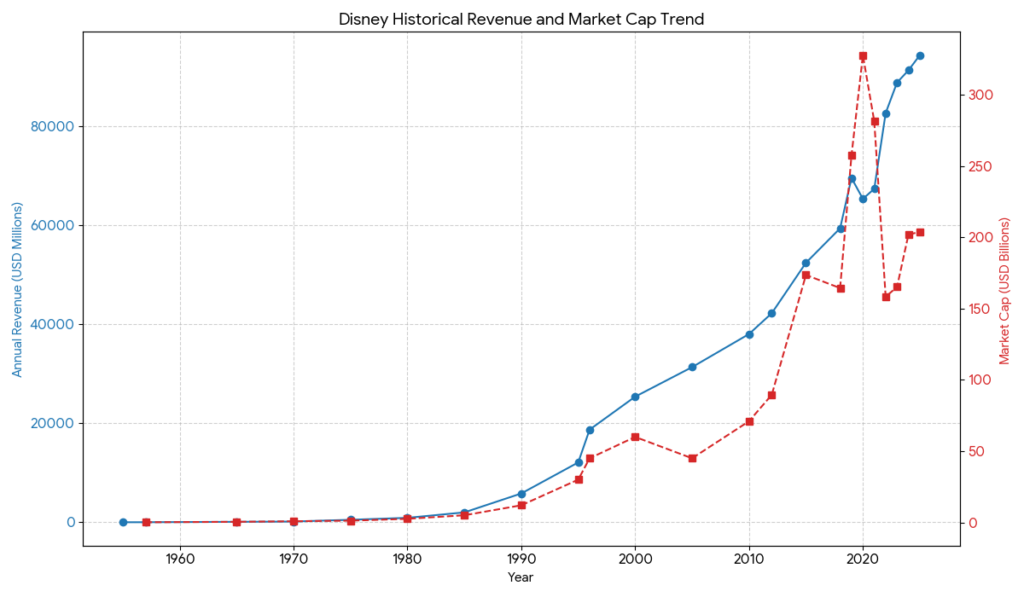
In analyzing the Walt Disney Company’s competitive landscape, we look at three primary battlegrounds: Streaming, Experiences (Parks), and Studios.
1. Streaming: The Shift from Growth to Profitability
In the streaming space, Disney is locked in a tug-of-war with Netflix. While Disney possesses a superior library of intellectual property (IP), Netflix maintains an edge in operational efficiency and global reach.
- Primary Competitors: Netflix, Amazon Prime Video, Warner Bros. Discovery (Max), and NBCUniversal (Peacock).
- Market Dynamics (2025/2026):
- Subscriber Base: The Disney bundle (Disney+, Hulu, ESPN+) now rivals Netflix’s total count in the U.S. However, Netflix remains the global leader with over 300 million individual subscribers.
- Financial Health: Disney achieved a major milestone in FY2025 by turning its streaming business profitable, reporting an operating income of approximately $1.3 billion. In contrast, Netflix continues to command high margins (around 28%).
- AI Integration: Disney has begun leveraging its 2025 partnership with OpenAI to optimize content production and personalization, aiming to close the technological gap with Netflix’s recommendation algorithms.
2. Parks & Experiences: The Deepest Moat Under Siege
This segment is Disney’s “cash cow,” but it faces its most significant challenge in decades from Universal.
- Primary Competitors: Universal Destinations & Experiences (Comcast) and Merlin Entertainments.
- Key Competitive Threats:
- Universal’s “Epic Universe”: The 2025 opening of Epic Universe in Orlando is the most direct threat to Disney World’s dominance in years. It is designed to turn Universal from a two-day destination into a full-week destination.
- Market Share: Disney currently holds roughly 28.3% of the U.S. theme park market, while Universal holds about 17.2%.
- Disney’s Response: Disney is executing a $60 billion investment plan over 10 years. This includes the launch of two new cruise ships (Disney Adventure and Disney Destiny) and major expansions for Avatar and Avengers themed lands to maintain its lead.
3. Studios & Content: Reclaiming the Crown
After a dip in 2022-2023, Disney has returned to a “quality over quantity” strategy to dominate the global box office.
- Primary Competitors: Warner Bros., Universal Pictures, and Sony Pictures.
- Current Standing:
- Box Office Leadership: In 2025, Disney led the industry with over $6.5 billion in global box office revenue, significantly outpacing Warner Bros. ($4.4 billion).
- Upcoming Slate: 2026 is anchored by massive releases including Avengers: Doomsday and Toy Story 5.
- Production Efficiency: By utilizing generative video technologies (like Sora), Disney is reducing digital production costs for its high-budget VFX-heavy films.
Competitive Summary Table (2025-2026)
| Metric | Disney | Netflix | Universal (Comcast) |
| Core Advantage | Deepest IP Portfolio | Data & Algorithmic Speed | High-Tech Thrill Attractions |
| Streaming Status | Profitable, ad-supported growth | High margins, global scale | Content feeder for linear TV |
| Weakness | Declining Linear TV (ESPN/ABC) | No physical monetization | IP depth is narrower |
| 2026 Focus | $60B Park Expansion | Expansion into Live Sports | Scaling “Epic Universe” |
Strategic Insight: Disney’s $1 billion equity-and-tech partnership with OpenAI in late 2025 is seen as a pivotal move to modernize its digital content pipeline and compete with the data-driven agility of Silicon Valley rivals.
Source:
- The Walt Disney Company – Investor Relations
- Disney Q4 and Full Year FY2025 Results
- Disney Q1 FY2026 Executive Commentary
- Disney (DIS) – Market Capitalization History
- Disney Revenue 1957-2026 | Macrotrends
- The Walt Disney Co. (DIS): Flywheel Transition and Succession Narrative
- What is the Competitive Landscape of Walt Disney?
- The Walt Disney Company – Wikipedia
- Disney Falls Short of Expectations – 2022 Review
Back to Disney page