
The history of GE Vernova is deeply intertwined with General Electric’s (GE) over 130 years of power and energy heritage. Its evolution reflects the global energy industry’s journey from Thomas Edison’s light bulb to modern decarbonization technologies.
Here are the four key stages of GE Vernova’s development:
1. Foundation and Expansion (1892 – 1980s)
This period established GE’s leadership in the power generation sector.
- 1892: Thomas Edison’s Edison General Electric Company merged with the Thomson-Houston Electric Company to officially form GE.
- Early 20th Century: GE developed the first commercial steam turbine and later expanded into hydroelectric and gas turbine technologies.
- Post-war Growth: As global electricity demand surged, GE became the world’s largest supplier of power generation equipment, spanning nuclear, gas, and grid infrastructure.
2. Diversification and Digital Transformation (1990s – Early 2010s)
Under the leadership of Jack Welch and Jeff Immelt, the company sought to integrate traditional industrial assets with digital and renewable energy.
- Acquisitions and Evolution: GE entered the wind market through strategic acquisitions (such as acquiring Enron Wind’s assets in 2002).
- Digital Commitment: The launch of the Predix platform attempted to connect power plant equipment to the cloud for big data analytics, serving as the predecessor to modern energy management software.
- 2015 Alstom Acquisition: This was the largest industrial acquisition in GE’s history, aimed at strengthening its global grid and steam turbine footprint, though it brought significant financial challenges.
3. Restructuring and Energy Focus (2018 – 2023)
Facing financial pressure and shifts in the fossil fuel market, GE underwent aggressive structural adjustments.
- Larry Culp’s Tenure: The CEO began divesting non-core assets to reduce debt.
- Spin-off Plan: In November 2021, GE announced it would split into three independent public companies: GE Aerospace (Aviation), GE HealthCare (Healthcare), and GE Vernova (Energy).
- Brand Birth: In 2022, GE officially named its energy business GE Vernova. “Ver” is derived from “verde” (green), symbolizing the Earth’s ecology; “Nova” is from the Latin “novus” (new), representing a new era of energy transition.
4. Independent Operation and Full Decarbonization (April 2024 – Present)
This marks the end of the GE conglomerate era and the beginning of Vernova’s independent chapter.
- Official Spin-off: On April 2, 2024, GE Vernova (Ticker: GEV) began trading as an independent company on the New York Stock Exchange.
- Strategic Core: The company currently focuses on three segments:
- Power: High-efficiency gas turbines and nuclear power (SMR Small Modular Reactors).
- Wind: Onshore and offshore wind power.
- Electrification: Grid software, converters, and energy storage systems.
- Current Mission: Dedicated to the decarbonization and modernization of global power systems, addressing the “Energy Trilemma” of security, affordability, and sustainability.
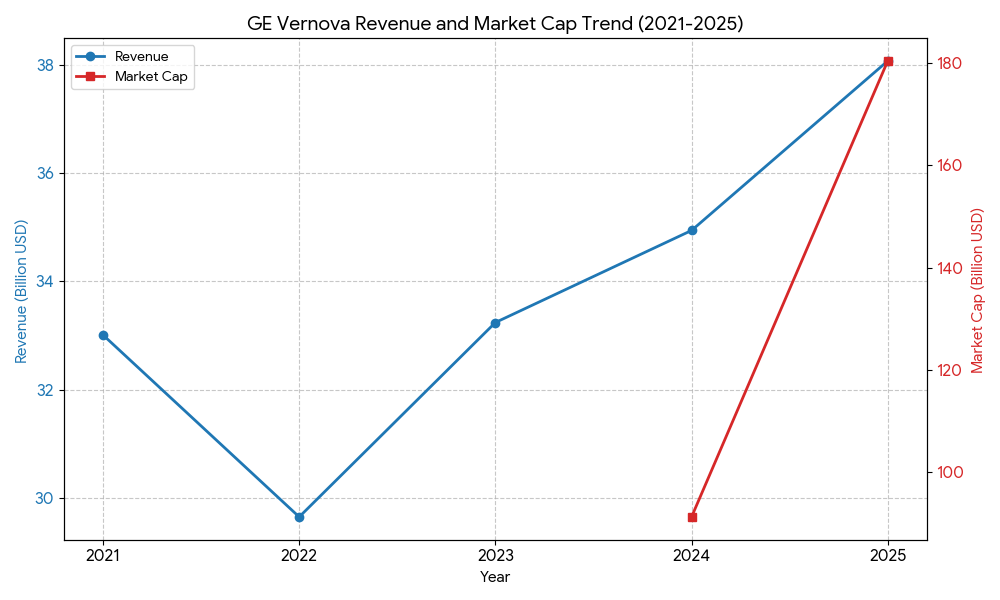
Key competitive analysis points for GE Vernova (GEV):
Core Business Competition
- Gas Power: GEV maintains a global triopoly with Siemens Energy and Mitsubishi Power. GEV leads in Asia with approximately 38% of the under-construction capacity market share.
- Wind Energy: In North America, GEV and Vestas dominate the market with a combined 96% share. However, globally, they face aggressive low-cost expansion from Chinese OEMs like Goldwind and Envision.
- Electrification: Key rivals include Schneider Electric, Siemens, ABB, and Hitachi Energy. The surge in AI data center power demand has made grid digitalization and transformer equipment the fastest-growing competitive frontiers.
Strategic Strengths and Hurdles
- Policy Tailwinds: GEV leverages the U.S. Inflation Reduction Act (IRA), providing a significant domestic cost advantage in onshore wind and renewable subsidies compared to European peers.
- Profitability Gap: While revenue is robust, GEV’s adjusted EBITDA margins (approx. 5.8%-7%) currently trail some industrial peers. Improving these margins is a top priority following its spin-off.
- Technical Leadership: In the SMR (Small Modular Reactor) space, GEV’s joint venture with Hitachi competes against NuScale Power and is considered one of the leaders in the race toward commercialization.
Emerging Threats
- Supply Chain Constraints: Global electricity demand driven by AI has extended lead times for transformers and high-efficiency turbines. Execution speed in capacity expansion will determine the winner between GEV and Siemens Energy.
- Chinese Wind Penetration: Chinese manufacturers are rapidly gaining market share in offshore wind and emerging overseas markets, challenging GEV’s global pricing power.
Source:
- https://www.macrotrends.net/stocks/charts/GEV/ge-vernova/revenue
- https://companiesmarketcap.com/ge-vernova/revenue/
- https://public.com/stocks/gev/market-cap
- https://www.youtube.com/watch?v=CQlSQvR0RoY
- https://www.gevernova.com/investors/news-events/press-releases/ge-vernova-completes-spin-off-and-begins-trading-on-the-new-york-stock-exchange
- https://www.reuters.com/business/energy/ge-completes-split-into-three-companies-2024-04-02/
- https://www.bloomberg.com/quote/GEV:US
Back to Vernova page