
Here is the summary of the Siemens AG Q1 FY2026 earnings release (for the period ending December 31, 2025):
Financial Performance Highlights
- Revenue: Reached €19.4 billion, representing a 5% growth on a comparable basis (excluding currency and portfolio effects).
- Orders: Totaled €20.5 billion with a book-to-bill ratio of 1.06, indicating sustained demand across core sectors.
- Industrial Business Profit: Stood at €2.9 billion with a profit margin of 15.8%.
- Net Income: Attributable net income was €2.1 billion.
- Free Cash Flow: All-in free cash flow for the quarter was €1.4 billion.
Segment Analysis
| Business Segment | Revenue | Profit Margin | Key Drivers |
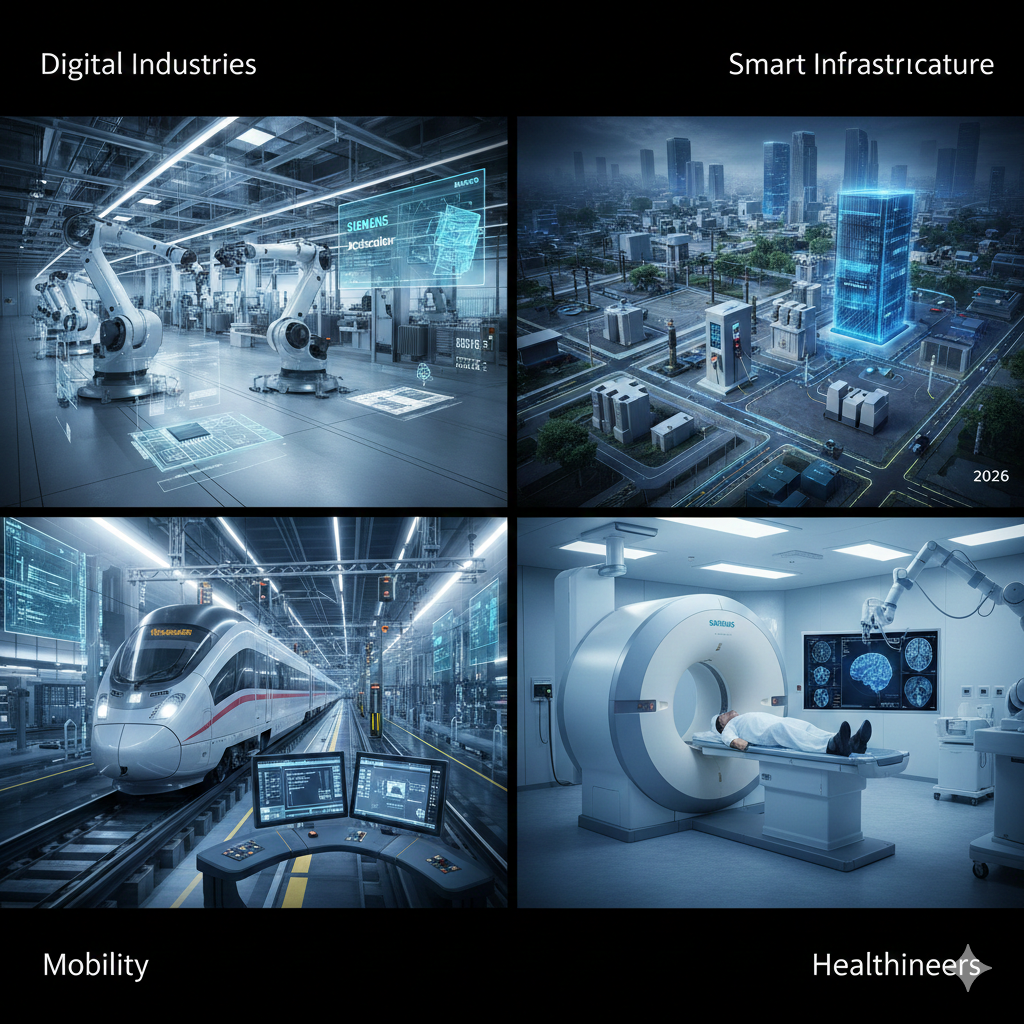
| Digital Industries | €4.8 billion | 18.5% | Strong software growth offset by challenges in automation hardware. |
| Smart Infrastructure | €5.3 billion | 17.2% | Record margins driven by data centers and electrical products. |
| Mobility | €2.7 billion | 8.8% | Growth in service business and digital signaling solutions. |
| Healthineers | €5.5 billion | 15.3% | Solid demand for imaging and advanced therapies. |
Strategic Updates & Outlook
Altair Acquisition
The integration of Altair Engineering is progressing as planned. This acquisition is expected to significantly bolster Siemens’ position in industrial software and simulation capabilities.
FY2026 Guidance Confirmed
- Comparable Revenue Growth: Expected in the range of 3% to 7%.
- Earnings Per Share (EPS pre-PPA): Projected between €10.40 and €11.00 (excluding Altair impacts).
- Growth Drivers: Smart Infrastructure and Mobility are expected to be the primary growth engines for the remainder of the fiscal year.
The growth of the Smart Infrastructure (SI) segment in Q1 FY2026 can be detailed as follows:
Financial Performance
- Comparable Revenue Growth: 9%
- Profit Margin: 17.2% (A record high for this segment)
- Orders: €6.0 billion
- Book-to-bill Ratio: 1.12 (Indicating strong future revenue visibility)
Growth Drivers
The growth was primarily driven by high demand in several key vertical markets:
- Data Centers: Significant demand fueled by the expansion of AI infrastructure.
- Grid Stability: Increased investment in electrical products and solutions to support grid modernization and electrification.
- Semiconductor Industry: Continued infrastructure requirements for chip manufacturing facilities.
Regional Highlights
The United States remained a primary engine of growth for the SI segment, benefiting from large-scale infrastructure projects and the ongoing energy transition.
Here is the analysis of Siemens’ financial ratios over the past five fiscal years (FY2021 to FY2025) based on historical performance and market data:
Profitability Ratios
Siemens has demonstrated significant margin expansion over the past five years as it transitioned from a traditional conglomerate into a focused industrial technology company.
Net Profit Margin:
During the 2021-2023 period, the net margin remained stable between 8% and 10%. By 2025, driven by high-margin software sales and the record-breaking performance of the Smart Infrastructure (SI) segment, the group’s adjusted EBITDA margin is projected to remain strong in the 17% to 19% range.
Return on Equity (ROE):
The ROE has shown a clear upward trend, rising from approximately 8% in 2020 to between 16% and 19% by 2024. This reflects more efficient use of shareholder capital to generate earnings.
Liquidity and Solvency Ratios
The company maintains a robust capital structure and sufficient liquidity to support strategic acquisitions like Altair Engineering.
Current Ratio:
Over the past five years, this ratio has mostly stayed between 1.3 and 1.5. In 2021, it reached a peak of 1.55. As of 2025, it stands at approximately 1.37, indicating that current assets remain more than sufficient to cover short-term liabilities.
Debt Management:
The Net Debt/EBITDA ratio has been targeted at below 1.5. Siemens maintains strict control over its leverage, which supports its high credit ratings (such as A+ from S&P).
Efficiency and Growth Ratios
Book-to-bill Ratio:
A key indicator for Siemens’ growth, this ratio has consistently remained above 1.0 over the past five years. In 2024 and 2025, the surge in demand for AI data centers and energy transition infrastructure led to record order backlogs, particularly in the SI and Mobility segments.
Asset Turnover:
This ratio has fluctuated between 0.5 and 0.7, reflecting Siemens’ hybrid nature as both a capital-intensive industrial manufacturer and a lean software provider.
5-Year Financial Summary Table
| Indicator | 2021 (A) | 2022 (A) | 2023 (A) | 2024 (A) | 2025 (E) |
| Revenue (Billion EUR) | 62.3 | 72.0 | 77.8 | 75.9 | ~78.0 |
| EPS (EUR) | 8.32 | 5.47 | 9.93 | 10.40 | 10.40-11.00 |
| Free Cash Flow (Billion EUR) | 8.2 | 8.2 | 10.0 | 9.5 | ~7.0+ |
Analysis Conclusion
Siemens has successfully transformed into a leading industrial tech firm over the last five years. Its financial profile is characterized by expanding margins (led by Smart Infrastructure), strong and consistent free cash flow (exceeding 7 billion EUR annually), and high resilience—where software and infrastructure growth have effectively offset temporary hardware de-stocking in the Digital Industries segment.
Based on the latest market data as of February 2026, here is the Price-to-Earnings (P/E) analysis of Siemens AG compared to its primary global competitors:
P/E Ratio Comparison
Siemens is currently valued at a relatively moderate level compared to its peers. While its valuation has risen during its transition into an industrial software and technology leader, it still trades at a discount compared to pure-play digital or energy management competitors.
| Company Name | Forward P/E Ratio | Key Drivers |
| Siemens AG (SIE) | 21x – 23x | High relative to its own history, but trades at a discount to peers. |
| Schneider Electric | 29x – 35x | Commands a premium due to dominant positioning in Data Centers and Energy Management. |
| ABB Ltd | 30x | High valuation driven by robotics, electrification, and high growth expectations. |
| Rockwell Automation | 25x – 28x | Pure-play industrial automation focus typically yields higher multiples. |
| Emerson Electric | 22x – 24x | Valuation is most closely aligned with Siemens. |
| Siemens Energy | 41.5x | Elevated multiple due to a sharp recovery in earnings and high growth projections. |
Key Analytical Insights
Relative Undervaluation:
Siemens’ P/E of approximately 23x is higher than its 10-year historical average (around 17.7x) but remains significantly lower than the peer group average of approximately 28.5x (led by ABB and Schneider). This suggests potential for a “re-rating” if Siemens continues to increase its software revenue mix.
Sector Comparison:
Siemens trades slightly above the European Industrials sector average of 21.3x. This premium reflects the market’s recognition of its high-growth segments, specifically Smart Infrastructure and Digital Industries, which are tied to the AI and data center boom.
Valuation Shift:
Analysts note that Siemens is successfully shedding its “conglomerate discount.” As high-margin software businesses (bolstered by the Altair acquisition) and record-setting infrastructure margins become a larger part of the bottom line, the market is gradually willing to assign a higher P/E multiple.
Intrinsic Value Perspective:
Some DCF (Discounted Cash Flow) models suggest that at current P/E levels, Siemens remains undervalued by approximately 12% to 16%. Some analysts estimate a “fair” P/E ratio could be as high as 32x if the company maintains its current growth trajectory in digitalization.
Source:
- https://simplywall.st/stocks/de/capital-goods/etr-sie/siemens-shares/valuation
- https://finbox.com/SWX:ENR/explorer/pe_fwd/
- https://www.wisesheets.io/pe-ratio/SIEGY
Back to Siemens page