
Here is the detailed summary of the SAP Q3 2025 financial report:
Revenue Performance and Strategic Transformation
Total revenue reached 9.08 billion euros, representing a 7% year-over-year increase. The primary growth engine remains the cloud business, which surged 22% to 5.29 billion euros, now accounting for 58.3% of total revenue. Specifically, the Cloud ERP Suite showed exceptional strength with a 26% growth rate. In contrast, traditional software licenses and support revenue continued to decline by 11%, confirming the massive customer migration toward subscription-based models. SAP’s predictable revenue share has now climbed to 87%, indicating a more stable and resilient financial structure.
Profitability and Operating Efficiency
Gross profit stood at 6.67 billion euros, up 7% year-over-year, maintaining a high gross margin of 73.5%. IFRS operating profit grew by 12% to 2.49 billion euros, outpacing revenue growth and demonstrating the realization of operating leverage. Net income saw a significant jump of 42% to 2.05 billion euros, while earnings per share (EPS) rose to 1.72 euros from 1.25 euros in the previous year. The expansion in margins is largely attributed to improved efficiency in cloud operations, with cloud gross margins now consistently exceeding 75%.
Balance Sheet and Financial Position
As of the end of September 2025, SAP maintains a strong liquidity position with cash and cash equivalents totaling 9.90 billion euros. Total assets reached 69.25 billion euros, with non-current assets making up approximately 70% of the total. The liability structure remains healthy, with total liabilities at 24.930 billion euros, resulting in a debt-to-asset ratio of roughly 36%. Total shareholders’ equity remains robust at 44.32 billion euros.
Cash Flow and Future Outlook
Operating cash flow for the quarter was 1.50 billion euros, a 7% increase year-over-year. After deducting capital expenditures of 236 million euros, the Free Cash Flow (FCF) amounted to 1.27 billion euros. Notably, the company raised its full-year 2025 financial guidance, now projecting FCF to reach between 8.0 billion and 8.2 billion euros. This reflects management’s confidence in the continued growth of the Current Cloud Backlog and ongoing improvements in operational discipline.
Income Statement
Unit: Million Euro
| Item | 2025 Q3 | 2024 Q3 | YoY | % of Total Rev |
| Cloud Revenue | 5,290 | 4,351 | 22% | 58.3% |
| Software Licenses & Support | 2,726 | 3,078 | -11% | 30.0% |
| Services | 1,060 | 1,041 | 2% | 11.7% |
| Total Revenue | 9,076 | 8,470 | 7% | 100% |
| Gross Profit | 6,671 | 6,212 | 7% | 73.5% |
| Operating Profit (IFRS) | 2,487 | 2,214 | 12% | 27.4% |
| Net Income (IFRS) | 2,051 | 1,441 | 42% | 22.6% |
| EPS (€) | 1.72 | 1.25 | 37% | – |
Segment Revenue
Unit: Million Euro
| Segment | 2025 Q3 Revenue | YoY Growth |
| Cloud ERP Suite | 4,586 | 26% |
| SaaS / PaaS | 5,212 | 23% |
| Software Licenses | 80 | -43% |
Analysis and Highlights
- Revenue Mix Transformation: Cloud revenue has become the definitive core of the business, accounting for nearly 60% (58.3%) of total revenue. The 43% decline in software licenses confirms SAP’s successful pivot from one-time sales to a steady subscription model.
- Improved Profitability Quality: IFRS operating profit grew by 12%, outpacing the 7% total revenue growth. This demonstrates operating leverage, driven by improved cloud gross margins and disciplined cost management during the transformation.
- Significant Net Income Surge: The 42% jump in net income reflects not only operational improvements but also optimized financial expenses and a favorable tax environment compared to the previous year.
- Predictability: Predictable revenue now reaches 87% of the total, up 3 percentage points year-over-year, significantly enhancing the stability of the company’s financial outlook.
Balance Sheet
Unit: Million Euro (As of September 30, 2025)
| Item | 2025 Q3 | 2024 Q3 (or Opening) | YoY Growth | % of Total Asset |
| Cash and Cash Equivalents | 9,900 | 7,940 | 24.7% | 14.3% |
| Other Current Assets | 10,550 | – | – | 15.2% |
| Total Current Assets | 20,450 | – | – | 29.5% |
| Goodwill & Intangible Assets | 32,100 | – | – | 46.4% |
| Other Non-current Assets | 16,700 | – | – | 24.1% |
| Total Non-current Assets | 48,800 | – | – | 70.5% |
| Total Assets | 69,250 | – | – | 100% |
| Current Liabilities | 14,800 | – | – | 21.4% |
| Non-current Liabilities | 10,130 | – | – | 14.6% |
| Total Liabilities | 24,930 | – | – | 36.0% |
| Total Equity | 44,320 | – | – | 64.0% |
Analysis and Highlights
- Strong Liquidity Position: Cash and cash equivalents grew to 9.90 billion euros, accounting for 14.3% of total assets. This provides excellent financial flexibility for R&D, potential acquisitions, or shareholder returns.
- Asset Composition: Non-current assets represent 70.5% of total assets, with Goodwill and Intangible Assets (46.4%) being a major component. This reflects SAP’s history of strategic acquisitions to bolster its cloud technology portfolio.
- Healthy Financial Leverage: The debt-to-asset ratio stands at a conservative 36%, which is within a very healthy range for the industry. This indicates that SAP is maintaining high financial discipline while scaling its cloud operations.
- Robust Equity Base: Shareholders’ equity accounts for 64% of total assets, showing that the company’s assets are primarily funded by its own capital, resulting in a very stable financial structure capable of weathering market volatility.
Cash Flow Statement
Unit: Million Euro
| Item | 2025 Q3 | 2024 Q3 | YoY |
| Operating Cash Flow (OCF) | 1,502 | 1,403 | 7% |
| Capital Expenditures (CapEx) | -236 | -203 | 16% |
| Free Cash Flow (FCF) | 1,266 | 1,200 | 5% |
| Other Investing & Financing Activities | -450 | – | – |
| Ending Cash and Cash Equivalents | 9,900 | 7,940 | 25% |
FCF Analysis
| Metric | Value / Status | Explanation |
| OCF Conversion | 84.3% | High FCF to OCF ratio indicates a light capital expenditure burden. |
| Restructuring Impact | ~200 Million | Cash outflows included restructuring payments; core cash generation is stronger excluding this. |
| FY2025 Guidance | 8,000 – 8,200 | Raised guidance reflects confidence in cloud subscription growth and cash collection. |
| Cash Efficiency | Excellent | Cloud gross margins above 75% drive higher cash generation per unit of revenue. |
Analysis and Highlights
- Resilient Cash Growth: Despite increased tax payments due to legal changes and restructuring outflows, FCF maintained a 5% year-over-year growth, highlighting the strength of recurring cloud inflows.
- Working Capital Management: The continuous growth of the Current Cloud Backlog supports operating cash flow through increased advance payments and predictable subscription cycles.
- Guidance Upgrade: Management’s decision to raise the full-year FCF target is a strong signal of operational discipline and often precedes positive news regarding dividends or share buybacks.
- Disciplined Investment: While CapEx increased, it remains a very small percentage of total revenue, illustrating the advantages of an asset-light software business model.
Five-Year Financial Ratio Analysis (2020 – 2024)
Unit: Percentage (%) unless otherwise specified
| Financial Metric | 2024 | 2023 | 2022 | 2021 | 2020 |
| Total Revenue (€bn) | 33.12 | 31.21 | 30.87 | 27.84 | 27.34 |
| Cloud Revenue % of Total | 46.4% | 43.1% | 40.7% | 33.8% | 30.1% |
| Operating Margin (Non-IFRS) | 30.2% | 29.8% | 28.5% | 29.2% | 30.0% |
| Net Profit Margin (IFRS) | 18.0% | 19.1% | 15.2% | 19.3% | 19.5% |
| Debt-to-Asset Ratio | 35.8% | 36.4% | 38.2% | 40.1% | 42.5% |
| Free Cash Flow (€bn) | 6.8 | 6.1 | 5.4 | 5.2 | 4.8 |
Key Trend Analysis
1. Revenue Mix and Cloud Acceleration
SAP has successfully executed its “Cloud Choice” transition. Over the past five years, Cloud Revenue as a percentage of total sales has surged from approximately 30% in 2020 to over 46% by the end of 2024. This shift has fundamentally changed SAP’s profile from a cyclical software vendor to a resilient, subscription-based provider.
2. Profitability and Operating Leverage
Despite the heavy investment required for cloud infrastructure and the restructuring costs associated with shifting the workforce toward AI and cloud roles, SAP has maintained a stable Non-IFRS Operating Margin of around 30%. The significant improvement in cloud gross margins (now exceeding 75%) indicates that the company is reaching a “tipping point” where cloud scale drives accelerated earnings growth.
3. Financial Strengthening
The Debt-to-Asset ratio has shown a consistent downward trend, dropping from 42.5% to 35.8%. This deleveraging highlights SAP’s strong internal cash generation, allowing it to fund growth and strategic acquisitions without overextending its balance sheet.
4. Cash Generation Power
Free Cash Flow (FCF) has grown at a steady pace, reaching €6.8 billion in 2024. The shift to a subscription model initially puts pressure on cash flow (as large upfront payments are replaced by smaller monthly ones), but SAP has moved past this “trough” and is now seeing the benefits of a highly predictable, recurring cash flow stream.
Market Outlook and Valuation
Analysts, including those from Morgan Stanley, remain bullish on SAP’s trajectory, citing its role as a key enabler of enterprise AI. The company is often viewed as a “Top Pick” in the European software sector, with valuation models reflecting high confidence in its mid-term 2025/2026 targets.
SAP’s recent M&A strategy is centered on two pillars: Cloud-First Transformation and Business AI Integration. The company has moved away from massive revenue-buying acquisitions toward “tuck-in” acquisitions that enhance the user experience, automate business processes, and deepen AI capabilities.
Here is a breakdown of SAP’s key acquisitions in recent years:
1. Business AI and Digital Adoption
These moves aim to make SAP software easier to use and more “intelligent” through generative AI.
- WalkMe (2024): Acquired for approximately $1.5 billion. WalkMe is a Digital Adoption Platform (DAP) that provides on-screen guidance. SAP is integrating this to help users navigate complex workflows and to deploy “Joule” (SAP’s AI assistant) directly across various interfaces.
- Strategic AI Investments (2023): Through SAP iO, the company made significant investments in Anthropic, Cohere, and Mistral AI. Rather than buying one LLM, SAP is building an ecosystem where its data can interact with the best models available.
2. Enterprise Architecture and Process Transformation
To accelerate the “RISE with SAP” program, SAP acquired tools that help customers map out their migration to the cloud.
- LeanIX (2023): A leader in Enterprise Architecture Management (EAM). It allows companies to see their entire IT landscape. This is critical for large enterprises trying to modernize legacy systems into the cloud.
- Signavio (2021): This was a cornerstone acquisition for Business Process Intelligence (BPI). It allows customers to model, analyze, and optimize their business processes before and after moving to S/4HANA Cloud.
3. Fintech and Supply Chain
- Taulia (2022): A leading provider of working capital management solutions. By acquiring Taulia, SAP strengthened its CFO stack, allowing businesses to improve liquidity and manage early payment discounts within the SAP Business Network.
M&A Summary Table
| Year | Company | Strategic Objective | Core Integration |
| 2024 | WalkMe | AI-driven user guidance and adoption | Cross-platform (SuccessFactors, S/4HANA) |
| 2023 | LeanIX | IT landscape transparency and modernization | SAP Signavio & RISE with SAP |
| 2022 | Taulia | Working capital and supply chain finance | SAP Business Network |
| 2021 | Signavio | Business Process Transformation (BPI) | S/4HANA Cloud |
| 2020 | Emarsys | Omnichannel marketing automation | SAP Customer Experience (CX) |
Strategic Insights
- Lowering the Barrier to Entry: Acquisitions like Signavio and WalkMe are designed to reduce the “friction” of using SAP. By making the software easier to adopt and processes easier to map, SAP reduces churn.
- Platform Play over Product Play: SAP is no longer just buying “another module.” It is buying technologies that sit on top of all its modules to create a unified intelligence layer.
- Data Synergy: Every recent acquisition brings in high-value metadata (how processes run, how users click, how cash moves). This data is the “fuel” for SAP’s Business AI strategy.
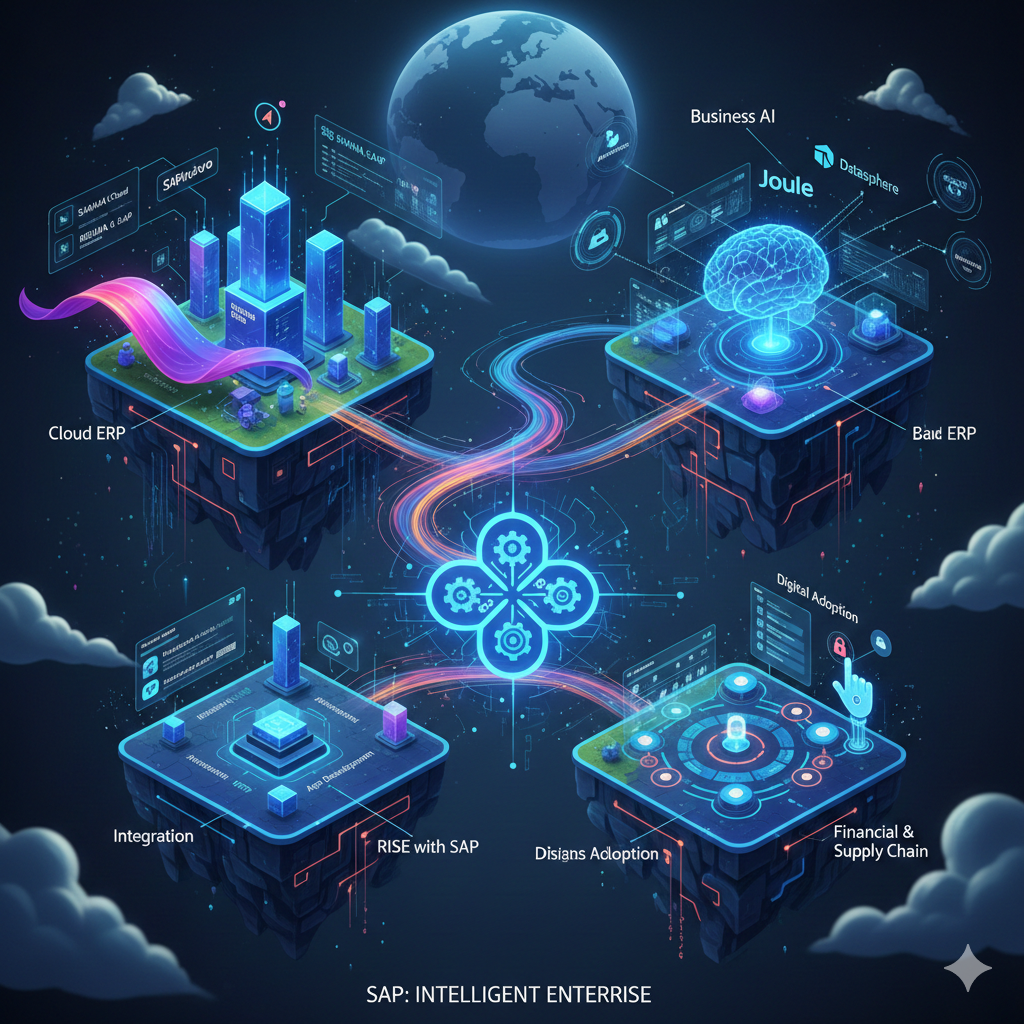
SAP’s M&A strategy is not merely about adding revenue; it is a deep technical integration designed to build what they call the “Intelligent Enterprise.” By integrating these specialized technologies into its core platforms—S/4HANA and the Business Technology Platform (BTP)—SAP has created a “closed-loop” system for digital transformation.
1. Process Layer: SAP Signavio (2021) —— The “Navigator”
Signavio is integrated into the RISE with SAP offering to solve the “where do we start?” problem in cloud migration.
- Technical Integration: Signavio’s Process Insights connects directly to S/4HANA data. It extracts real-time execution logs and compares them against SAP’s “Best Practices” database.
- The Value: It identifies friction points in a customer’s current business logic before they move to the cloud, allowing them to fix broken processes rather than just moving “messy” data to a new system.
2. Architecture Layer: LeanIX (2023) —— The “X-Ray”
LeanIX handles the complexity of “Hybrid IT” environments where legacy systems co-exist with new cloud apps.
- Technical Integration: LeanIX is integrated into the SAP Business Transformation Suite. Its database shares a common metadata layer with Signavio, creating a link between “Business Processes” and “IT Infrastructure.”
- The Value: When a business analyst changes a process in Signavio, LeanIX immediately shows which underlying servers, databases, or third-party APIs will be affected, reducing the risk of system outages during transformation.
3. User Experience Layer: WalkMe (2024) —— The “Digital Co-Pilot”
WalkMe is the final piece of the puzzle, focusing on the human side of software adoption.
- Technical Integration: WalkMe operates as an Overlay on top of SAP’s native UI (SuccessFactors, Concur, S/4HANA). It is now being integrated with Joule, SAP’s generative AI assistant.
- The Value: If a user asks Joule, “How do I submit a travel claim?”, WalkMe doesn’t just give text instructions; it physically highlights the buttons on the screen and can even automate the data entry. This effectively masks the complexity of SAP’s legacy interfaces.
4. Financial Layer: Taulia (2022) —— The “Cash Flow Engine”
Taulia is integrated into the SAP Business Network (formerly Ariba).
- Technical Integration: It embeds financial services directly into the procurement-to-pay workflow. When a supplier submits an invoice in the SAP portal, Taulia’s algorithms automatically offer “Early Payment” options based on real-time risk assessment.
- The Value: It turns static accounting documents into dynamic liquidity, allowing CFOs to manage supply chain finance without leaving the SAP environment.
Technical Integration Matrix
| Acquired Technology | Core Platform Integration | Technical Function | Transformation Role |
| Signavio | SAP BTP & S/4HANA | Process Mining & Data Modeling | Diagnostic & Optimization |
| LeanIX | SAP Signavio & BTP | Automated IT Mapping & Governance | Landscape Transparency |
| WalkMe | Joule AI & All Cloud Suites | Cross-system Navigation & RPA | Adoption & User Experience |
| Taulia | SAP Business Network | Embedded Finance (Fintech) | Cash Flow Optimization |
Summary: Completing the Technical Puzzle
These acquisitions create a lifecycle for the customer:
- LeanIX maps the IT reality.
- Signavio optimizes the business logic.
- WalkMe + Joule lowers the barrier for employees to use the new system.
- SAP BTP acts as the central “brain” where all this data is processed for AI-driven decision-making.
Source:
- https://www.sap.com/docs/download/investors/2025/sap-2025-q3-statement.pdf
- SAP Annual Reports & Investor Relations (2020-2024)
- Morgan Stanley Equity Research: SAP SE 2Q25 AlphaWise Survey
- SAP Q3 2025 Financial Statement
- SAP News: Mergers and Acquisitions
- Official WalkMe Acquisition Announcement
- SAP Investor Relations: Strategic Highlights
- SAP’s Integration Strategy for Signavio
- How LeanIX Complements SAP Portfolio
- SAP and WalkMe: The Future of Digital Adoption
Back to SAP page