
RTX Corporation (RTX) is one of the world’s largest aerospace and defense companies. Its history spans over a century, characterized by the evolution and eventual merger of two industrial giants: Raytheon Company and United Technologies (UTC).
The following are the four key stages of RTX’s development:
Phase 1: Pioneers of Radar and Vacuum Tubes (1922-1945)
Raytheon was founded in 1922 in Cambridge, Massachusetts, originally as the American Appliance Company.
- Key Technology: The company gained fame for its gaseous rectifier tube, which allowed radios to plug into wall outlets. During WWII, Raytheon became the primary supplier of magnetrons, the core component for Allied radar systems.
- Defense Foundation: War demand transformed the company from a million-dollar business to a hundred-million-dollar defense contractor, setting the stage for its role in national security.
Core Technology: Gaseous rectifier tubes, Magnetrons, and early-stage radar systems.
Core Strategy: Transitioned from a civilian radio component maker to a primary military electronics supplier. Leveraged academic ties (MIT) to industrialize cutting-edge physics for the war effort.
Revenue Level: Explosive growth during WWII. Revenue jumped from approximately $1 million in the late 1930s to over $170 million by 1945 due to massive government radar contracts.
Phase 2: Cold War, Missiles, and Diversification (1946-2019)
During this period, both Raytheon and UTC expanded through organic growth and strategic acquisitions.
- Raytheon:
- The Missile King: Developed the Patriot, Hawk, and Sidewinder missiles, which became staples of global defense.
- Commercial Innovation: Raytheon engineers discovered microwave cooking by accident while working on radar, leading to the first commercial microwave oven (Radarange) in 1947.
- United Technologies (UTC):
- UTC built a powerhouse in aerospace through Pratt & Whitney (engines) and Collins Aerospace.
- For decades, UTC also operated famous non-aerospace brands like Otis (elevators) and Carrier (air conditioning).
Core Technology: Missile Guidance Systems (Patriot, Sidewinder), Jet Engines (Pratt & Whitney), and Integrated Avionics (Collins).
Core Strategy:
- Raytheon: Focused on horizontal expansion in defense electronics and missiles, becoming the global leader in interceptor technology.
- UTC: Built a vertical monopoly in the aerospace supply chain while maintaining industrial hedge segments (elevators and HVAC) to balance cyclical aerospace risks.
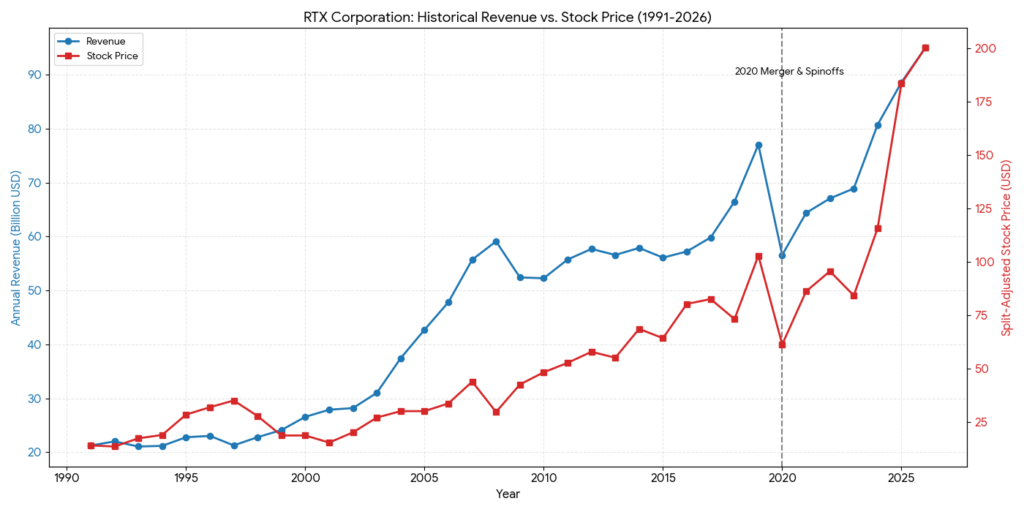
Revenue Level: Steady growth into the tens of billions. In 2019 (pre-merger), UTC reported revenue of ~$77 billion, while Raytheon Company reported ~$29 billion.
Phase 3: The Mega-Merger and Structural Pivot (2019-2023)
This phase marks the official birth of the modern RTX.
- 2019 Merger Announcement: UTC and Raytheon announced an “all-stock merger of equals.”
- 2020 Completion: The merger was finalized, forming Raytheon Technologies Corporation. To focus purely on aerospace and defense, UTC spun off its Otis and Carrier businesses as independent entities.
- Strategic Relocation: In 2022, the company moved its global headquarters from Massachusetts to Arlington, Virginia, to be closer to the Pentagon and key government decision-makers.
Core Technology: Full-Domain Aerospace Integration. Combined engine propulsion, airframe systems, and advanced sensor/missile technology.
Core Strategy: The “Pure-Play” Pivot. Spun off Otis and Carrier to create a focused aerospace and defense powerhouse. The goal was to consolidate R&D for next-generation platforms like the Geared Turbofan (GTF) engine and hypersonics.
Revenue Level: Initially impacted by the COVID-19 pandemic’s hit on commercial aviation. Combined revenue in 2020 was approximately $56.6 billion, marking a period of consolidation and recovery.
Phase 4: Brand Unity and The Three Pillars (2023-Present)
In 2023, the company officially rebranded to RTX Corporation and reorganized into three focused business segments.
| Business Unit | Core Operations |
| Pratt & Whitney | Designs and builds aircraft engines for military (F135) and commercial (GTF) use. |
| Collins Aerospace | Provides aerostructures, avionics, interiors, and flight controls. |
| Raytheon | Focuses on missile defense, radars, space systems, and cyber intelligence. |
Core Technology: Geared Turbofan (GTF) Engines, Hypersonic Weapons, Space-Based Surveillance, and Cyber Intelligence.
Core Strategy: Synergy and Scalability. Reorganized into three streamlined segments (Pratt & Whitney, Collins, Raytheon) to maximize supply chain efficiency and respond to the surge in global defense demand (e.g., Ukraine, Middle East, Taiwan Strait).
Revenue Level:
- 2024: Revenue reached $80.7 billion.
- 2025: Revenue climbed to $88.6 billion (YoY+10%).
- Backlog: Reached a record high of $268 billion by early 2026.
RTX Corporation’s competitive landscape is unique because it is one of the few entities globally that maintains a dominant foothold in both commercial aerospace and advanced defense systems. Its competition is best analyzed through its three distinct business pillars:
1. Collins Aerospace
Primary Competition: Avionics, Flight Controls, and Interiors
Collins is the “systems integrator” of the aircraft. Its main rivals provide the electronic and mechanical backbone of modern flight.
- Honeywell: The primary rival in avionics (cockpit displays) and APUs (Auxiliary Power Units). The two companies are often in a “duopoly” battle for placement on new aircraft platforms.
- Safran (France): Competes fiercely in landing gear, nacelles, and interior systems.
- Garmin: While historically focused on smaller planes, Garmin is increasingly moving “up-market” into the business jet segment, challenging Collins’ traditional dominance in cockpit electronics.
2. Pratt & Whitney
Primary Competition: Propulsion (Jet Engines)
The jet engine market is an ultra-high-barrier oligopoly.
- GE Aerospace: The most formidable competitor. GE, often through its CFM International joint venture with Safran, competes directly against Pratt’s Geared Turbofan (GTF) for the A320neo family of aircraft.
- Rolls-Royce: Primarily competes in the wide-body (large aircraft) segment.
- Key Dynamic: The competition here is currently defined by reliability. While Pratt’s GTF engine offers superior fuel efficiency, GE’s LEAP engine has historically shown higher “time-on-wing” (reliability), making this a battle of efficiency vs. maintenance costs.
3. Raytheon
Primary Competition: Missiles, Sensors, and Space Systems
In the defense sector, RTX competes for massive government contracts against other “Primes.”
- Lockheed Martin: The world’s largest defense contractor. Lockheed is both a rival (in missile defense and hypersonics) and a partner (RTX provides the engines and sensors for Lockheed’s F-35).
- Northrop Grumman: A major competitor in space-based surveillance, radar technology, and next-generation stealth capabilities.
- Boeing Defense: Competes in the realm of precision-guided munitions and satellite communications.
RTX Competitive Strategy Matrix
| Dimension | RTX Strength | Potential Vulnerability |
| Product Breadth | The only player providing both the “heart” (engine) and “brain” (avionics) of an aircraft. | Organizational complexity makes internal integration and cost control difficult. |
| Defense Moat | Near-monopoly in combat-proven missile defense (Patriot, NASAMS, LTAMDS). | High sensitivity to shifts in U.S. DoD (Department of Defense) budget priorities. |
| Innovation | Industry leader in Geared Turbofan (GTF) technology and Hypersonic detection. | Technical setbacks (e.g., the 2023 powder metal issue) lead to massive compensation payouts. |
| Backlog | A record $268 billion backlog provides multi-year revenue visibility. | Supply chain and labor shortages threaten the ability to convert this backlog into cash fast enough. |
Strategic Summary
RTX’s “moat” is its depth of integration. When a manufacturer like Airbus or Boeing designs a new aircraft, RTX components often account for more than 50% of the value of the entire plane. This deep-rooted presence makes it nearly impossible for a competitor to displace them entirely from a platform once selected.
Source:
- https://www.rtx.com/news/news-center/2026/01/27/rtx-reports-2025-results-and-announces-2026-outlook-
- https://www.macrotrends.net/stocks/charts/RTX/rtx/revenue
- https://www.wallstreetzen.com/stocks/us/nyse/rtx/revenue
- https://investors.rtx.com/financial-information/annual-reports
- https://www.macrotrends.net/stocks/charts/RTX/rtx/stock-price-history
- https://www.slickcharts.com/symbol/RTX/returns
Back to RTX page