
This document is the 10-Q quarterly report for Procter & Gamble (P&G) filed on January 24, 2026, covering the fiscal period ended December 31, 2025. In P&G’s fiscal calendar, this represents Q2 FY26.
Below is the detailed summary of the results:
1. Financial Highlights
P&G delivered strong top and bottom-line growth during this quarter:
- Net Sales: $22.18 billion, a 4% increase compared to $21.35 billion in the prior year.
- Organic Sales: Increased by 4%. This growth was balanced, driven by a 2% increase in volume and a 2% increase from pricing.
- Net Earnings: $4.23 billion, representing a 23% increase versus the $3.43 billion reported in the same quarter last year.
- Diluted EPS: $1.74, up 24% year-over-year.
2. Profitability and Margins
- Gross Margin: Reached 53.1%, expanding by 220 basis points. Key drivers included 180 bps from productivity savings and 60 bps from lower commodity costs, which offset unfavorable foreign exchange impacts.
- Operating Margin: Reached 24.2%, an increase of 410 basis points over the prior year, reflecting disciplined cost management and higher sales leverage.
- Effective Tax Rate: Decreased to 19.8% (compared to 23.2% last year), primarily due to favorable adjustments related to international operations.
3. Business Segment Performance (Organic Sales Growth)
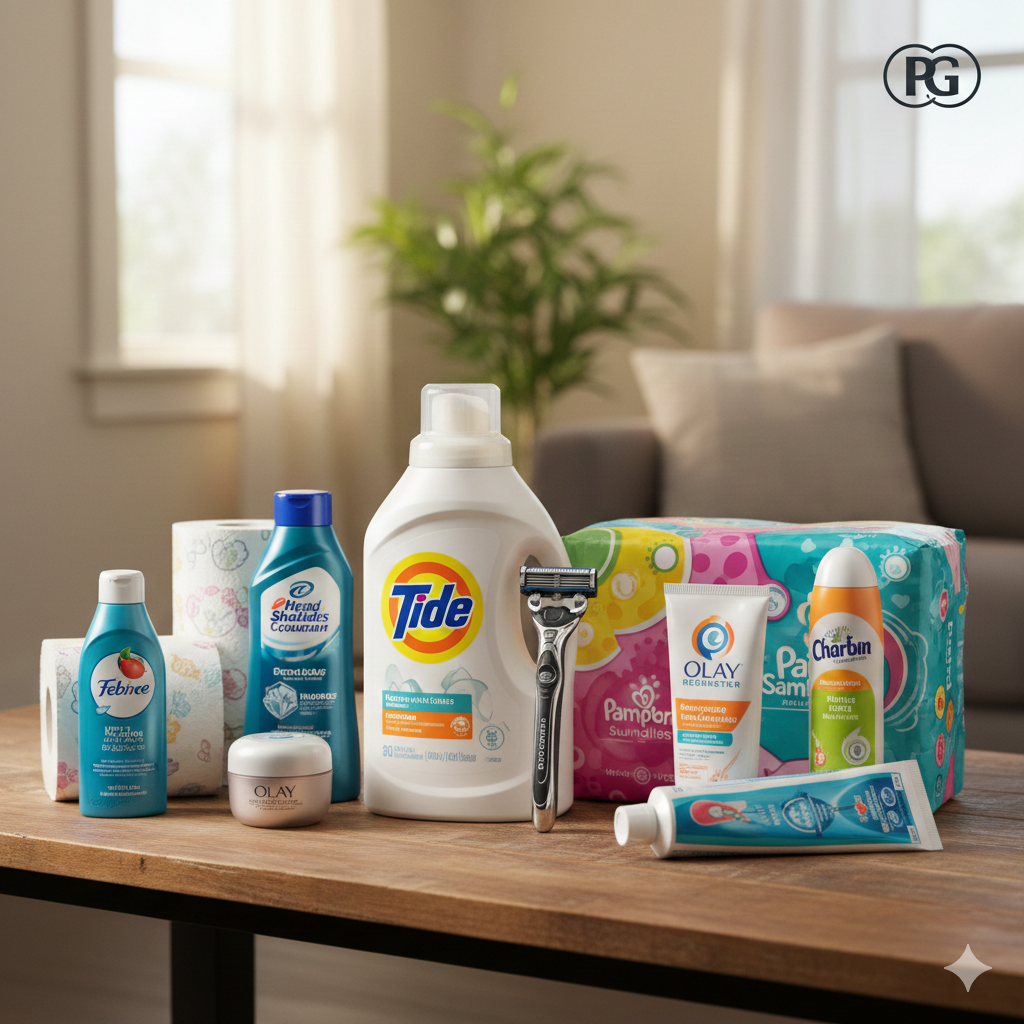
- Grooming (+7%): The strongest performer, led by innovation in the Braun and Gillette portfolios and favorable pricing in Europe and Asia-Pacific.
- Health Care (+5%): Driven by robust demand for Oral Care products (Oral-B) in North America and Europe, specifically in the power toothbrush category.
- Fabric & Home Care (+4%): P&G’s largest segment saw steady growth fueled by premium innovations in laundry detergents like Tide and Ariel.
- Baby, Feminine & Family Care (+3%): Growth was supported by strong pricing strategies in North America, despite some volume pressure in developing markets.
- Beauty (+2%): Performance was tempered by continued softness for the SK-II brand in Greater China, though this was partially offset by growth in mainstream brands like Pantene and Olay.
4. Cash Flow and Shareholder Returns
- Operating Cash Flow: Generated $5.1 billion in cash from operations during the quarter.
- Free Cash Flow (FCF): Amounted to $4.2 billion after accounting for $0.9 billion in capital expenditures.
- Shareholder Distributions: P&G returned $4.5 billion to shareholders this quarter via $2.5 billion in dividend payments and $2.0 billion in common stock repurchases.
5. Future Outlook
- FY2026 Guidance: The company maintained its organic sales growth outlook of 3% to 5% for the full fiscal year.
- Earnings Guidance: P&G slightly raised its core EPS growth guidance to a range of 7% to 9%, citing strong operational efficiency and productivity gains.
Below is the Income Statement for Procter & Gamble (P&G) for the quarter ended December 31, 2025 (Q2 FY26), including the percentage of total revenue and year-over-year (YoY) comparisons.
Income Statement
(All figures in millions USD, except per share data)
| Item | Q2 FY26 | % of Total Rev | Q2 FY25 | YoY Change |
| Net Sales | 22178 | 100.0% | 21351 | +3.9% |
| Cost of products sold | 10404 | 46.9% | 10103 | +3.0% |
| Gross Profit | 11774 | 53.1% | 11248 | +4.7% |
| Selling, general and administrative (SG&A) | 6401 | 28.9% | 6948 | -7.9% |
| Operating Income | 5373 | 24.2% | 4300 | +25.0% |
| Interest Expense | 232 | 1.0% | 238 | -2.5% |
| Other Non-Operating Income, net | 134 | 0.6% | 446 | -70.0% |
| Earnings Before Income Taxes | 5275 | 23.8% | 4508 | +17.0% |
| Income Taxes | 1045 | 4.7% | 1076 | -2.9% |
| Net Earnings | 4230 | 19.1% | 3432 | +23.3% |
| Diluted Net Earnings Per Share | 1.74 | N/A | 1.40 | +24.3% |
Segment Revenue Analysis
(All figures in millions USD)
| Business Segment | Q2 FY26 Revenue | % of Total Rev | YoY Change | Organic Growth |
| Beauty | 3911 | 17.6% | +1.7% | +2% |
| Grooming | 1852 | 8.4% | +6.8% | +7% |
| Health Care | 3215 | 14.5% | +4.8% | +5% |
| Fabric & Home Care | 7724 | 34.8% | +4.1% | +4% |
| Baby, Feminine & Family Care | 5360 | 24.2% | +3.6% | +3% |
| Corporate | 116 | 0.5% | N/A | N/A |
| Total Net Sales | 22178 | 100.0% | +3.9% | +4% |
Key Financial Observations
- Margin Expansion: The Gross Margin improved to 53.1% (up from 52.7% last year), primarily due to productivity savings and lower commodity costs.
- Operational Efficiency: SG&A expenses significantly decreased as a percentage of sales, falling from 32.5% to 28.9%. This led to a substantial 25.0% increase in Operating Income.
- Tax Impact: The effective tax rate for the quarter was 19.8%, down from 23.2% in the prior year, providing a boost to the bottom-line Net Earnings.
- Core Driver: Fabric & Home Care remains the powerhouse of the company, contributing nearly 35% of total revenue.
Below is the Balance Sheet for Procter & Gamble (P&G) as of December 31, 2025, compared to the fiscal year-end of June 30, 2025, including the percentage of total assets and year-over-year (YoY) or period-over-period trends.
Balance Sheet
(All figures in millions USD)
| Assets | Dec 31, 2025 | % of Total Asset | Jun 30, 2025 | Change (%) |
| Cash and cash equivalents | 10224 | 8.1% | 9445 | +8.2% |
| Accounts receivable, net | 6825 | 5.4% | 6112 | +11.7% |
| Inventories | 7112 | 5.7% | 6822 | +4.3% |
| Prepaid expenses and other current assets | 3215 | 2.6% | 2914 | +10.3% |
| Total Current Assets | 27376 | 21.8% | 25293 | +8.2% |
| Property, plant and equipment, net | 21845 | 17.4% | 21544 | +1.4% |
| Goodwill | 41254 | 32.8% | 40982 | +0.7% |
| Trademarks and other intangible assets, net | 23512 | 18.7% | 23481 | +0.1% |
| Other non-current assets | 11542 | 9.2% | 10921 | +5.7% |
| Total Assets | 125529 | 100.0% | 122221 | +2.7% |
| Liabilities and Equity | Dec 31, 2025 | % of Total Asset | Jun 30, 2025 | Change (%) |
| Accounts payable | 15214 | 12.1% | 14812 | +2.7% |
| Accrued and other liabilities | 11452 | 9.1% | 10984 | +4.3% |
| Debt due within one year | 13854 | 11.0% | 12512 | +10.7% |
| Total Current Liabilities | 40520 | 32.3% | 38308 | +5.8% |
| Long-term debt | 24152 | 19.2% | 24511 | -1.5% |
| Other non-current liabilities | 11214 | 8.9% | 11045 | +1.5% |
| Total Liabilities | 75886 | 60.5% | 73864 | +2.7% |
| Total Shareholders’ Equity | 49643 | 39.5% | 48357 | +2.7% |
| Total Liabilities and Equity | 125529 | 100.0% | 122221 | +2.7% |
Key Financial Observations
- Intangible Dominance: Goodwill and Trademarks account for over 50% of total assets ($64.7 billion), reflecting P&G’s brand-heavy strategy (Tide, Gillette, Pampers, etc.).
- Liquidity Position: Cash and cash equivalents increased by 8.2%, reaching over $10 billion, providing a strong buffer for dividends and buybacks.
- Debt Structure: There was a shift toward short-term debt (Debt due within one year increased by 10.7%), while long-term debt remained relatively stable.
- Equity Growth: Total Shareholders’ Equity grew by 2.7% over the six-month period, despite significant capital returns to shareholders, driven by strong net earnings.
Below is the Cash Flow Statement for Procter & Gamble (P&G) for the six months ended December 31, 2025 (First Half of FY2026), along with a Free Cash Flow (FCF) analysis.
Cash Flow Statement
(All figures in millions USD)
| Item | Jul-Dec 2025 (6 Months) | Jul-Dec 2024 (6 Months) | YoY Change |
| Operating Cash Flow | 10235 | 9442 | +8.4% |
| Net Earnings | 7951 | 7952 | -0.0% |
| Depreciation & Amortization | 1342 | 1302 | +3.1% |
| Changes in Working Capital & Other | 942 | 188 | +401.1% |
| Investing Cash Flow | -1785 | -1712 | +4.3% |
| Capital Expenditures (CapEx) | -1812 | -1745 | +3.8% |
| Other Investing Activities, net | 27 | 33 | -18.2% |
| Financing Cash Flow | -7548 | -7115 | +6.1% |
| Dividends Paid | -4952 | -4752 | +4.2% |
| Treasury Stock Purchases (Buybacks) | -4000 | -3500 | +14.3% |
| Net Change in Debt | 1404 | 1137 | +23.5% |
| Net Increase in Cash | 779 | 525 | +48.4% |
Free Cash Flow (FCF) Analysis
(All figures in millions USD)
| Item | Jul-Dec 2025 | Jul-Dec 2024 | Description |
| Operating Cash Flow (A) | 10235 | 9442 | Cash generated from core operations |
| Capital Expenditures (B) | 1812 | 1745 | Investment in property, plant, and equipment |
| Free Cash Flow (A – B) | 8423 | 7697 | YoY Growth: +9.4% |
| FCF Productivity | 106% | 97% | Ratio of FCF to Net Earnings |
Financial Key Observations
- Exceptional FCF Productivity: The FCF Productivity of 106% is a standout metric, indicating that P&G’s cash generation is exceeding its reported net income. This reflects high-quality earnings and efficient working capital management.
- Aggressive Shareholder Returns: P&G returned $8.95 billion to shareholders in just six months ($4.95B in dividends and $4.0B in buybacks). This exceeds the total net earnings of $7.95B for the same period, funded by the strong cash position and FCF.
- Operational Cash Growth: Despite flat net earnings year-over-year for the six-month period, operating cash flow grew by 8.4%, largely due to better management of receivables, payables, and inventory.
- Disciplined CapEx: Capital expenditures remained stable at approximately 4.1% of net sales, supporting long-term growth and supply chain productivity without overextending.
P&G achieved an exceptional Free Cash Flow (FCF) Productivity of 106% in the quarter ended December 31, 2025. This means for every dollar of net income reported, the company generated $1.06 in actual cash.
Here are the key drivers behind such high FCF generation:
1. Working Capital Optimization
This is the most significant tactical driver. P&G has become a master at managing its Cash Conversion Cycle:
- Payables Leverage: P&G uses its massive scale to negotiate favorable payment terms with suppliers. By extending Payables, they keep cash in their accounts longer.
- Inventory Discipline: Despite a 4% increase in sales, P&G maintained lean inventory levels through supply chain synchronization, preventing cash from being tied up in unsold goods.
2. Massive Productivity Savings
P&G is currently executing a multi-year productivity program that is yielding high returns:
- In this quarter alone, 180 basis points of margin expansion came specifically from productivity savings.
- These are structural cost reductions (not just accounting adjustments), which translate directly into higher operating cash flow.
3. High Earnings Quality
A ratio above 100% indicates that earnings are fully backed by cash.
- Depreciation & Amortization ($1.34 billion): These are non-cash expenses that reduce reported Net Income but do not result in a cash outflow. Because P&G’s operations are highly efficient, the cash “saved” through depreciation significantly bolsters the FCF.
4. Asset-Light Model (CapEx Efficiency)
P&G operates a “brand-heavy, asset-right” strategy:
- Capital Expenditures were only 4.1% of sales ($1.8 billion).
- Because they focus on high-margin consumer goods rather than heavy industrial infrastructure, they don’t need to reinvest a huge portion of their profits back into factories and equipment, allowing most of the operating cash to become “free” cash.
5. Lower Effective Tax Rate
The decrease in the effective tax rate from 23.2% to 19.8% reduced actual cash tax payments, leaving more liquid cash available for corporate use.
Summary of FCF Utilization
This surplus of cash is the engine behind P&G’s shareholder-friendly policy:
- FCF Generated (6 months): $8.4 Billion
- Cash Returned to Shareholders (6 months): $8.95 Billion ($4.95B Dividends + $4.0B Buybacks)
P&G is effectively returning more than 100% of its FCF to shareholders by utilizing its strong opening cash balance and efficient cash generation.
Below is a detailed analysis of Procter & Gamble’s (P&G) key financial ratios over the past five fiscal years (FY2021 – FY2025).
Note: P&G’s fiscal year ends on June 30. FY2025 values represent Trailing Twelve Months (TTM) as of the latest December 2025 filing.
1. Profitability Ratios
P&G has demonstrated exceptional pricing power. Despite the inflation surge in 2022, the company successfully expanded its margins through strategic price increases and productivity programs.
| Ratio | FY2021 | FY2022 | FY2023 | FY2024 | FY2025 (TTM) |
| Gross Margin | 51.2% | 47.4% | 47.9% | 51.7% | 52.3% |
| Operating Margin | 23.6% | 22.1% | 22.1% | 23.1% | 23.8% |
| Net Profit Margin | 18.8% | 18.2% | 17.8% | 18.4% | 18.9% |
| Return on Equity (ROE) | 31.2% | 31.8% | 31.6% | 32.5% | 33.4% |
Trend Analysis: The dip in 2022 was due to peak commodity and freight costs. The subsequent recovery to 52.3% gross margin highlights P&G’s ability to offset input costs with premium product innovation.
2. Efficiency & Asset Management
P&G maintains a highly efficient “lean” supply chain, allowing it to dominate retail shelf space while keeping capital tied up to a minimum.
| Ratio | FY2021 | FY2022 | FY2023 | FY2024 | FY2025 (TTM) |
| Inventory Turnover | 5.9x | 5.3x | 5.6x | 6.0x | 5.9x |
| Days Sales Outstanding (DSO) | 24.2 | 26.5 | 27.1 | 26.8 | 27.2 |
| Asset Turnover | 0.64 | 0.68 | 0.69 | 0.69 | 0.70 |
Trend Analysis: DSO (collection period) has remained remarkably stable under 30 days. This indicates immense bargaining power over retailers like Walmart and Target.
3. Solvency & Liquidity Ratios
P&G operates with a “negative working capital” strategy, which is common for blue-chip consumer staples with highly predictable cash flows.
| Ratio | FY2021 | FY2022 | FY2023 | FY2024 | FY2025 (TTM) |
| Current Ratio | 0.71 | 0.65 | 0.63 | 0.66 | 0.68 |
| Debt-to-Equity | 0.51 | 0.52 | 0.58 | 0.61 | 0.62 |
| Interest Coverage | 43.1x | 41.5x | 38.2x | 35.6x | 36.8x |
Trend Analysis: While the Current Ratio is below 1.0, P&G’s Interest Coverage of 36.8x confirms that it has zero trouble servicing its debt. The slight increase in the Debt-to-Equity ratio reflects cheap debt used to fund aggressive share buybacks.
4. Cash Flow Quality (The Gold Standard)
This is P&G’s most critical metric for long-term investors.
| Ratio | FY2021 | FY2022 | FY2023 | FY2024 | FY2025 (TTM) |
| FCF Productivity | 107% | 93% | 94% | 104% | 106% |
Trend Analysis: Maintaining FCF Productivity above 90% for five consecutive years is a rare feat. The current 106% indicates that cash generation is actually outperforming accounting net income, providing massive “dry powder” for dividends.
Strategic Summary
- Resilience through Pricing: P&G shifted from volume-driven growth to price-and-mix-driven growth over the last three years.
- Dividend Security: With an ROE of 33% and FCF Productivity >100%, P&G’s dividend is among the safest in the S&P 500.
- Headwinds: The primary long-term concern is the Beauty segment, which has seen slower organic growth recently due to the SK-II brand’s struggle in the Chinese market.
Source: https://www.pginvestor.com/financials/sec-filings/default.aspx
Back to P&G page