
The history of Oracle Corporation can be divided into five distinct eras, reflecting the evolution of data technology from early mainframes to modern artificial intelligence.
1. The Foundation and Innovation Era (1977-1982)
This period marks the birth of the first commercial relational database, inspired by Edgar F. Codd’s research paper on the relational model.
- 1977: Larry Ellison, Bob Miner, and Ed Oates founded Software Development Laboratories (SDL) in Silicon Valley.
- 1979: The company released Oracle V2, the first commercially available SQL-based Relational Database Management System (RDBMS). It was named V2 because they believed customers wouldn’t buy a V1.
- 1982: The company officially changed its name to Oracle Systems Corporation.
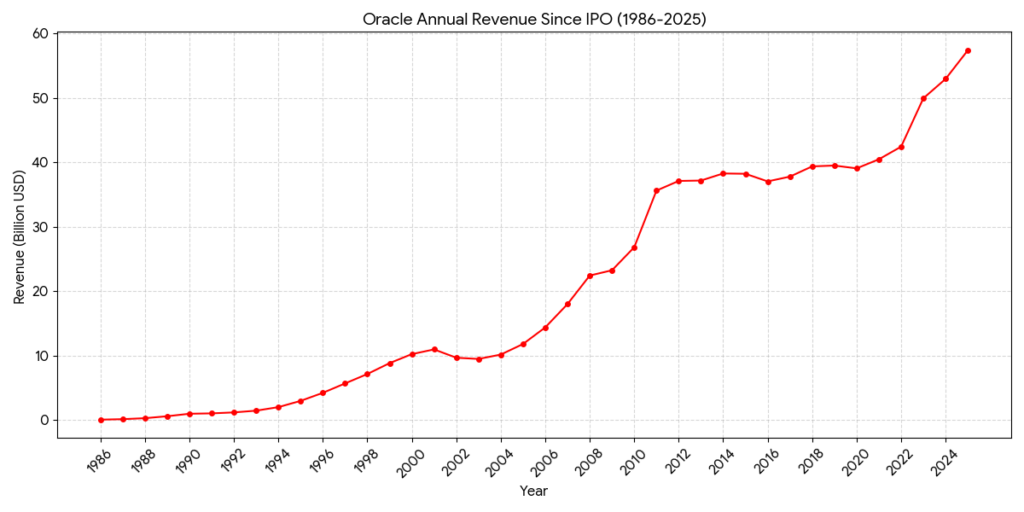
Revenue Level: Negligible to start-up scale. In 1979, the first commercial contract was worth only a few hundred thousand dollars.
Core Technologies:
- SQL Implementation: The first to commercialize the SQL language based on IBM’s research.
- Relational Model: Transitioned data management from hierarchical/network models to the modern relational (RDBMS) structure.
2. Standardization and Market Leadership (1983-1991)
Oracle focused on portability and performance, allowing its software to run on various hardware platforms, which led to rapid growth.
- 1983: Oracle V3 was released. Written in C, it became the first portable RDBMS, compatible with mainframes, minicomputers, and PCs.
- 1986: Oracle went public on NASDAQ.
- 1988: Oracle V6 introduced row-level locking and online backup, setting a new standard for high-performance transaction processing.
Revenue Level:
- 1986 (IPO): Approximately $55 million.
- 1990: Surpassed $1 billion.
Core Technologies:
- C Language Portability (V3): Rewriting the database in C allowed Oracle to run on almost any hardware, from PCs to mainframes.
- Row-Level Locking (V6): Permitted multiple users to update different rows in the same table simultaneously, drastically increasing transaction speed.
- Client/Server Architecture: Enabled the separation of the database engine from the user interface.
3. Internet and Distributed Computing (1992-2002)
As the world moved toward the web, Oracle shifted its focus to support massive scale and internet-native applications.
- 1992: Oracle 7 was launched, introducing stored procedures, triggers, and declarative referential integrity.
- 1999: Oracle 8i (the “i” stands for Internet) was released. It integrated a Java Virtual Machine (JVM) directly into the database, supporting the growing demand for web applications.
- 2001: Oracle 9i introduced Real Application Clusters (RAC), allowing businesses to scale their databases across multiple servers.
Revenue Level:
- 1994: Approximately $2 billion.
- 2000 (Dot-com Peak): Surpassed $10 billion.
Core Technologies:
- PL/SQL (Oracle 7): Introduced stored procedures and triggers to execute complex logic directly within the database.
- Real Application Clusters (RAC): Allowed a single database to run across a cluster of servers, providing high availability and scalability.
- Java Integration (8i): Built a Java Virtual Machine (JVM) inside the database to support web-based application development.
4. Acquisitions and Grid Computing (2003-2012)
During this decade, Oracle transformed from a software company into a full-stack technology giant through massive strategic acquisitions.
- 2003: Oracle 10g (the “g” stands for Grid) was released, focusing on grid computing to optimize resource sharing and lower costs.
- 2005-2009: Oracle acquired major competitors and software leaders, including PeopleSoft (ERP), Siebel (CRM), and BEA Systems (Middleware).
- 2010: Oracle completed the acquisition of Sun Microsystems, gaining control of the Java programming language, the Solaris OS, and specialized hardware.
Revenue Level:
- 2010: Approximately $26.8 billion.
- 2012: Approximately $37.1 billion.
Core Technologies:
- Grid Computing (10g): Software that treats groups of low-cost modular storage and servers as a single large pool of resources.
- Exadata: A hardware-software integrated system (Database Machine) designed to run Oracle Database at extreme speeds.
- Fusion Middleware: A layer that connects various software applications acquired during this era (like PeopleSoft and Siebel).
5. Cloud Transformation and Autonomous AI (2013-Present)
The current era is defined by the shift to Cloud Infrastructure (OCI) and the automation of database management using machine learning.
- 2013: Oracle 12c (the “c” stands for Cloud) introduced a multitenant architecture, enabling easier migration to cloud environments.
- 2018: Oracle launched the Autonomous Database, the world’s first “self-driving” database that automates patching, tuning, and security.
- 2022: Oracle acquired Cerner, a leader in health information systems, to expand its industry-specific cloud services.
- 2024: Oracle 23ai was released, integrating vector search capabilities to support generative AI and Large Language Models (LLMs).
Revenue Level:
- 2021: Approximately $40.5 billion.
- 2025: Surpassed $57.4 billion.
- 2026 Forecast: Quarterly revenue has reached $16.1 billion, trending toward an annual run rate of $67 billion.
Core Technologies:
- Multitenant Architecture (12c): Allowed a “container” database to hold many “pluggable” databases, essential for cloud efficiency.
- Autonomous Database: Uses machine learning to automate tuning, security, and patching with zero human intervention.
- AI Vector Search (23ai): Integrates vector capabilities directly into the database to support Generative AI and Retrieval-Augmented Generation (RAG).
- OCI (Oracle Cloud Infrastructure): A second-generation cloud architecture specifically designed for heavy AI workloads and RDMA networking.
Sources
- Oracle Company History Official Site: https://www.oracle.com/corporate/history/
- Oracle Database Wikipedia: https://en.wikipedia.org/wiki/Oracle_Database
- Timeline of Oracle Acquisitions: https://www.oracle.com/corporate/acquisitions/